Concrete-mesa | Concrete Admixtures, Tools, and Production Machines

Stop Ruining Your Mix: The Concrete Foaming Agent Mistakes That Cost You Thousands
The $20,000 Hole in the Roof
I got a call from a contractor two years ago. He built a lightweight concrete roof deck. Looked perfect. Three months later, he had a sagging, cracked mess. Cost him $20,000 to tear it out. He blamed the Concrete Foaming Agent. He blamed the cement. He blamed the weather. He was wrong on all counts. He made a rookie mistake. He treated the foam like a simple additive. It is not. It is a living, breathing, unstable beast. You must respect it. Or it will ruin your project.
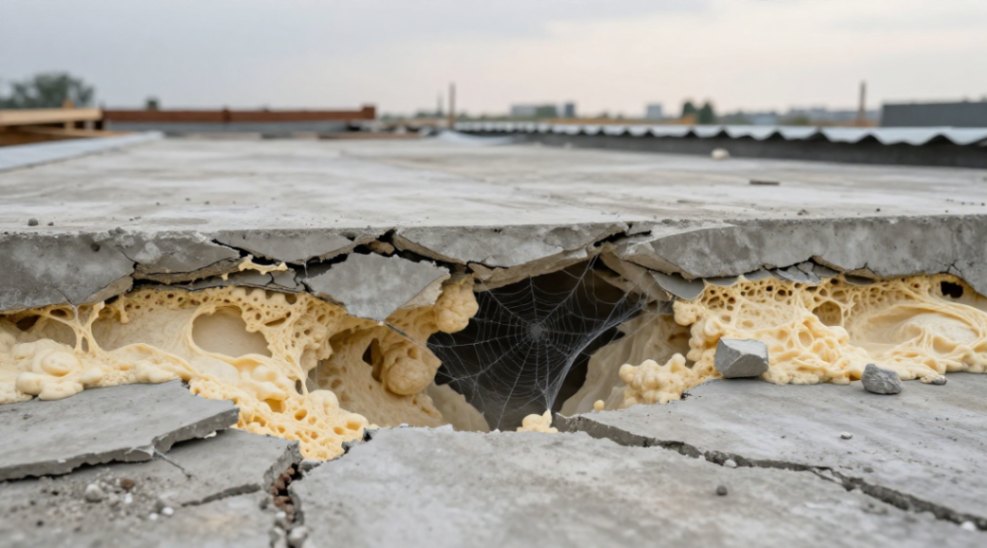
This is not a gentle guide. This is a warning. I have seen engineers and DIY builders alike make the same five mistakes over and over. They waste money. They waste time. They produce brittle, unsafe concrete. You are here because you want to avoid this. Good. Listen closely.
The Concrete Foaming Agent is the magic ingredient that turns heavy, dense concrete into light, insulating, fire-resistant foam. It is used everywhere: precast blocks, cast-in-place walls, roof insulation, void filling. It reduces structural load. It dampens sound. It resists fire. But misuse it, and you get a disaster. Let’s cut through the hype and the bad advice. Here is what you must never do.
1. The Fatal Confusion: Foaming Agent vs. Release Agent
This is the first trap. Do not confuse a Concrete Foaming Agent with a Concrete Release Agent. They do opposite things. A release agent stops concrete from sticking to a mold. A foaming agent creates bubbles. I once visited a site where a worker poured release oil into the mixer, thinking it would make the concrete ‘lighter’. He created an oily, weak mess that never cured. It was a total loss.
Here is the logic: A Concrete Foaming Agent chemically generates or stabilizes air bubbles. A release agent is a lubricant. Mix them up, and you get zero structural integrity. Always check the label. If it says ‘mold release’ on the bottle, do not put it in your mix. Period.
2. Protein vs. Synthetic: The Choice That Defines Your Project
Not all foaming agents are equal. You have two main families: synthetic and protein-based. Each has its own behavior. Use the wrong type for your application, and you are asking for trouble.
2.1 The Synthetic Trap: High Foam, Low Tolerance
Synthetic agents generate a high volume of foam fast. They are cheap. They are attractive. They are also sensitive. They collapse under pressure. They do not mix well with harsh chemicals. If you use a synthetic Concrete Foaming Agent with a cheap Superplasticizer or a high dose of Calcium Chloride accelerator, the foam dies. You get a dead mix. The concrete becomes heavy and dense. You lose all insulation value.
2.2 The Protein Powerhouse: Stable but Stubborn
Protein-based agents (like hydrolyzed keratin) create smaller, tougher bubbles. They resist collapse. They hold up better in wet, cold conditions. They are the workhorse for structural Light weight Concrete. But they have a downside. They smell. They can be more expensive. And they require a precise water-to-agent ratio. Too much water, and the foam ‘weeps’ out of the mix. Too little, and you get a dry, brittle foam that crumbles.
My advice: For indoor, non-structural fill, synthetic works. For roof decks, load-bearing walls, or anything exposed to weather, go protein-based. Do not compromise on this. The savings are not worth the collapse.
3. The Biggest Mistake: Assuming Foam is ‘Just Bubbles’
This is the heart of the problem. Builders treat Foamed Concrete as if they are just adding soapy water to cement. They ignore the mechanics. A foam bubble is a fragile structure. It has walls that must resist pressure from the cement paste. The cement itself is a chemical system. It releases heat as it hydrates. That heat can kill your foam. The Foam Generator is not just a nozzle. It is a precision tool. You need the right equipment to match your agent.
Ask yourself these questions before you start:
- Is my Foaming Equipment calibrated for the density I need?
- Can my Foam Generator produce a stable, uniform foam, or is it sputtering and creating oversized bubbles?
- Am I testing the foam before I mix it into the cement?
You must test the foam in a bucket of water. Scoop it out. Does the foam hold its shape for 60 seconds? If it collapses, your agent is wrong, your ratio is wrong, or your equipment is bad. Fix this before you mix a single batch of concrete.
4. Water Is Not Your Friend: The Ratio Paradox
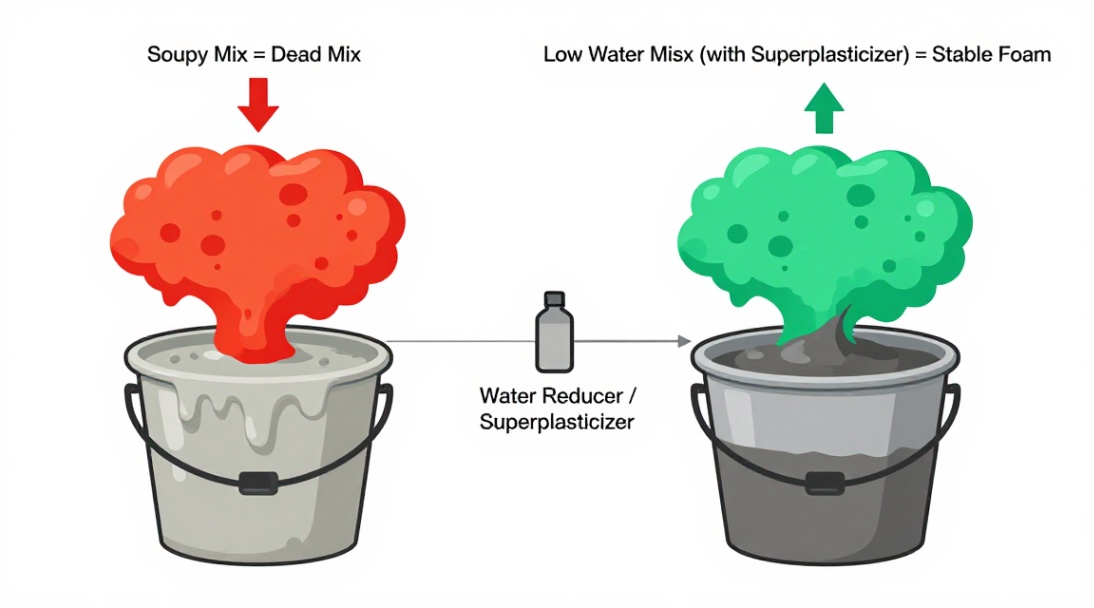
Everyone thinks water makes concrete flow. That is true for normal concrete. For Foamed Concrete, water is the enemy of the bubble. Every extra drop of water weakens the soap film. The bubble walls become thin. They break. The Concrete Foaming Agent needs a specific water-to-agent ratio to create a stable foam. This ratio is not flexible. If the manufacturer says 50:1 water to agent, stick to it. Do not add more water to ‘help it spread’.
The same applies to your cement mix. Use a Concrete Water Reducer or a specific Superplasticizer to control the water content in the cement paste. Less water in the paste means less stress on the foam. A low water mix is a stable foam mix. A soupy mix is a dead mix. Remember that.
5. The Additive Trap: Killers in Your Mix
You think adding a Fiber will make it stronger? Maybe. But many fibers disrupt the foam. You think a Concrete Defoamer is only for removing bubbles? Yes. But if you use a defoamer on purpose, you are destroying your lightweight concrete. The same goes for certain Early Strength Agent formulations. They accelerate curing so fast that the foam does not have time to set. The bubbles burst.
Here is the rule: Introduce any chemical additive – a Nano-modifier, a Redispersible Polymer Powder, Hydroxypropyl Methyl Cellulose, Hydroxyethyl Cellulose, Sodium Silicate, or Potassium Silicate – and you change the pH and the surface tension of the water. Every chemical you add is a potential foam killer. Test it on a small scale first. Do not trust the data sheet. Trust your bucket test.
For example, Sodium Silicate can accelerate setting. This sounds good. But if the foam has not stabilized, the quick set traps the bubbles in a fragile state. The final concrete will have uneven density and weak spots. Be warned.
6. Quality Control: The Simple Test That Saves Your Project
Do not wait for the concrete to cure to find out if you messed up. Test the fresh foam. Take a sample of the wet Foamed Concrete. Put it in a container. Measure the weight. Calculate the density. This is your first check.
Then, take a second sample. Let it sit for 15 minutes. Pour it out. Does the foam hold its shape, or does it turn into a puddle of gray water? A puddle means your foam is dead. Your Concrete Foaming Agent is either depleted, you used too much water, or a chemical killed it. Do not pour that mix into a form. You will only have to break it out later.
The final test is for the hardened concrete. Cut a core sample. Look at the cell structure. Are the bubbles uniform? Or are there giant voids? Giant voids mean unstable foam. Uniform, small cells mean good quality. Do not skip this. Your eyes and a simple scale are the best quality control tools.
7. Environmental and Safety: The Unspoken Risks
Most Concrete Foaming Agent formulas are water-based and biodegradable. That is good. But do not dump waste agent into a storm drain. It can kill aquatic life, especially protein-based foams. Synthetic agents may contain surfactants that are not biodegradable. Check the Material Safety Data Sheet.
VOC emissions are generally low, but you are working with chemicals. Wear gloves and goggles. Some protein agents smell like something died. That is normal. It is the protein breaking down. Ventilate the area. Do not work in an enclosed space without airflow.
The fire resistance of Light weight Concrete is excellent. The trapped air is an insulator. But when the foam collapses due to high temperature (say, in a fire), the concrete becomes denser and may spall. This is a known behavior. Do not rely on foamed concrete as a fire barrier in critical structural elements without a fire-rated design.
The Bottom Line: You Can Do This Right
Let me be blunt. Concrete Foaming Agent is not a ‘magic powder’. It is a precise chemical tool. It requires respect. You must match your agent to your application. You must use proper Foaming Equipment. You must test your foam before you mix. You must control your water and your additives. If you skip any of these steps, you will fail. The industry is full of stories like the roof deck that sagged. Do not be that story.
You need a partner who understands the chemistry. Not a supplier who just ships barrels. You need expertise. That is where TRUNNANO comes in. We do not just sell chemicals. We sell solutions. We provide Concrete Foaming Agent formulations that work. We supply the Special Cement blends and Early Strength Agent packages that are compatible with our foams. We can even advise on the correct Fiber type to use so you do not kill your foam.
Do not gamble with your next project. Contact TRUNNANO today. Get the right technical data. Get the right product. Get the right support. Stop wasting money on failed pours. Start building lightweight concrete that actually performs. Click the link, fill out the form, and talk to an expert who has been in the pit with you. Your next project deserves better.
Supplier
We are the global leader in lightweight concrete and advanced engineered foam solutions. Known globally for its commitment to research, innovation, and applied expertise, we have been providing engineered foam solutions since the early 2012’s.
We can supply high-quality concrete admixture and foam concrete related products all over the world.
The company has a professional technical department and quality supervision department, a well-equipped laboratory, and equipped with advanced testing equipment and after-sales customer service center.
If you are interested, please feel free and contact us.