Concrete4U | Concrete Admixtures, Tools, and Production Machines

High Pressure Foam Generators vs. Low Pressure: An Objective Guide for Superior Concrete
The Precision Challenge in Cellular Concrete
Have you ever struggled with inconsistent foam density that ruined an entire pour? Have you watched your foam collapse before it could be mixed, wasting material and labour? These are the daily frustrations when using undersized or inappropriate foam generation technology. The core of reliable, high-strength cellular concrete lies in one critical piece of equipment: the foam generator. The choice between high-pressure and low-pressure systems isn’t just about cost; it directly dictates your final product’s structural integrity, thermal performance, and overall project viability.
High-Pressure Foam Generators: The Anatomy of Control
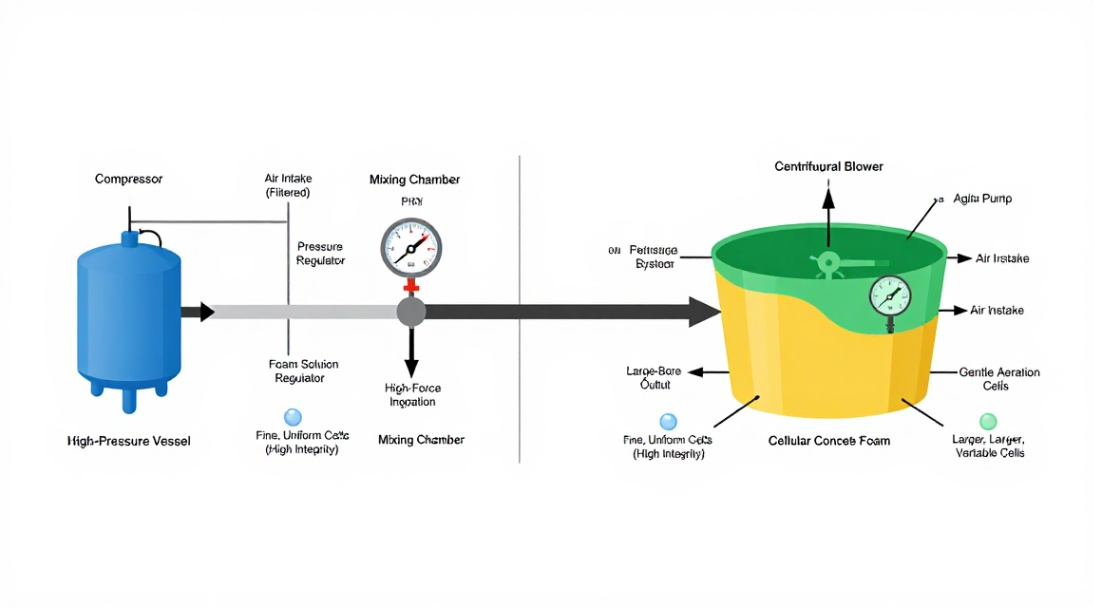
A high-pressure foam generator for concrete is a sophisticated dosing and mixing system. Its primary function is to produce a consistent stream of ultra-stable microfoam by forcing a premixed foam agent solution and compressed air through a restricted pathway under significant force. This process creates bubbles with a uniform, microscopic size, which is the foundation of predictable concrete performance.
Core Components and Operational Flow
The system operates on a closed-loop, pressurized principle. A high-pressure pump (typical operating range of 10-20 bar) draws the diluted foam agent from its tank. It forces this solution into a pressurized mixing chamber or vessel. Simultaneously, a regulated stream of dry, oil-free compressed air is injected. The intense turbulence and shear forces inside the chamber cause the rapid formation of billions of tiny, resilient bubbles. This dense, wet foam is then discharged directly into the concrete mixer via a hose and diffuser nozzle.
High Pressure vs. Low Pressure: A Technical Breakdown
The debate often centers on these two technologies. The distinction is not minor; it defines your capabilities.
High-Pressure Foam Generator Advantages
- Superior Foam Stability: The high shear forces create bubbles with a tougher membrane. This foam resists breakdown during mixing and pouring, leading to a more homogeneous final cell structure in the cured concrete.
- Precise Density Control: Operators can make fine adjustments to the air-to-solution ratio and pressure, allowing for on-the-fly changes to foam density with minimal lag time. This is critical for hitting strict design specifications.
- Higher Yield Efficiency: The system generates a larger volume of usable foam from a given amount of concentrate, improving the cost-effectiveness of the foam agent.
- Consistency at Scale: Once dialed in, a high-pressure generator will produce the same quality foam hour after hour, batch after batch. This repeatability is non-negotiable for large pours and precast operations.
Low-Pressure Foam Generator Limitations
- Bubble Size Variability: These systems often rely on simpler venturi or agitation methods, producing a wider range of bubble sizes. Larger bubbles are weak and prone to collapse.
- Density Drift: Maintaining a consistent air-to-liquid ratio is more challenging, leading to drift in the foam density over the course of a pour. This translates to inconsistent concrete strength.
- Application Constraints: They are generally suitable for lower-density fills and non-structural applications where absolute strength consistency is less critical. They struggle with the demands of structural lightweight concrete or insulating screeds.
Making the Right Choice: Decision Criteria
Your project requirements should dictate your equipment selection. Do not force a machine to fit a job it was not designed for.
When to Choose a High-Pressure System
Select a high-pressure foam generator for concrete when your work involves structural lightweight concrete, insulating floor screeds (e.g., CLC screeds), or precision precast elements. Choose it if your specifications call for densities below 1200 kg/m³ with high compressive strength, or if you require exceptional thermal insulation values (low lambda). The initial investment pays for itself in reduced material waste, fewer callbacks, and the ability to bid on higher-value projects.
When a Low-Pressure System Might Suffice
A low-pressure generator can be a viable tool for simple void fills, low-density landscaping applications, or temporary insulating layers where exact mechanical properties are not specified. It serves as an entry-level tool for operations not yet ready to commit to the full cellular concrete workflow. Many users on industry forums report upgrading to a high-pressure system after experiencing the limitations of low-pressure technology firsthand.
Critical Support Systems and Best Practices
A high-pressure generator does not operate in isolation. Its performance is wholly dependent on its supporting equipment. You must pair it with an air compressor that delivers a continuous, adequate volume of clean, dry air. The foam agent must be specifically formulated for high-pressure systems. Operational best practices include daily checks for leaks, meticulous cleaning of the mixing chamber to prevent residue buildup, and calibration of the dosing pump. Always follow the manufacturer’s pressure guidelines and wear appropriate PPE when servicing the system.
The Objective Verdict
For professional contractors and precasters who stake their reputation on consistent quality, the high-pressure foam generator is the unequivocal choice. The technology delivers the foam stability, density control, and operational reliability that modern lightweight concrete demands. Low-pressure systems represent a compromise on quality and control that is rarely justified in commercial or industrial applications.
Do not compromise your concrete’s integrity. The evidence from job sites and laboratory testing is clear. For superior foam stability, precise density control, and professional-grade results, you need the controlled force of a high-pressure system. If you are serious about cellular concrete, your next step is to consult with a specialist who can match a high-pressure foam generator to your specific output volume and application requirements. Request a demonstration with your actual materials to see the difference in foam quality firsthand.
Supplier
We are the global leader in lightweight concrete and advanced engineered foam solutions. Known globally for its commitment to research, innovation, and applied expertise, we have been providing engineered foam solutions since the early 2012’s.
We can supply high-quality concrete admixture and foam concrete related products all over the world.
The company has a professional technical department and quality supervision department, a well-equipped laboratory, and equipped with advanced testing equipment and after-sales customer service center.
If you are interested, please feel free and contact us.