Concrete4U | Concrete Admixtures, Tools, and Production Machines

Decoding the Nano-Titanium Dioxide Modifier: A Clear Comparison to Traditional Air Purification
Five years ago, I stood in a newly renovated office building with a sophisticated HVAC system. The air was clinically cool, yet a persistent chemical odor lingered-a classic sign of volatile organic compounds off-gassing from carpets, adhesives, and paints. The facility manager had installed high-grade HEPA filters, but they were powerless against these gaseous pollutants. This wasn’t an isolated failure; it was a fundamental limitation of the dominant air cleaning technology. It was the moment that crystallized the necessity for a different paradigm: one that doesn’t just capture contaminants, but destroys them. This is where the conversation about a nano-titanium dioxide modifier for air purification truly begins, not as a miracle cure, but as a specific tool with distinct advantages and stringent requirements.
The Photocatalytic Engine: How Nano-TiO2 Actually Works
At its core, nano-titanium dioxide is a semiconductor photocatalyst. Its function is mechanistic, not mechanical. When photons of sufficient energy-typically ultraviolet light-strike its surface, they excite electrons. This creates highly reactive electron-hole pairs. These pairs then interact with water vapor and oxygen in the air, generating potent oxidizing agents like hydroxyl radicals and superoxide anions. Think of these radicals as molecular scavengers. They don’t trap formaldehyde or toluene; they dismantle them, oxidizing these complex organic molecules into harmless carbon dioxide and water. This process, photocatalytic oxidation, also ruptures the cell walls of bacteria and lipid envelopes of viruses, leading to inactivation. The catalyst itself remains unchanged, theoretically offering continuous operation. However, this ideal mechanism hinges on one non-negotiable factor: light activation of the correct wavelength.
A Side-by-Side Analysis: Photocatalysis vs. The Incumbents
To make an informed choice, you must stack this technology against the established pillars: mechanical filtration (HEPA) and adsorption (activated carbon). Each addresses a specific slice of the pollution spectrum.
HEPA Filtration excels at removing particulate matter. Dust, pollen, mold spores, and to a high degree, virus-laden droplets are physically captured in a dense web of fibers. Its effectiveness is quantifiable and predictable for particles above 0.3 microns. But it is passive. A HEPA filter has zero effect on gases, odors, or ultrafine particles that bypass the media. It also becomes a reservoir for captured microbes unless treated with antimicrobials. Performance decays as the filter loads, increasing energy consumption until replacement.
Activated Carbon is the complement to HEPA, targeting gaseous pollutants through adsorption. Its vast internal surface area traps VOC molecules. Its strength is its broad, non-selective capture of gases. Its critical weakness is saturation. Once its pores are filled, it stops working and can even begin desorbing pollutants back into the airstream. It is a consumable, often requiring frequent and costly replacement in polluted environments.
Now, consider the nano-titanium dioxide photocatalytic system. Its profile is fundamentally different. It does not capture; it decomposes. This gives it a unique set of pros and cons. The primary advantage is its broad-spectrum, destructive action against a range of pollutants HEPA and carbon cannot address: low-concentration VOCs, odor molecules, nitrogen oxides (NOx), and microorganisms. It operates continuously under light, with no saturation-only a potential gradual deactivation of the catalyst surface. Maintenance is low if the catalyst is properly immobilized. The disadvantages, however, are just as stark. Its efficacy is entirely dependent on sufficient light intensity and correct wavelength. In a dark air duct, it is inert. The reaction kinetics can be slow for high pollutant concentrations. There is also the scientific challenge of electron-hole recombination, where the generated charges recombine before producing radicals, wasting energy.
The Critical Role of the Modifier
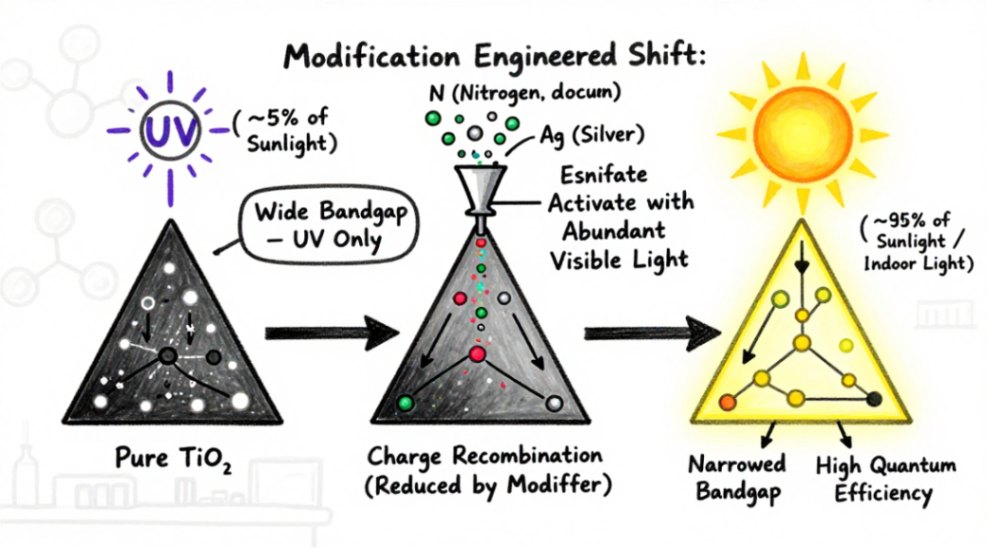
This is where the ‘modifier’ in nano-titanium dioxide modifier for air purification becomes the decisive factor. Pure, unmodified TiO2 primarily responds to UV light, which constitutes only about 5% of sunlight and is scarce indoors. Researchers and commercial developers apply modifiers-through doping with metals like silver or nitrogen, or compositing with other semiconductors-to engineer a crucial shift. The goal is to narrow the bandgap, allowing the material to be activated by visible light, which is abundant. A secondary goal is to reduce charge recombination, boosting quantum efficiency. A modified TiO2 is not a generic substance; its performance is directly dictated by the specific modification chemistry and application method. This explains the vast performance differences between commercial products.
Implementation and Real-World Considerations
You will find this technology in three main applications. First, as a coated component inside commercial and residential air purifiers, often paired with a UV-A lamp. Second, as a functional coating applied to building interiors, like wall panels or ceiling tiles, leveraging ambient light. Third, incorporated into HVAC system components or specialized modules. The choice of application dictates performance. A purifier with a powerful, dedicated UV lamp will drive faster reactions than a wall coating in a dimly lit corridor.
Safety is a non-negotiable discussion point. The potential release of free nanoparticles from poorly engineered coatings is a legitimate concern. Respirable nanoparticles pose unknown long-term health risks. Therefore, superior implementations focus on immobilization techniques-strongly bonding the catalyst to a substrate like ceramic, metal, or glass. A trustworthy system is designed not to shed. As Dr. Elena Martinez, an aerosol scientist whose work I’ve followed for years, stated in a recent conference paper: ‘The commercial viability of photocatalytic air cleaning is inseparable from the material’s fixed-bed stability. Leaching or erosion transforms an air purification strategy into an air contamination event.’ This sums up the engineering priority.
Making Your Decision: A Framework for Selection
So, when does a nano-titanium dioxide system make sense, and when should you default to traditional methods? The decision matrix is clear.
Choose to integrate a nano-titanium dioxide modifier for air purification when your primary targets are gaseous pollutants (VOCs, odors) and microorganisms, and you have a controlled light source or strong visible light exposure. It is an excellent supplemental technology in medical settings for infection control, in buildings with ‘sick building syndrome’ from off-gassing, or for continuous low-level odor abatement. It is not a replacement for a HEPA filter where particulate matter (PM2.5, allergens) is the chief concern.
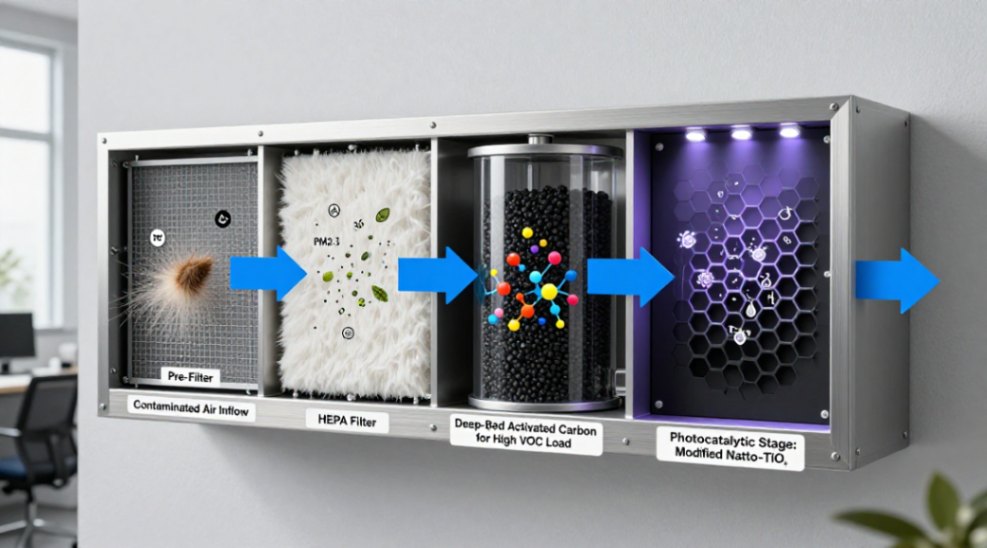
For a comprehensive solution, the industry consensus points toward hybridization. The most effective air purification systems I have evaluated use a staged approach: a pre-filter for large dust, a HEPA filter for particulates, a deep bed of activated carbon for rapid adsorption of high VOC loads, and finally, a photocatalytic stage with a modified nano-titanium dioxide component powered by UV LEDs to polish the air, breaking down the low-level gases that slip past the carbon and neutralizing pathogens. This layered defense addresses the full spectrum of contaminants, leveraging the strengths of each technology while mitigating their individual weaknesses.
The future of this field lies in smarter modifiers-precision doping, graphene composites, and metal-organic frameworks (MOFs) that enhance visible light absorption and target-specific pollutants. The objective is no longer just making TiO2 work, but making it work efficiently under real-world, energy-constrained conditions. Your task as a decision-maker is to look past the label of ‘photocatalytic’ and interrogate the specifics: What is the modifier? How is the catalyst immobilized? What is the required light source and its power consumption? What third-party test data exists for VOC destruction rates under realistic conditions? The answers separate the viable air purification tool from the speculative concept.
Supplier
We are the global leader in lightweight concrete and advanced engineered foam solutions. Known globally for its commitment to research, innovation, and applied expertise, we have been providing engineered foam solutions since the early 2012’s.
We can supply high-quality concrete admixture and foam concrete related products all over the world.
The company has a professional technical department and quality supervision department, a well-equipped laboratory, and equipped with advanced testing equipment and after-sales customer service center.
If you are interested, please feel free and contact us.