Concrete4U | Concrete Admixtures, Tools, and Production Machines

The Science of AAC Block Specifications: How to Design for Strength, Insulation, and Speed
Starting with a Simple, Flawed Idea
Let me tell you about the first time I truly understood the power of aerated autoclaved concrete block specifications. We were on a site, reviewing a project that aimed for a high-performance building envelope. The architect had called for dense concrete blocks, and the insulation contractor had a separate layer of rigid foam. That was three different trades, two different material deliveries, and a compounding margin for error. Then a veteran colleague asked a deceptively simple question. He asked why we were using a heavy, cold material and then separately trying to make it light and warm. It was a moment of clarity. The real value isn’t in a block; it’s in a system. The specifications for AAC aren’t just a list of numbers. They represent a single, integrated solution. When you learn to read these specifications, you stop seeing separate parts and start seeing a complete, high-performance wall.
The Alchemy of Air and Steam
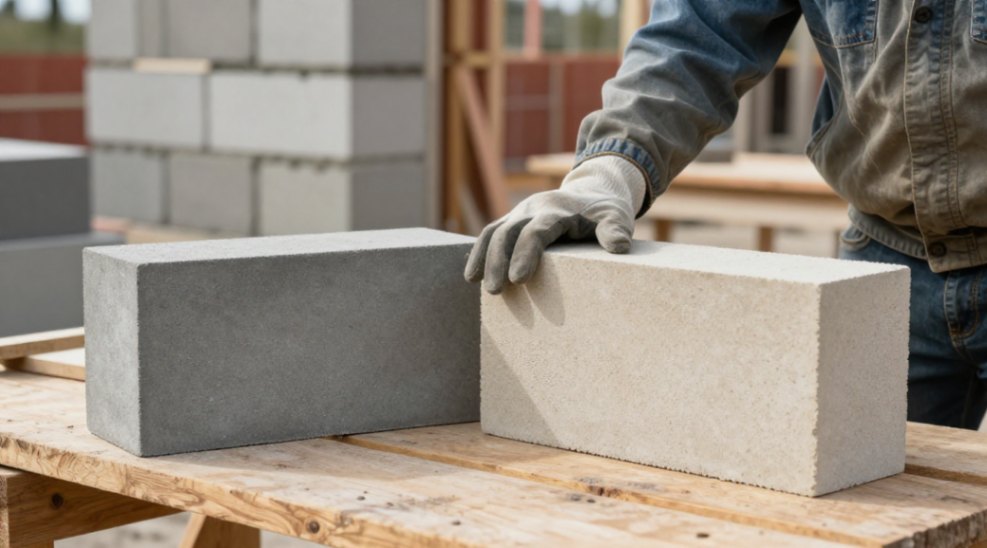
Everything begins with its composition. We take common ingredients: cement, lime, sand, and water. But the magic starts with a tiny addition of aluminum powder. This isn’t for strength. It’s a catalyst for a controlled chemical reaction. When mixed, the aluminum reacts with the calcium hydroxide, producing millions of microscopic hydrogen gas bubbles. This is where the “aerated” part comes to life. The mix expands like a sophisticated bread dough, creating a uniform, closed-cell matrix. But at this point, it’s fragile. This is where “autoclaved” makes all the difference. We place the blocks into a massive, high-pressure steam chamber-an autoclave. The intense heat and pressure don’t just dry the blocks; they force a chemical transformation. The silica in the sand reacts with the lime, forming a new, strong crystalline structure called calcium silicate hydrate. This process gives AAC its defining characteristics: a low density with a remarkably high, consistent compressive strength. Understanding this fundamental link between the alchemy of air and the rigor of steam is the first step to mastering its specifications. The block’s entire performance profile is locked in during this stage.
Decoding the Core Data
Now, let’s translate that process into the language we use on drawings and submittals. We talk about three non-negotiable specs. First is density class. You’ll see numbers like 500, 600, or 700 kg/m³. This isn’t just weight. It’s the primary dial for performance. A lower density block is a better insulator but has slightly less compressive strength. A higher density block trades a bit of insulation for more load-bearing capacity. You choose based on the wall’s job. Second is compressive strength, expressed in N/mm² or psi. This tells you how much vertical load a block can carry. A 600 kg/m³ block might have a strength of 4-5 N/mm², which is more than sufficient for multi-story construction when properly designed. Third is dimensional tolerance. This is where AAC shines. The precision of the autoclaving process yields blocks with incredibly tight tolerances, often ±1mm. This means thin-bed mortar, straight walls, and dramatically reduced labor for finishing.
Performance as a System
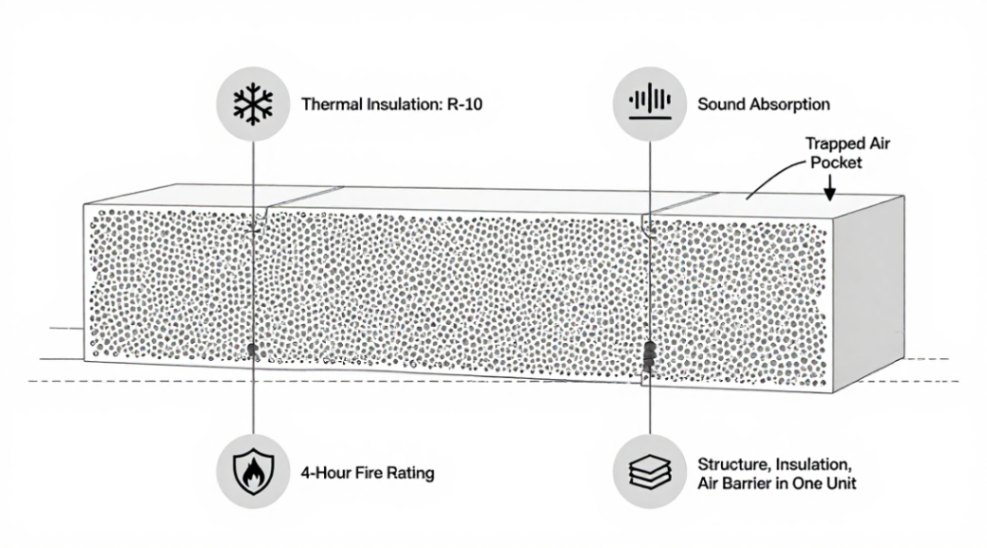
Those core specs enable its legendary performance as a system. The trapped air pockets give it an excellent thermal resistance, or R-value. A standard 8-inch AAC block wall can achieve an R-value around 10, acting as structure, insulation, and air barrier in one unit. That same cellular structure absorbs sound energy, providing solid airborne sound insulation. But its most critical system performance is fire resistance. AAC is mineral-based and entirely non-combustible. A 200mm thick load-bearing AAC wall can achieve a 4-hour fire rating without any additional treatment. That’s not an added feature; it’s an inherent property dictated by its material composition. We also must talk about how it goes together. You can cut it with a hand saw, rout channels for electrical conduit, and shape it with a planer. This workability means we can adapt on-site without specialized masonry blades or excessive dust.
Designing With the Material, Not Against It
To use AAC correctly, you must design for its nature. This means using a thin-bed, polymer-modified mortar designed for AAC to maintain the thermal break. For structural walls, you use reinforced bond beams and vertical reinforcement grouted into the block’s pre-formed cavities. Lintels are often made from reinforced AAC units themselves. For exterior applications, you must respect its porous nature. While it resists moisture absorption well, it needs a protective, vapor-permeable coating or cladding system to manage long-term exposure. This isn’t a weakness; it’s a design parameter. From a sustainability angle, the story is strong. It uses abundant raw materials, can incorporate industrial by-products like fly ash, and its manufacturing waste is often recycled back into the process. The high insulation value directly reduces the building’s operational energy for decades.
A Direct Comparison
Let’s be blunt. Compared to a conventional concrete masonry unit (CMU), AAC is a different category of material. A standard 8-inch CMU has an R-value of about 1.1. An 8-inch AAC block is roughly R-10. To match the fire rating of an AAC wall with CMU, you’d need multiple layers of gypsum board. To match the sound insulation, you’d need resilient channels and extra mass. To achieve the workability, you’d need power tools and create silica dust. The conventional block is just a component. The AAC block, when its full specifications are leveraged, is a pre-engineered wall system.
The Logical Conclusion for Your Project
After twenty years, the pattern is clear. Projects that succeed with AAC are the ones where the team-architect, engineer, contractor-understands it as an integrated system from the start. They don’t try to force it into a CMU detailing guide. They design to its strengths: its insulation, its fire performance, its precision. The specifications are the blueprint for that integration. If you’re working on a project where energy efficiency, fire safety, speed of construction, and a reduction of on-site trade coordination are priorities, then AAC isn’t just an option; it’s the most logical choice. Stop layering solutions on top of problems. Your next step is to review the full technical specifications with a supplier who can provide design support. Request the product data sheets, the structural design manual, and the detailing guide. Then design the single, elegant wall system your project deserves.
Supplier
We are the global leader in lightweight concrete and advanced engineered foam solutions. Known globally for its commitment to research, innovation, and applied expertise, we have been providing engineered foam solutions since the early 2012’s.
We can supply high-quality concrete admixture and foam concrete related products all over the world.
The company has a professional technical department and quality supervision department, a well-equipped laboratory, and equipped with advanced testing equipment and after-sales customer service center.
If you are interested, please feel free and contact us.