Concrete4U | Concrete Admixtures, Tools, and Production Machines

Stop Wasting Money on Nanoclay: The 3 Mistakes That Ruin Durability
Are You Making These Critical Nanoclay Mistakes?
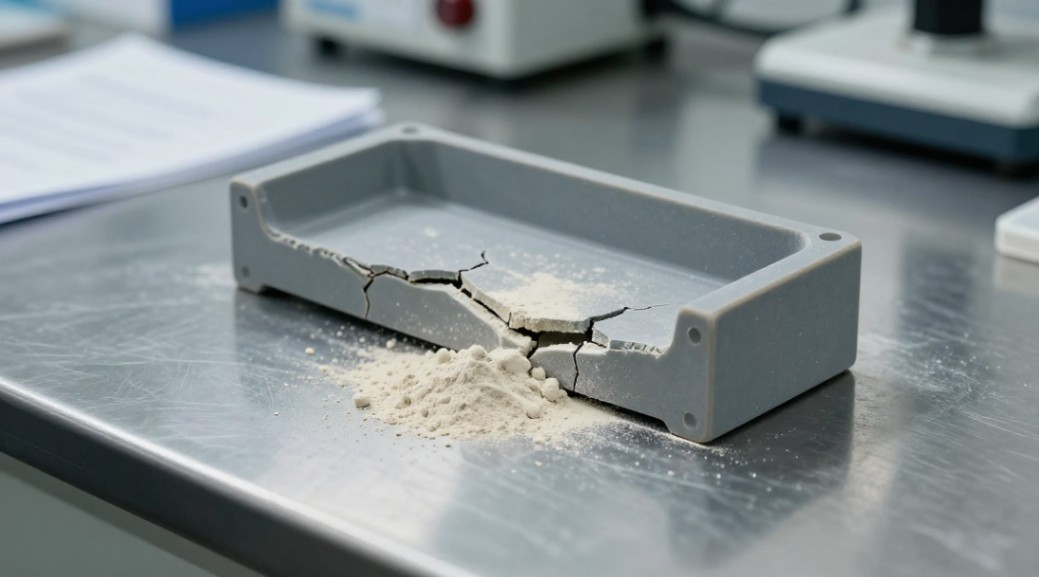
You invested in nano-clay modifier for improved durability. You expected stronger, tougher materials. Instead, you got brittle parts. Cracks formed. The composite failed long before it should have. If this sounds familiar, you’re not alone. The promise of nanoclay is immense, but common processing and formulation errors completely negate its benefits. Let’s fix that.
The Hidden Logic Behind Nanoclay’s Power (And Pitfalls)
Think of pristine nanoclay platelets as incredibly thin, strong sheets of paper. Their strength is legendary. But if you simply dump a stack of papers into a polymer, they stick together. You get clumps, not reinforcement. This is the core challenge. The true value of a nano-clay modifier for improved durability comes from exfoliation – separating those sheets – and compatibility – making them bond with the polymer matrix. Fail at either step, and you’ve just added expensive, weak filler.
Mistake #1: Ignoring Surface Modification
You cannot use raw nanoclay. Its surface chemistry is wrong for most polymers. It loves water, not plastic. Surface modification chemically treats the clay. It grafts organic molecules onto the platelets. This step is non-negotiable. The modifier makes the clay organophilic, meaning it wants to be with your polymer. Skip modification, and the clay will agglomerate. Your composite’s strength plummets. Always specify a pre-modified nanoclay or commit to the complex in-house modification process.
Key Modification Methods
- Ion Exchange: Swaps natural sodium ions for organic ammonium ions. This is the most common method. Typical usage is 30 to 50 wt% of modifier relative to the clay.
- Silane Coupling: Forms direct chemical bridges between clay and polymer. Use 1 to 3 wt% silane based on clay weight. Requires precise moisture control during reaction.
Mistake #2: Poor Dispersion and Processing
Buying modified clay is only half the battle. You must disperse it. Gentle mixing will not work. You need high shear. The goal is to peel apart the stacked platelets. Under-process, and you have intercalated clay (sheets still loosely stacked). Over-process with excessive heat or shear, and you degrade the polymer or break the platelets. It’s a precise operation.
Recommended Processing Parameters
| Method | Key Parameter | Target Range | Goal |
|---|---|---|---|
| Twin-Screw Extrusion | Specific Mechanical Energy (SME) | 0.15 – 0.25 kWh/kg | Provide enough shear for exfoliation without degradation. |
| Melt Compounding | Melt Temperature | 10-20°C above polymer Tm | Lower viscosity for mixing, but stay below clay/polymer degradation point. |
| In-Situ Polymerization | Clay Loading | 2 – 5 wt% | Allow monomer to penetrate clay galleries before polymerization. |
Mistake #3: Choosing Nanoclay When a Cheaper Filler Will Do
Nanoclay is not a magic dust for every problem. For pure stiffness at low cost, talc or calcium carbonate often win. For ultimate impact strength, short glass fibers are superior. The unique advantage of nanoclay is its multi-functional nature. It improves several properties simultaneously with a small addition. Use this table to decide.
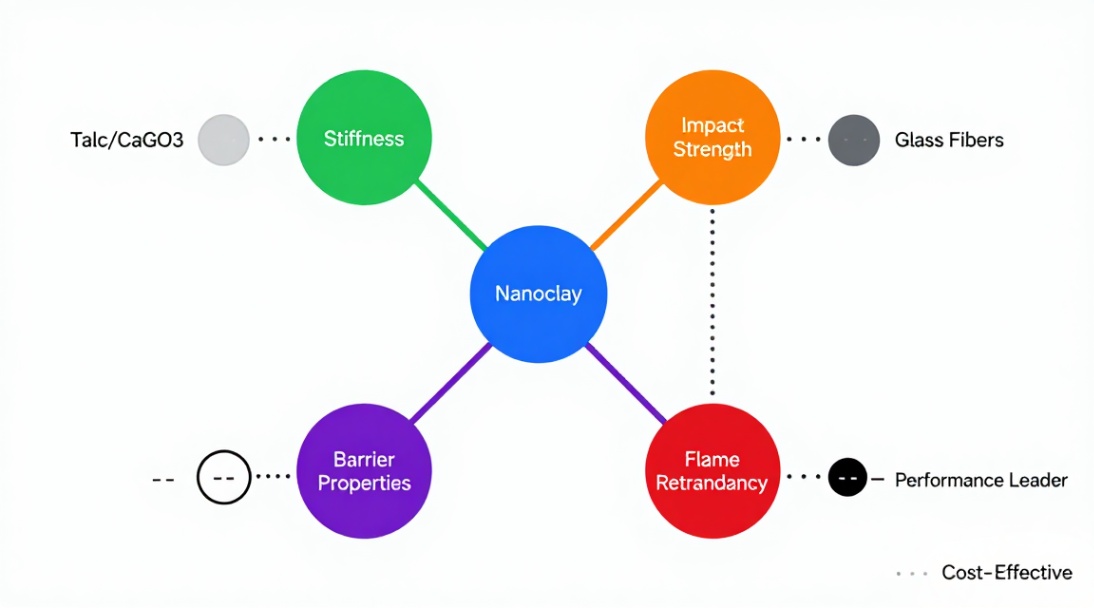
Filler Comparison: When to Use What
| Filler Type | Best For | Durability Impact | Trade-off |
|---|---|---|---|
| Nano-Clay Modifier (2-5 wt%) | Barrier properties (O2, H2O), flame retardancy, combined stiffness & strength, thermal stability. | Improves crack resistance, reduces creep, slows degradation from gas/moisture ingress. | Cost, complex processing. Brittleness if poorly dispersed. |
| Talc (10-40 wt%) | High stiffness (flexural modulus), dimensional stability, heat deflection temperature. | Good for rigidity under load, but can reduce impact strength dramatically. | Heavy, can reduce toughness, poor barrier properties. |
| Short Glass Fiber (10-30 wt%) | Tensile strength, impact resistance, creep resistance at high temperatures. | Excellent for long-term load-bearing durability and fatigue resistance. | Anisotropic shrinkage, surface finish issues, abrasive to equipment. |
Where Correctly Used Nanoclay Shines
When you avoid the mistakes, the results are transformative. In automotive, a 3% nanoclay load in polypropylene bumpers increases scratch resistance and reduces warpage from heat. For packaging film, a 2% dispersion creates a tortuous path for oxygen, extending food shelf-life by 40% or more. In epoxy coatings, it dramatically slows down moisture penetration, protecting steel from corrosion for years longer. The key is correct application.
The Path Forward: Your Action Plan
Stop guessing. Stop wasting material. The logic is clear. To achieve the true durability benefits of nanoclay, you must respect its nature. Use a properly modified clay. Process it with intentional, measured shear. And choose it for the right job. This is how you build products that last.
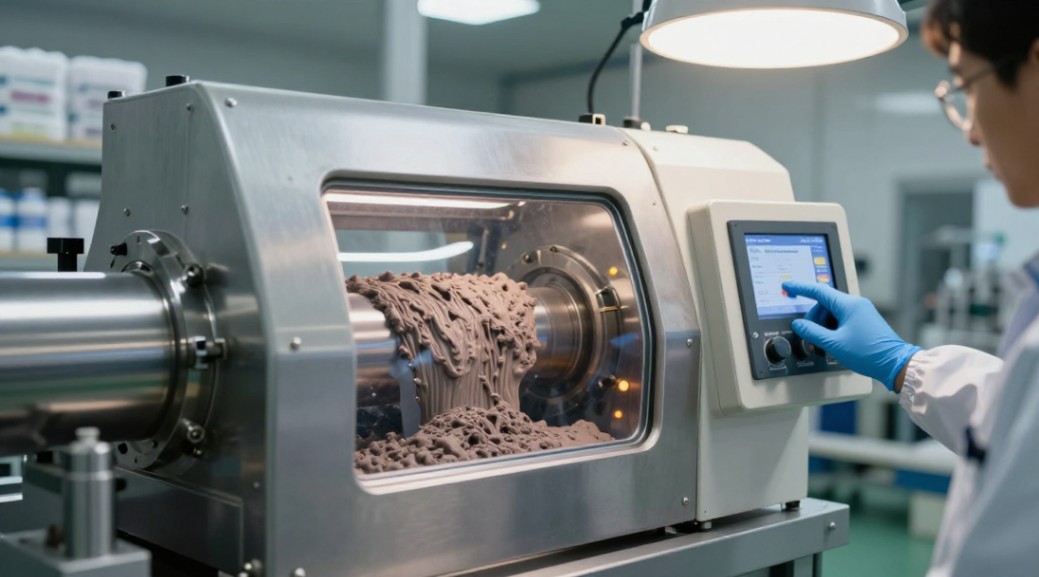
Ready to implement this correctly? The fastest way to avoid these costly errors is to start with a nanocomposite masterbatch designed for your polymer. Our NanoDur series of pre-exfoliated, compatibilized masterbatches eliminates the dispersion guesswork. You get consistent, optimal performance directly in your process. Contact our team today for a sample tailored to your resin system and a processing guide to guarantee your results. Let’s build something durable.
Supplier
We are the global leader in lightweight concrete and advanced engineered foam solutions. Known globally for its commitment to research, innovation, and applied expertise, we have been providing engineered foam solutions since the early 2012’s.
We can supply high-quality concrete admixture and foam concrete related products all over the world.
The company has a professional technical department and quality supervision department, a well-equipped laboratory, and equipped with advanced testing equipment and after-sales customer service center.
If you are interested, please feel free and contact us.