Concrete4U | Concrete Admixtures, Tools, and Production Machines

The 5 Concrete Foaming Agent Mistakes That Will Sink Your Project
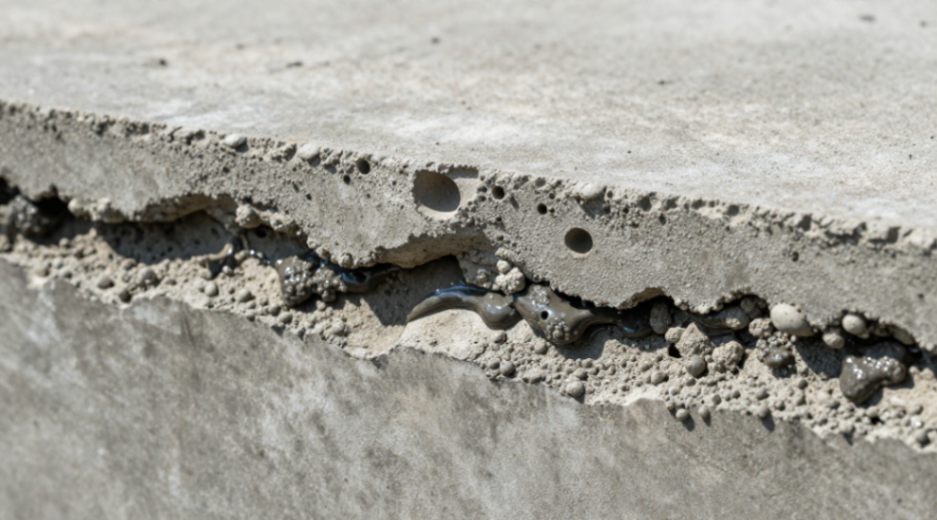
I watched a crew pour a 100-cubic-metre roof screed last year. The mix looked perfect at the plant. On-site, it began to weep. The bubbles collapsed, leaving a dense, segregating slurry. The result? A full demolition, a six-figure loss, and a three-week delay. The root cause was not the cement or the aggregates. It was a fundamental error in how to choose a concrete foaming agent. The wrong agent for the application and mixing method doomed the project from the start. Let’s ensure that doesn’t happen to you.
What You Must Know Before Choosing
A concrete foaming agent is a specialized surfactant. It generates stable air voids when mechanically agitated with water and air. These voids remain after mixing with cement paste, creating foamed concrete. The primary benefits are a significant reduction in density, improved thermal insulation, and enhanced flowability for filling complex forms. Your choice dictates all of these properties.
The 5 Critical Mistakes to Avoid When Choosing a Foaming Agent
Mistake 1: Prioritizing Price Over Chemistry
This is the most common and costly error. You see two agents: a synthetic at $8 per liter and a protein-based at $18. The synthetic seems logical. Dr. Alan Perkins, author of Structural Lightweight Aggregate Concrete, warns: “The initial cost of the agent is less than 2% of the in-place cost of the concrete. Specifying the wrong agent risks 100% of the value.”
- Never assume cheaper equals cost-effective. Synthetic agents (hydrolyzed proteins, synthetic surfactants) are generally less expensive and offer high foam volume. However, their bubbles are typically larger and less stable under pressure, leading to higher long-term density variation.
- Never use a synthetic agent for structural or load-bearing applications without exhaustive testing. Protein-based agents (from animal hoof/horn keratin) produce smaller, more uniform, and vastly more stable bubbles. This results in superior strength-to-density ratios and consistent performance. The higher upfront cost buys predictable engineering properties.
Mistake 2: Ignoring the Bubble Structure & Stability Data
Foam is not just air. It’s an engineered material. You must demand and analyze performance data from the supplier.
- Never accept an agent without a standardized foam stability test report. A common metric is drainage time. High-quality foam should retain at least 85-90% of its volume after 30 minutes with minimal water separation (bleed).
- Never overlook bubble size distribution. Ask for microscopy images. Uniform, sub-1mm bubbles are ideal. Large, irregular bubbles coalesce, weaken the matrix, and increase permeability. According to a 2021 RILEM technical report, bubble size coefficient of variation below 20% is a key indicator of a high-performance agent.
Mistake 3: Mismatching Agent to Application and Mixing Method
Each application imposes unique demands. Your agent must match them.
| Application | Recommended Agent Type | Critical Performance Need | Mixing Method Warning |
|---|---|---|---|
| Precast Panels | Protein-based | Extreme stability for handling & demolding | Prefoam system required. Never batch mix directly. |
| CLC Blocks | Synthetic or Protein | Fast setting, consistent density in molds | Inline generator is standard. Verify foam flow rate calibration. |
| Floor Screeds/Roofing | Protein-based | High flow, zero bleed, long working time | Compatible with pump lines. Test for shear stability. |
| Insulation Fill | Synthetic | Ultra-low density (≤ 600 kg/m³), high volume | Simple pre-foam often sufficient. Check for dust suppression. |
Choosing a high-strength protein agent for a simple insulation fill is overkill. Using a basic synthetic agent for a pumped roof screed invites disaster.
Mistake 4: Neglecting Compatibility and Site Conditions
The foaming agent does not work in isolation. It is one component in a complex chemical system.
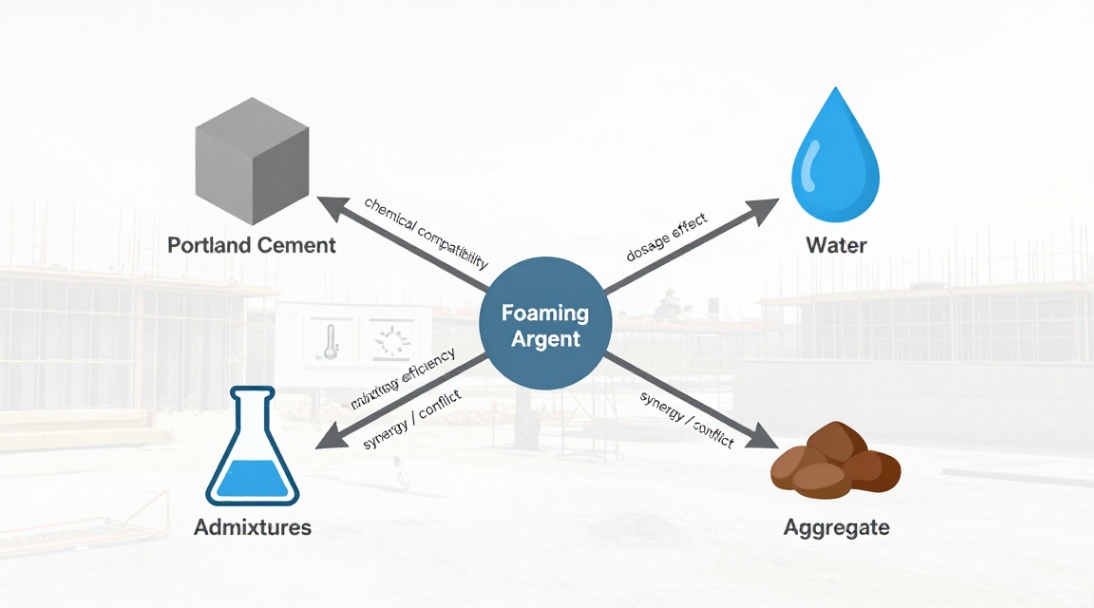
- Never mix the agent with other admixtures (plasticizers, retarders) in concentrated form. Always introduce them separately into the mixing water. Conduct a jar compatibility test first.
- Never use poor-quality water. High mineral content, chlorides, or organic matter can neutralize surfactants. Use potable water.
- Never ignore temperature. Water and ambient temperature drastically affect foam generation and stability. Most agents have an optimal range of 15-25°C (59-77°F). Cold water increases viscosity, yielding wet, heavy foam. Hot water accelerates drainage.
Mistake 5: Skipping the Full-Scale Field Trial
Lab data is a starting point. Site conditions are the final exam.
You must conduct a field trial. Scale it appropriately. Produce at least 2-3 cubic meters using the actual site equipment, water, and personnel. Cast test panels or cubes. Measure these parameters after 24 hours and 7 days:
- Fresh Density: Check consistency across multiple batches. Variation should be < 5%.
- Cast Density & Strength: Core samples tell the true story. Compare to your design specs.
- Workability/Flow: Does it place and finish as needed?
- Surface Finish: Check for blistering, tearing, or rapid stiffening.
This trial is your final verification of everything: agent choice, dosage, mixing method, and crew procedure. It is non-negotiable.
The Professional’s Selection Checklist
To choose correctly, follow this sequence. Document every decision.
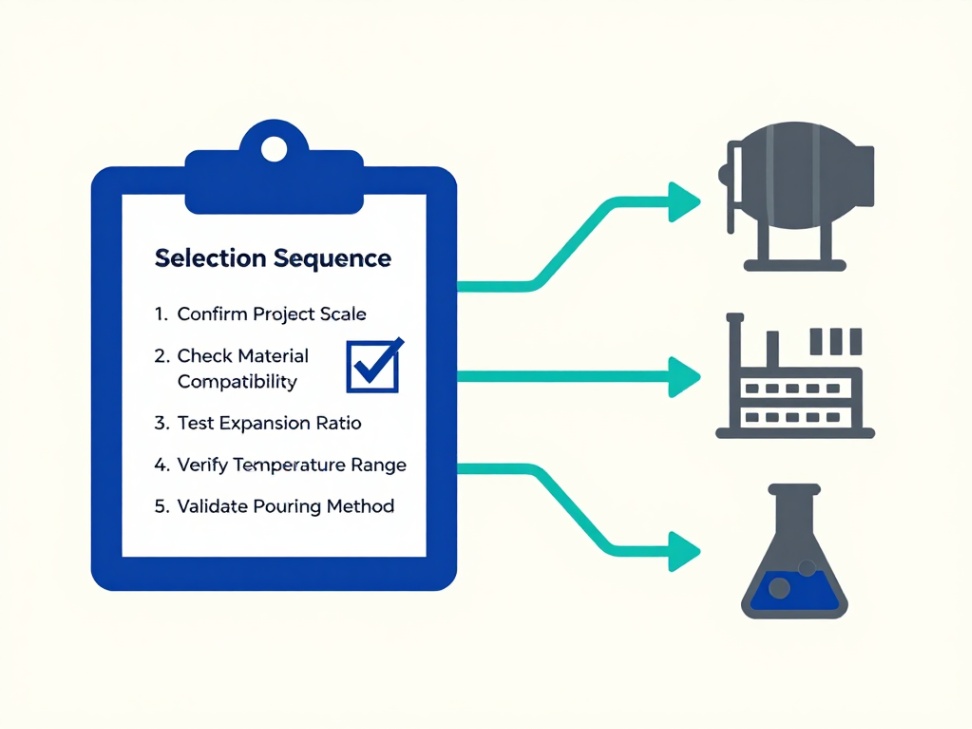
- Define the Application & Specs: Target density (kg/m³), compressive strength (MPa), placement method (pump, pour, shoot).
- Select Agent Chemistry: Protein for high-performance/structural; Synthetic for simple fill/insulation.
- Audit Supplier Data: Demand test reports for stability, bubble size, and compatibility with your cement type.
- Verify Mixing & Batching Protocol: Confirm your equipment (prefoam, inline generator) matches the agent’s requirements.
- Calculate Total Cost-in-Use: Factor dosage rate (typically 1-3% by volume of foam), not just drum price.
- Assess Supplier Support: Do they provide on-site technical startup? Is their literature clear?
- Execute Field Trial: Validate the entire system under real conditions before main pour.
The goal is predictable performance. The right foaming agent is the cornerstone of successful lightweight concrete. It is not a commodity. It is a precision-engineered component. By avoiding these five critical mistakes, you move from hoping for a good result to engineering one. Your next step is to apply this framework to your project’s specific documents and begin vetting suppliers with a critical, informed eye.
Supplier
We are the global leader in lightweight concrete and advanced engineered foam solutions. Known globally for its commitment to research, innovation, and applied expertise, we have been providing engineered foam solutions since the early 2012’s.
We can supply high-quality concrete admixture and foam concrete related products all over the world.
The company has a professional technical department and quality supervision department, a well-equipped laboratory, and equipped with advanced testing equipment and after-sales customer service center.
If you are interested, please feel free and contact us.