Concrete-mesa | Concrete Admixtures, Tools, and Production Machines

Mid-Range Water Reducer: The Concrete Workhorse Your Mix Design Has Been Missing
The Unspoken Truth: Most Concrete Doesn’t Need a Superplasticizer
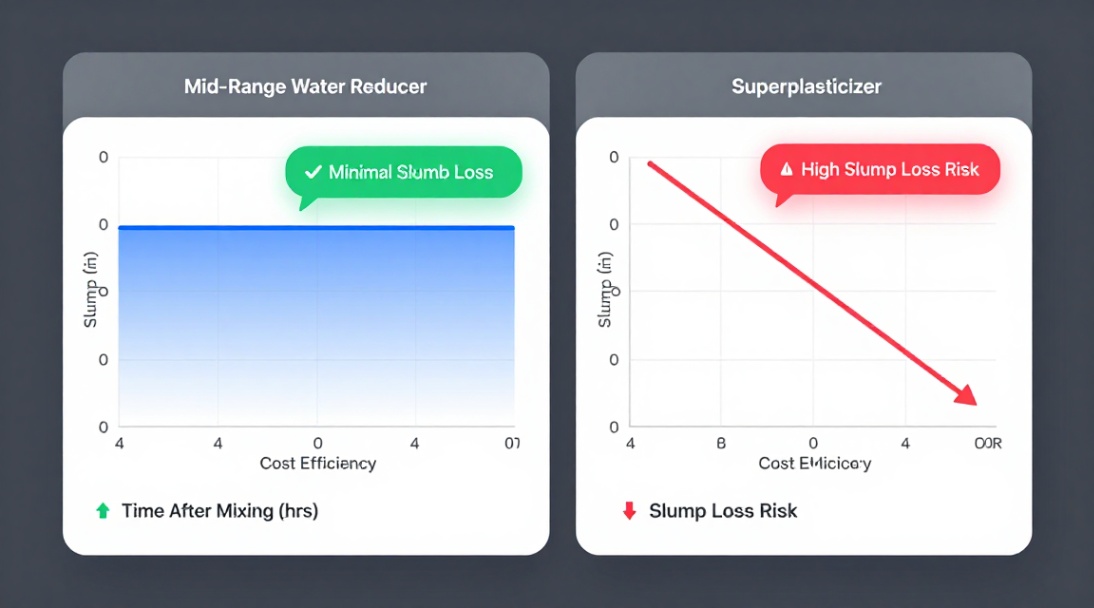
Here’s the jarring statistic: on a typical commercial slab, bridge deck, or architectural precast project, using a high-range water reducer (superplasticizer) over a mid range water reducer for concrete provides zero measurable benefit at the point of placement. Yet, you pay more. You introduce higher slump-loss risk. You chase performance you don’t need. The industry’s obsession with maximum flow has blinded us to the most practical tool in the admixture box.
What is a Mid-Range Water Reducer, Really?
Forget vague terms like “plasticizer.” A mid range water reducer for concrete is a chemical agent designed to do one job supremely well: reduce water demand by 5% to 12% while proportionally increasing slump. It doesn’t aim to create self-consolidating concrete. It aims to give you a predictable, placable, and finishable mix. The core mechanism involves dispersing cement particles, reducing the friction in the paste. This allows you to achieve the desired slump with less water, which directly translates to higher strength and better durability. It’s the pragmatic choice for the vast majority of concrete placed today.
The Admixture Showdown: Choosing Your Workhorse
The choice between admixture types isn’t about “good” versus “better.” It’s about matching the tool to the task. Let’s clear the confusion with a logic-driven comparison.
The Core Admixture Spectrum
| Feature / Admixture Type | Standard Water Reducer (ASTM C494 Type A) | Mid-Range Water Reducer (ASTM C494 Type A, D) | High-Range Water Reducer / Superplasticizer (ASTM C494 Type F, G) |
|---|---|---|---|
| Primary Objective | Modest water reduction (5-8%) for basic workability. | Significant workability & slump increase without drastic water reduction. | Maximum water reduction (12-30%) or extreme flow for self-consolidation. |
| Typical Water Reduction | 5% – 8% | 6% – 12% | 12% – 30%+ |
| Slump Increase (from base) | 2 – 3 inches (50-75mm) | 3 – 6 inches (75-150mm) | 7+ inches (175mm+) to self-leveling |
| Slump Retention (Key Weakness/Strength) | Poor to moderate. Rapid loss possible. | Good to excellent. Less sensitivity to time/temperature. | Variable. High risk of rapid slump loss unless retarding type is used. |
| Chemical Base | Lignosulfonates, basic carboxylates. | Advanced lignosulfonates, polycarboxylate ether (PCE) derivatives, naphthalene sulfonates. | Polycarboxylate ether (PCE) polymers, polynaphthalene sulfonates (PNS). |
| Impact on Setting Time | Often retarding, can be inconsistent. | Controlled set behavior. Can be neutral or slightly retarding. | Neutral or highly retarding, depending on formulation. |
| Best Concrete Application | Simple footings, mass pours with minimal handling. | Virtually everything else: slabs, walls, columns, paving, precast, architectural finishes. | SCC, heavily reinforced sections, complex forms, pumped concrete to great heights. |
| Cost-Effectiveness | Lowest cost, but limited benefit. | Highest value. Optimal performance-to-cost ratio for 90% of jobs. | Highest cost. Justified only by extreme performance requirements. |
The table reveals the core logic: if you need more than a 6-inch slump for standard placement, the mid range water reducer is your default. It provides ample workability without the cost and complications of its high-range cousin.
Unlocking the Benefits: Beyond Simple Workability
The primary benefit-easy placement-is obvious. The secondary benefits are what separate competent concrete from exceptional concrete.
- Strength & Density: Every gallon of water you don’t add to the mix remains as space in the hardened matrix. A mid range water reducer lets you achieve the same slump with a lower water-cement ratio. This directly increases compressive strength, often by 10-20% at 28 days. The paste becomes denser, less permeable.
- Durability: Denser concrete resists chloride ingress, sulfate attack, and freeze-thaw cycles. This isn’t a secondary benefit; it’s the main financial reason to use it on parking structures, bridges, and exterior slabs.
- Finishing Control: Mid-range admixed concrete maintains a cohesive, buttery feel. It doesn’t bleed excessively. It doesn’t segregate under vibration. This gives finishers a consistent material that responds predictably to trowels and floats, reducing surface defects.
How to Dose and Use It: A No-Nonsense Guide
Precision matters. Guessing leads to waste and failure.
1. Find Your Baseline and Target
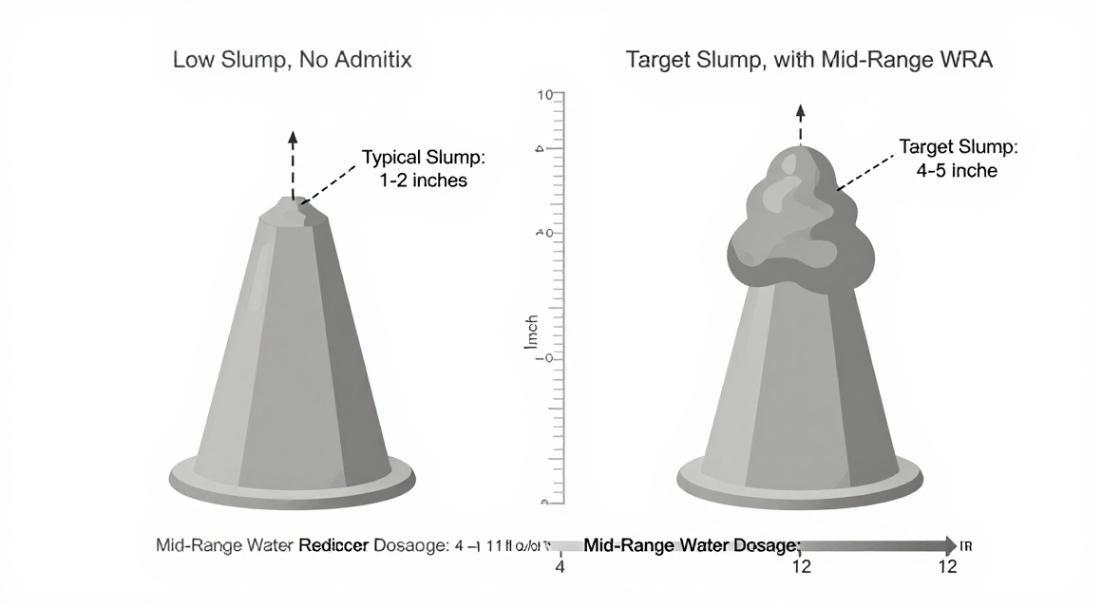
Start with your mix design’s target slump and water-cement ratio. Know your baseline slump without any admixture. The typical dosage for a mid range water reducer for concrete is between 4 to 12 fluid ounces per 100 pounds of cementitious material (fl oz/cwt). Always start at the manufacturer’s recommended low end.
2. Conduct a Plant or Site Trial Batch
Do not skip this. Batch a representative sample using your exact materials (cement, SCMs, aggregates). Add the admixture at the prescribed rate, usually with the mixing water. Measure the resulting slump immediately and at 60, 90, and 120 minutes. Observe the finishability.
3. Adjust for Specific Factors
Cement Chemistry: High C3A cements may require a slightly higher dosage. Supplementary Materials: Fly ash and slag can improve workability, potentially allowing a slight dosage reduction. Temperature: In hot weather, dosage may need a slight increase to maintain slump life. Never use it to compensate for poor aggregate gradation.
4. Compatibility is Non-Negotiable
If using an air-entraining agent (AEA), you must perform a compatibility test. Add the mid range water reducer first, then the AEA. Incompatibility can destroy air content. The trial batch will reveal this.
Pitfalls to Avoid: Common Contractor Mistakes
- Using It as a Water Fix: Never add more water to the truck because the slump is low, then add more admixture to stiffen it back up. You’ve destroyed the water-cement ratio and the admixture’s effectiveness.
- Ignoring Slump Loss: Understand that slump will decrease over time. Plan your pour sequence and truck timing accordingly. A quality mid-range product has good retention, but it’s not infinite.
- Over-dosing for Speed: Cranking the dosage to get a 9-inch slump on a slab pour invites segregation, excessive bleeding, and surface crusting. Use the correct tool for the job.
Selecting a Quality Product: Look Beyond the Data Sheet
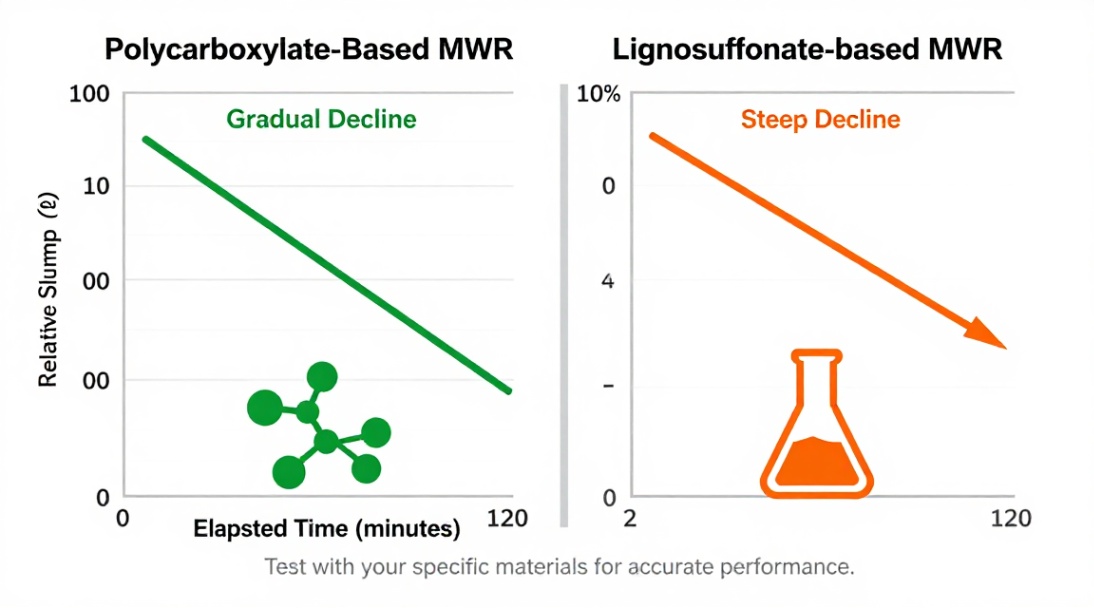
Technical data sheets show standard results. You need consistency. Look for a supplier that provides robust technical support and batch-to-batch uniformity. The chemical base matters: modern polycarboxylate-derived mid-range water reducers often offer superior slump retention and less set retardation than older lignosulfonate types. However, a well-refined lignosulfonate can be perfectly adequate and cost-effective for many applications. The key is testing it with your materials.
The Logical Conclusion: Your New Default Admixture
Forget defaulting to a basic water reducer. Abandon the reflex to specify superplasticizers for every job. The logic is inescapable. For the vast middle ground of concrete construction-where control, finish quality, durability, and cost intersect-the mid range water reducer for concrete is the optimal, rational choice. It solves more problems than it creates. Your next step isn’t to buy the first jug you see. It’s to demand a plant trial with a reputable supplier. Compare two different chemistries against your standard mix. Let the performance of the concrete, not the marketing, dictate your specification. This shift in thinking is the single most impactful change a concrete professional can make to improve results and reduce headaches.
Supplier
We are the global leader in lightweight concrete and advanced engineered foam solutions. Known globally for its commitment to research, innovation, and applied expertise, we have been providing engineered foam solutions since the early 2012’s.
We can supply high-quality concrete admixture and foam concrete related products all over the world.
The company has a professional technical department and quality supervision department, a well-equipped laboratory, and equipped with advanced testing equipment and after-sales customer service center.
If you are interested, please feel free and contact us.