Concrete4U | Concrete Admixtures, Tools, and Production Machines

Fast Setting Early Strength Agent for Precast: The Key to Cycle Time Reduction
The Core Problem in Precast Concrete Production
Are you constantly fighting the clock on your precast production line? Does your schedule depend on demolding times, leaving expensive forms idle for hours or even a full day? You face immense pressure to increase throughput, reduce labour costs, and meet aggressive project deadlines. Traditional waiting for concrete to gain sufficient handling strength creates a major bottleneck. This is the exact challenge a fast setting early strength agent for precast is engineered to solve.

What is a Fast Setting Early Strength Agent?
A fast setting early strength agent for precast is a specialized chemical admixture designed to dramatically accelerate the rate of hydration and strength gain in concrete during the first critical hours after placement. Its primary purpose is not long-term enhancement, but strategic intervention in the initial phase to enable earlier demolding, handling, and finishing of precast elements. Think of it as a catalyst for the early-age concrete matrix.
- Core Function: It targets the development of what is termed ‘early strength’-the compressive strength needed to safely remove forms, transfer tension in prestressed strands, or move products without damage.
- Primary Metric: Success is measured by achieving a specified demolding strength, often in the 10-20 MPa range, in 4 to 12 hours instead of 18 to 24 hours or more.
- Result: This leads directly to cycle time reduction, allowing more production cycles per day from the same molds and plant footprint.
How It Works: Key Chemical Compositions
These agents are not a single chemical but a family of compounds selected for their specific effects on cement chemistry. The choice depends on required set time, cost, and compatibility.
- Calcium Sulfoaluminates (CSA-based agents): These are the most common and effective for precast. They rapidly form ettringite, which provides immediate strength and heat, accelerating the entire hydration process.
- Nitrates and Nitrites: Primarily function as set accelerators and provide corrosion inhibition in non-prestressed applications. They offer a predictable acceleration profile.
- Chlorides: Highly effective but strictly prohibited in reinforced or prestressed concrete due to severe corrosion risks. Their use is limited to non-ferrous applications.
- Alkali Hydroxides & Carbonates: Increase the pH of the mix, rapidly initiating silicate reactions for very fast set. They require careful dosage control.
- Nucleation Seed Agents: Provide sites for hydration products to form, creating a denser, faster-developing microstructure from the outset.
Critical Benefits and Performance Impact
The strategic use of these agents transforms plant logistics and economics.
1. Accelerated Demolding and Cycle Reduction
This is the primary driver. Reducing demolding time from 24 hours to 6-8 hours effectively triples the daily output potential of a mold. This single benefit pays for the admixture cost many times over through improved asset utilization.
2. Energy and Cost Savings vs. Steam Curing
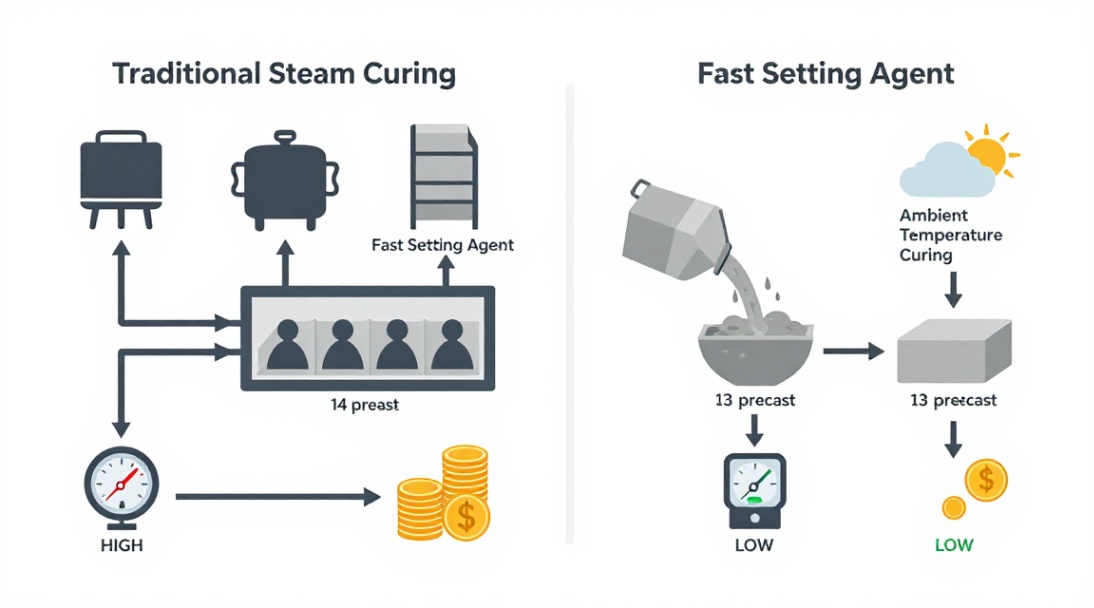
While effective, traditional steam curing requires significant capital investment, energy consumption, and operational space. A properly dosed fast setting early strength agent for precast can achieve comparable early strength at ambient temperatures in many climates, eliminating or drastically reducing steam energy costs.
3. Final Strength and Long-Term Durability
A common misconception is that rapid early gain harms ultimate strength. When used correctly, these agents simply shift the strength development curve forward. The 28-day and long-term compressive strength typically meets or exceeds that of the control mix. Proper formulation ensures no negative impact on durability factors like shrinkage or sulfate resistance.
Application and Best Practices
Key Scenarios for Use
- Architectural Cladding & Facades: Enables fast turnaround of complex, high-value molds.
- Hollow-Core Slabs & Double-Tees: Critical for early strand release and bed re-use in high-volume production.
- Pipes, Manholes, and Utility Products: Allows rapid demolding for curing cycles or immediate finishing.
- Tilt-Up Panels: Facilitates faster panel pick-up, reducing on-site crane time and risk.
Batching, Mixing, and Dosage Optimization
Success depends on precise execution. The agent must be uniformly dispersed.
- Batching: Liquid agents are best added with the mixing water. Powder agents require pre-blending with cement or a high-shear mixer to prevent clumping.
- Dosage: This is not a ‘more is better’ scenario. Follow manufacturer guidelines strictly. Overdosing can cause flash set, reduced workability, and cracking. Underdosing fails to deliver the required benefit. Start with the recommended dosage and adjust based on trial batches under your plant’s specific conditions (cement type, temperature, mix design).
- Compatibility: Always perform compatibility tests with your specific cement, supplementary cementitious materials (like fly ash or slag), and other admixtures (superplasticizers, retarders). Incompatibility can lead to severe set control issues.
Selecting the Right Agent and Safety Protocol
Selection is a technical decision based on your plant’s constraints and product requirements.
- For Speed-Critical, High-Value Products: A CSA-based agent often provides the most robust and reliable performance.
- For Moderate Acceleration in Mild Climates: A nitrate-based accelerator may be sufficient and cost-effective.
- For Plants with High Fly Ash or Slag Content: Choose an agent specifically formulated for compatibility with low-C3A or high-SCM blends, as these mixes hydrate slower naturally.
Safety, Handling, and Storage
These are industrial chemicals. Treat them as such.
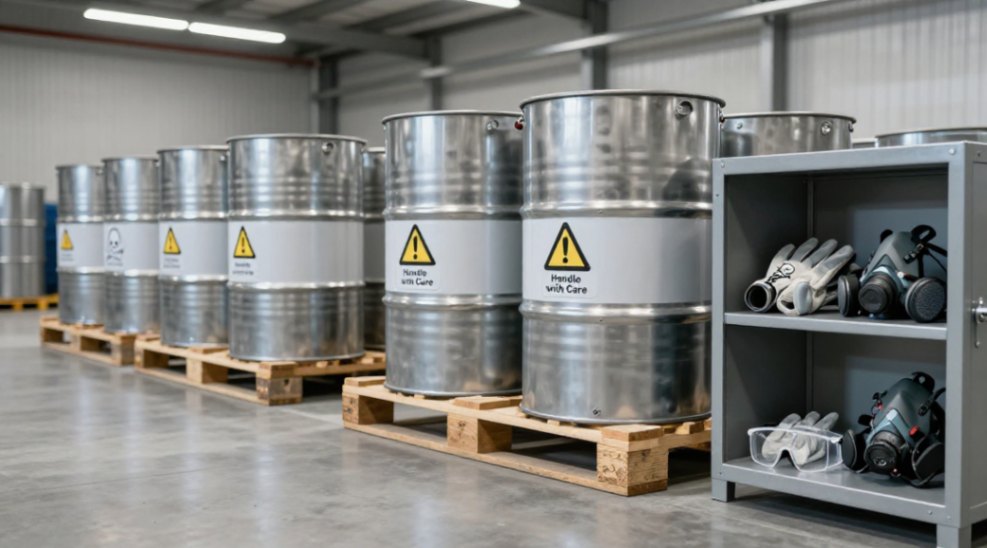
- Wear appropriate PPE: gloves, safety glasses, and protective clothing.
- Store in original, labeled containers away from moisture and extreme temperatures.
- Prevent contamination of other admixtures. Use dedicated dispensing equipment.
- Have Material Safety Data Sheets (MSDS/SDS) readily available and train all personnel on handling procedures and emergency response.
The Strategic Path Forward
Implementing a fast setting early strength agent for precast is a process optimization decision. It moves production from a passive waiting game to an actively managed chemical process. The most effective approach begins with a clear definition of your target demolding strength and time. Then, conduct systematic trial batches with candidate agents under your actual plant conditions-using your cement, your aggregates, your water, and your ambient temperature. Measure the 4-hour, 8-hour, and 24-hour strengths. Assess workability and finishability. Only this empirical, data-driven method will identify the optimal agent and dosage to unlock the cycle time reduction your operation requires. Focus on the total cost-in-use, not just the price per liter, factoring in the value of increased mold turns and reduced energy consumption.
Supplier
We are the global leader in lightweight concrete and advanced engineered foam solutions. Known globally for its commitment to research, innovation, and applied expertise, we have been providing engineered foam solutions since the early 2012’s.
We can supply high-quality concrete admixture and foam concrete related products all over the world.
The company has a professional technical department and quality supervision department, a well-equipped laboratory, and equipped with advanced testing equipment and after-sales customer service center.
If you are interested, please feel free and contact us.