Concrete-mesa | Concrete Admixtures, Tools, and Production Machines

Choosing the Right Foaming Agent for Foamed Concrete: Your 2024 Decision Guide
The Core Question: Which Foaming Agent Wins for Your Project?
Have you ever poured a foamed concrete slab only to watch it sag and weep? Did your insulation-grade mix fail to meet the target density because the foam collapsed? The culprit is often the wrong foaming agent. Choosing one isn’t a minor detail. It’s the fundamental decision that dictates your mix’s weight, strength, and stability. Let’s cut through the confusion and compare your two main options.
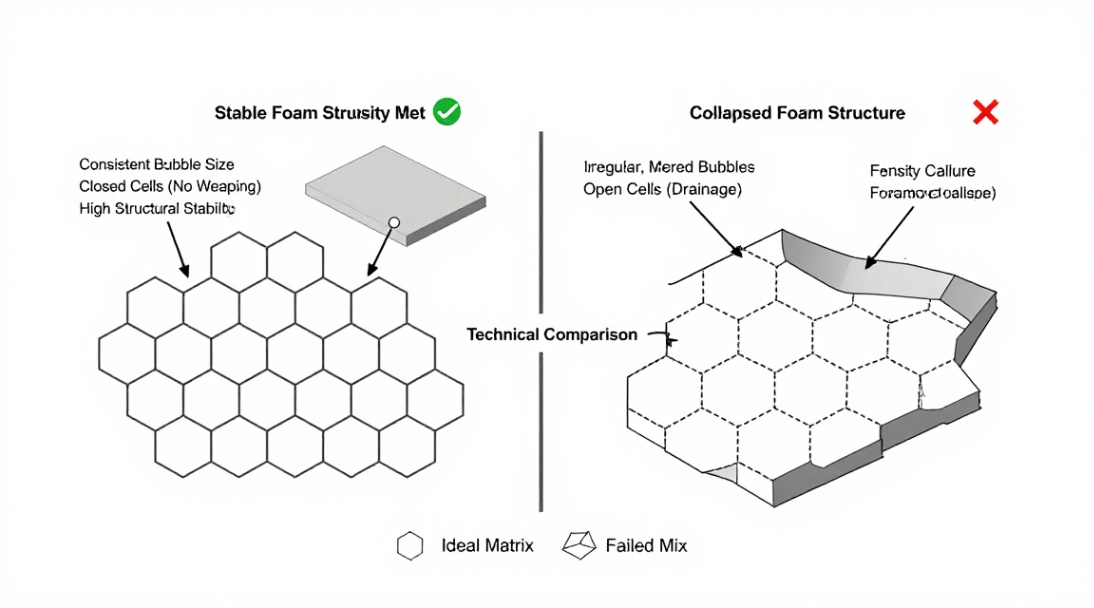
The Two Main Contenders: Protein vs. Synthetic
All foaming agents create air voids by stabilizing tiny bubbles within the concrete slurry. The difference lies in their chemistry and performance. You have two primary paths.
1. Protein-Based Foaming Agents
Derived from hydrolyzed animal proteins (like hoof and horn), these are the traditional, high-performance choice.
Advantages:
- Superior Bubble Stability: The protein molecules form a tough, elastic membrane around each air bubble. This membrane resists the crushing weight of the cement paste and the disruptive chemistry of hydration.
- Closed Cell Structure: Bubbles remain separate and intact. This creates a uniform pore network that maximizes thermal insulation and minimizes water absorption.
- Higher Final Strength: Stable, closed cells act like millions of microscopic ball bearings, distributing load efficiently. Your concrete ends up stronger for a given density.
Disadvantages:
- Higher Cost: Raw material and processing costs make protein agents more expensive per liter of foam generated.
- Sensitivity to Water Quality: Hard water or water with certain minerals can interfere with the protein’s foaming action, requiring pre-testing.
- Shorter Shelf Life: Being a natural organic material, it can degrade over time, especially if stored in warm conditions.
2. Synthetic Foaming Agents
These are surfactants, typically sulfonated or polymer-based compounds engineered in a lab.
Advantages:
- Lower Cost: Synthetic chemicals are generally cheaper to produce, offering a significant price advantage for high-volume projects.
- Consistent Performance: Batch-to-batch uniformity is excellent. They are less fussy about water quality and mix temperature.
- Long Shelf Life: Synthetic formulations remain stable for years if stored properly, reducing waste.
Disadvantages:
- Open Cell Tendency: The bubble film is often less elastic and more brittle. Bubbles can coalesce, creating interconnected pores. This reduces insulation value and can increase water permeability.
- Lower Strength Potential: The weaker bubble structure can collapse under pressure, leading to a higher density than designed and compromised compressive strength.
- Potential for Bleeding: Instability can cause water to separate from the mix, weakening the surface and creating a poor finish.
Your Ultimate Decision Checklist
Use this list to match the agent to your project’s non-negotiable requirements.
Choose a Protein-Based Agent IF:
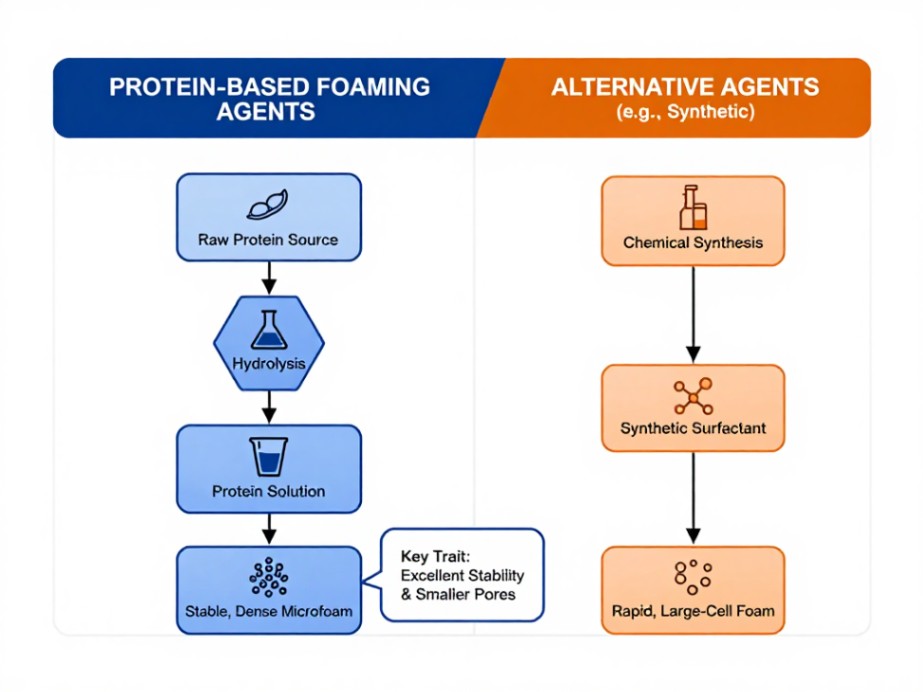
- Your priority is maximum strength-to-density ratio (e.g., structural lightweight fills, floor screeds).
- Thermal insulation or soundproofing is a critical design goal.
- You need exceptional freeze-thaw resistance due to the closed-cell structure.
- Project scale allows for the higher investment in material cost.
Choose a Synthetic-Based Agent IF:
- Your project is extremely cost-sensitive, and you are filling large, non-critical voids.
- You are producing simple, low-density blocks or panels where ultra-high strength is not required.
- Consistent, easy-to-use performance across varying site conditions is your top concern.
- You need a long-shelf-life product for sporadic use.
Critical Process Steps for Success (With Either Agent)
The best agent will fail if your process is wrong. Follow these steps religiously.
- Pre-Dilution: Never add concentrate directly to the mixer. Dilute the foaming agent with clean, cool water in a separate tank. A typical ratio is 1 part concentrate to 30-40 parts water by volume.
- Foam Generation: Use a dedicated foam generator. Pass the diluted solution through the generator at its specified air pressure (typically 0.4-0.6 MPa) to create wet, shaving-cream-like foam. The foam density should be checked regularly-aim for 45-65 kg/m³.
- Mixing Sequence: First, mix your base slurry (cement, sand, fly ash, water) thoroughly. Then, while the mixer is running, inject the pre-made foam. Mix for 60-90 seconds only. Overmixing destroys bubbles.
- Placement: Pour or pump the foamed concrete immediately. Do not vibrate it. Vibrations will collapse the cellular structure. Use screeds or lightweight tamping for leveling.
Common Pitfalls and How to Avoid Them
- Pitfall: Inconsistent Density: Caused by fluctuating foam density or improper foam injection. Solution: Calibrate your foam generator daily. Use a flow metre for the diluted agent.
- Pitfall: Foam Collapse: Caused by harsh water, incompatible admixtures (like some superplasticizers), or cement with a very fast set. Solution: Test compatibility in a lab first. Consider staggered addition of admixtures.
- Pitfall: Segregation or Bleeding: The mix looks watery. Solution: Your base slurry is too thin. Increase the fines content (add more cement or fly ash) to stabilize the bubbles.
The Clear Winner for Demanding Applications
For projects where performance cannot be compromised-where every Newton of strength and every point of R-value counts-the evidence is overwhelming. A high-quality protein-based foaming agent delivers the stable, closed-cell structure that defines superior foamed concrete. It is the engineered solution for engineered results.
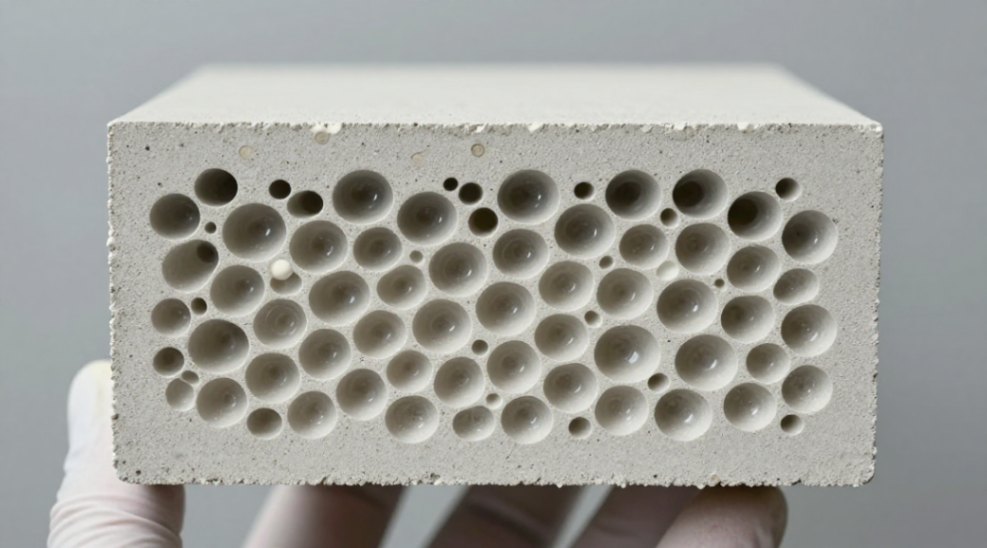
Ready to eliminate guesswork and achieve consistent, high-performance foamed concrete? Stop experimenting with generic solutions. Consult with our technical team today for a tailored specification and access to premium, high-stability protein foaming agents. Let’s build something lightweight and strong.
Supplier
We are the global leader in lightweight concrete and advanced engineered foam solutions. Known globally for its commitment to research, innovation, and applied expertise, we have been providing engineered foam solutions since the early 2012’s.
We can supply high-quality concrete admixture and foam concrete related products all over the world.
The company has a professional technical department and quality supervision department, a well-equipped laboratory, and equipped with advanced testing equipment and after-sales customer service center.
If you are interested, please feel free and contact us.