Concrete-mesa | Concrete Admixtures, Tools, and Production Machines

The Superplasticizer Dosage Playbook: Hitting the Sweet Spot for Every Concrete Mix
Getting the Dosage Right is Everything
Determining the correct superplasticizer dosage for a concrete mix is more art than science, and it is the single biggest factor determining your concrete’s success on site. We start every mix design knowing the wrong dose can cost us time, money, and structural integrity.

Understanding the Superplasticizer Tool
Superplasticizers are high-range water reducers. Their primary function is to disperse cement particles. This allows us to significantly reduce the water content for a given slump. The result is stronger, denser concrete. Or, we can achieve much higher fluidity (like in self-consolidating concrete) without adding water and compromising strength. This dual capability makes them indispensable.
Dosage Comparison: The Good, The Bad, and The Unworkable
The right dose is a precise target. Deviations cause predictable, often costly, problems. Let’s break down the outcomes side-by-side to see why precision matters so much.
| Factor | Under-Dosage (Too Low) | Optimal Dosage (The Goal) | Over-Dosage (Too High) |
|---|---|---|---|
| Workability / Slump | Insufficient. Concrete is stiff, difficult to place and consolidate. | Perfectly meets design target (e.g., 150mm slump, 650mm SCC flow). | May be excessive, leading to segregation of aggregates and paste. |
| Water Reduction | Minimal. We don’t achieve target strength or density gains. | Maximized for the mix, achieving target w/c ratio and compressive strength. | No further benefit. Wasted chemical and increased risk. |
| Set Time | Unchanged or slightly accelerated. | As designed, typically with slight, predictable retardation. | Severely retarded. Concrete may not gain strength on schedule. |
| Bleeding & Segregation | Low risk. | Controlled and minimal. | High risk. Excess water and fines rise, aggregates settle. |
| Cost Impact | Low chemical cost, but high labour cost due to poor workability. | Most economical balance of material and performance. | High chemical cost, plus potential repair costs for defects. |
| Final Strength & Durability | Lower than potential. Permeability may be higher. | Optimized for design life. Dense, impermeable microstructure. | Can be compromised by segregation, poor consolidation, or high air content. |
The Variables That Shift Your Target Dosage
You cannot copy a dosage from one job to the next. We must adjust based on several key factors. Treat these as dials you must tune.
1. Cement & Supplementary Materials
Cement chemistry drives dosage. Finer cements or those with high C3A content typically need more superplasticizer. Materials like fly ash or slag often improve workability and can alter the required dose. We always run a compatibility test with the actual plant materials before full-scale production.
2. Aggregate Shape & Grading
Harsh, angular aggregates need more paste lubricant. A well-graded aggregate reduces the paste volume requirement. This directly impacts how much superplasticizer we need to achieve fluidity.
3. Ambient & Concrete Temperature
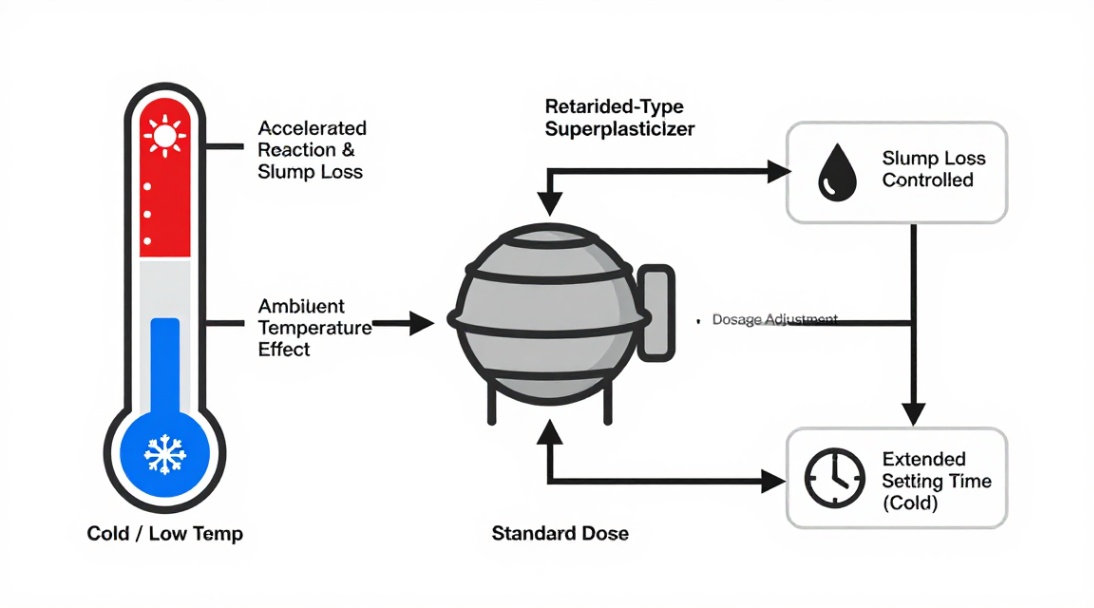
Heat is a killer. High temperatures accelerate slump loss. We often need a slightly higher initial dosage in hot weather or use a retarding-type superplasticizer. In cold weather, standard doses work, but setting slows.
4. Desired Concrete Performance
A standard 100 MPa high-strength mix has a very low water content and demands a high dose to become placeable. A self-consolidating concrete (SCC) mix requires an even higher dosage to achieve extreme flow without segregation. A standard slab mix might need only a modest dose.
A Real-World Process for Finding Your Dose
Let’s walk through the process we use to lock in the right superplasticizer dosage for the concrete mix. It’s methodical.
- Start with Manufacturer’s Range. Use their suggested starting point, typically 0.5% to 2.0% by weight of cementitious material.
- Conduct Lab or Site Trial Batches. This is non-negotiable. Mix a small batch with your exact materials.
- Perform the Slump/Flow Test. Measure workability at 0, 30, 60 minutes to see slump loss.
- Adjust Methodically. Increase dosage in small increments (0.1% or 0.2%) until you hit the target slump at the time of placement.
- Check for Segregation. Observe the mixed concrete. If it’s bleeding or the coarse aggregate is settling, you’ve gone too far.
- Lock In the Procedure. Once the dose is set, standardize the batching sequence. Adding the superplasticizer to the mix water or with the initial batch water is usually most effective.
The Non-Negotiable Best Practices
Good habits protect your investment and your concrete quality.
- Store Properly: Keep containers sealed, away from freezing or extreme heat.
- Measure Precisely: Use calibrated dispensers, not buckets or guesswork.
- Mind the Compatibility: If using other admixtures (air-entrainer, retarder), test them together first. They can interfere.
- Train the Crew: Everyone on site must understand that adding extra water to fix stiff concrete destroys the mix design. They should request a superplasticizer dose adjustment instead.
Stop Guessing and Start Optimizing
For over two decades, we’ve seen projects fail from admixture guesswork and succeed with precise dosing. The data is clear. The process is proven. If you’re still adjusting dosage by eye or sticking to a single number for all your mixes, you are leaving performance and profit on the table. You need a partner who provides consistent, high-performance superplasticizers and the technical support to dial them in perfectly.
Ready to eliminate placement headaches and achieve guaranteed strengths? Don’t experiment with your next pour. Contact our technical team today for a free mix design review and superplasticizer dosage recommendation. Let’s optimize your concrete together.
Supplier
We are the global leader in lightweight concrete and advanced engineered foam solutions. Known globally for its commitment to research, innovation, and applied expertise, we have been providing engineered foam solutions since the early 2012’s.
We can supply high-quality concrete admixture and foam concrete related products all over the world.
The company has a professional technical department and quality supervision department, a well-equipped laboratory, and equipped with advanced testing equipment and after-sales customer service center.
If you are interested, please feel free and contact us.