Concrete-mesa | Concrete Admixtures, Tools, and Production Machines

Stop Concrete Shrinkage Cracks: The Definitive Microfibers vs. Steel Fiber Comparison
Your Concrete Is Shrinking. You’re Trying To Stop It.
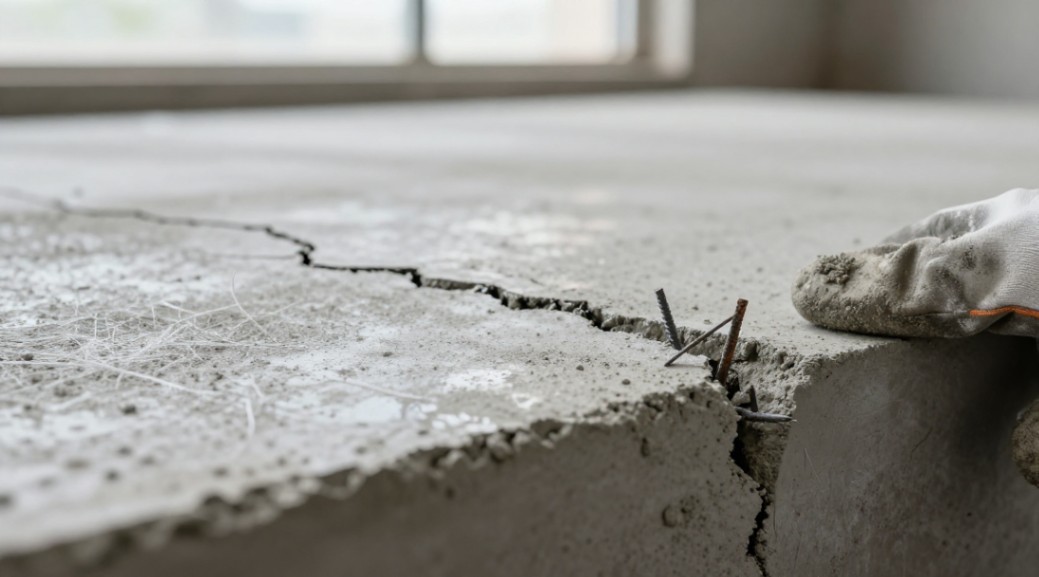
You finished the slab. It looked perfect. Then, within hours, hairline cracks spiderwebbed across the surface. Your client called. Your reputation took a hit. This isn’t just about aesthetics. It’s a durability failure. Water and chemicals now have a direct path to the rebar. The problem is plastic and early-age shrinkage. The conventional solution? Throwing steel at it. Here’s a counterintuitive truth: for shrinkage control, tiny synthetic micro fibers for shrinkage reduction in concrete often outperform heavy steel reinforcement. This guide gives you the blunt, data-backed comparison to make the right call.
1. How Microfibers Actually Work: It’s Not About Strength
Forget tensile strength for a moment. The primary job of micro fibers for shrinkage reduction in concrete is three-dimensional reinforcement during the critical first 24-48 hours. They function at the capillary level.
- The Mechanism: As water bleeds and evaporates from the fresh paste, capillary tension builds, pulling the paste particles together. This causes shrinkage. A dense network of microfibers physically bridges these developing micro-voids.
- Immediate Restraint: They act like a microscopic internal scaffold, holding the matrix together against these internal tensile stresses long before it gains any meaningful strength.
- Water Retention: Studies, like those referenced in ACI 544.3R, show fine monofilament polypropylene fibers reduce plastic shrinkage cracking by over 90%. They disrupt the capillary bleed channels, slowing moisture loss at the surface.
Think of them as a distributed, internal crack-arresting system. Steel fibers, by contrast, are too large and spaced too far apart to affect this microscopic stage.
2. The Showdown: Microfibers vs. Steel Fibers for Shrinkage Control
Let’s cut through the noise. Here is the objective breakdown.
2.1. The Case for Microfibers
- Unmatched Plastic Shrinkage Control: This is their core competency. A dosage of 0.1% to 0.3% by volume of fine polypropylene fibers is the industry standard for virtually eliminating plastic shrinkage cracks in slabs, overlays, and toppings.
- Superior Mix Integration: They disperse uniformly, creating a homogeneous reinforcement network. No balling. No segregation.
- Finishability: When used correctly, they have minimal impact on surface finishing. Decorative concrete contractors rely on them for crack control without compromising aesthetics.
- Corrosion-Proof: Polypropylene, nylon, and PVA fibers are inert. They cannot rust, a critical advantage in decks, parking structures, and marine environments.
- Impact on Other Properties: They marginally improve abrasion and shatter resistance. They do not significantly increase the compressive or flexural strength of hardened concrete.
2.2. The Case for Steel Fibers
- Post-Crack Toughness (Ductility): This is their domain. Steel fibers provide significant residual strength after the concrete cracks, ideal for industrial floors, pavements, and blast-resistant structures (ASTM C1609/C1550).
- Poor Plastic Shrinkage Performance: Steel fibers are ineffective at preventing the initial plastic shrinkage cracks we’re addressing. They are spaced too widely.
- Handling & Placement Challenges: Higher dosages can lead to balling, mix stiffening, and finishing difficulties. They require careful mix design adjustments.
- Corrosion Risk: If cracks do occur and are wide enough, steel fibers can corrode, leading to staining and spalling.
- Cost Per Unit Volume: Steel fibers are typically more expensive per cubic yard of concrete compared to synthetic microfibers.
3. Best Practices: How To Use Microfibers Correctly
Getting it wrong is easy. Follow these steps.
Mixing Protocol: Add the fibers to the mix after the aggregates and some mixing water. This ensures proper dispersion. Mix for a minimum of 3-5 minutes at normal drum speed. Visual cheque: no fiber clumps.
Dosage Guidelines by Application:
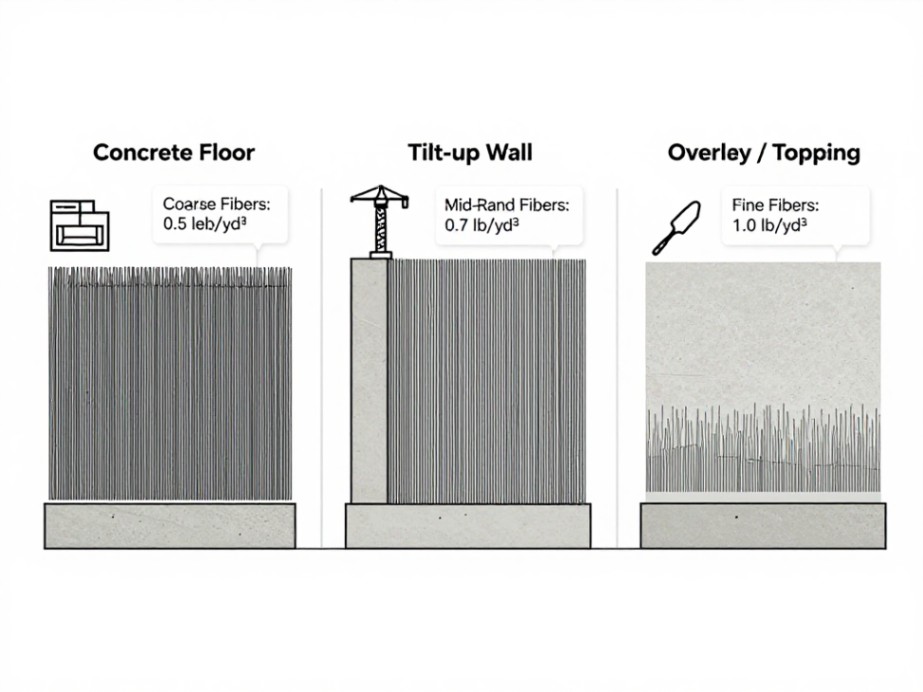
- Standard Slabs-on-Grade (Warehouse, Retail): 0.10% to 0.20% by volume (0.9 lb to 1.8 lb per cubic yard for PP). Controls plastic shrinkage, reduces early cracking.
- Overlays & Toppings (50 mm or less): 0.20% to 0.30% by volume (1.8 lb to 2.7 lb per cubic yard). Critical for high restraint and thermal differentials.
- Decorative Concrete (Stamped, Colored): 0.10% to 0.15% by volume. Use fine monofilament fibers to avoid surface fiber prominence.
- Shotcrete: 0.15% to 0.25% by volume. Reduces rebound and cracking in vertical applications.
4. The Long-Term Payoff: Beyond the First Crack
This isn’t just a cosmetic fix. By preventing micro-cracks at the start, you fundamentally alter the concrete‘s durability trajectory.
- Reduced Permeability: No interconnected cracks mean a tighter, less permeable surface. This directly improves resistance to chloride ingress (deicing salts) and sulfate attack.
- Less Maintenance: A crack-free slab won’t need epoxy injection or routing and sealing later. The lifecycle cost plummets.
- Specification: Reference ASTM C1116 for synthetic fibers and ACI 544.1R for performance guidance. Don’t just write “add fibers.” Specify type, dosage, and compliance standard.
5. The Final Verdict: Which One Is For You?
Stop using the wrong tool. Your choice is binary and driven by the failure mode you need to prevent.
Choose Microfibers If: Your primary enemy is plastic and drying shrinkage cracking in slabs, overlays, or decorative work. You need a cost-effective, corrosion-proof, and easy-to-use solution that integrates seamlessly into standard mixes. You prioritize long-term durability through crack prevention.
Choose Steel Fibers If: You need post-crack ductility and toughness for industrial floors, pavements, or seismic applications. You are designing for structural fiber-reinforced concrete (SFRC) where fibers carry load after cracking. Shrinkage control is a secondary benefit, not the primary goal.
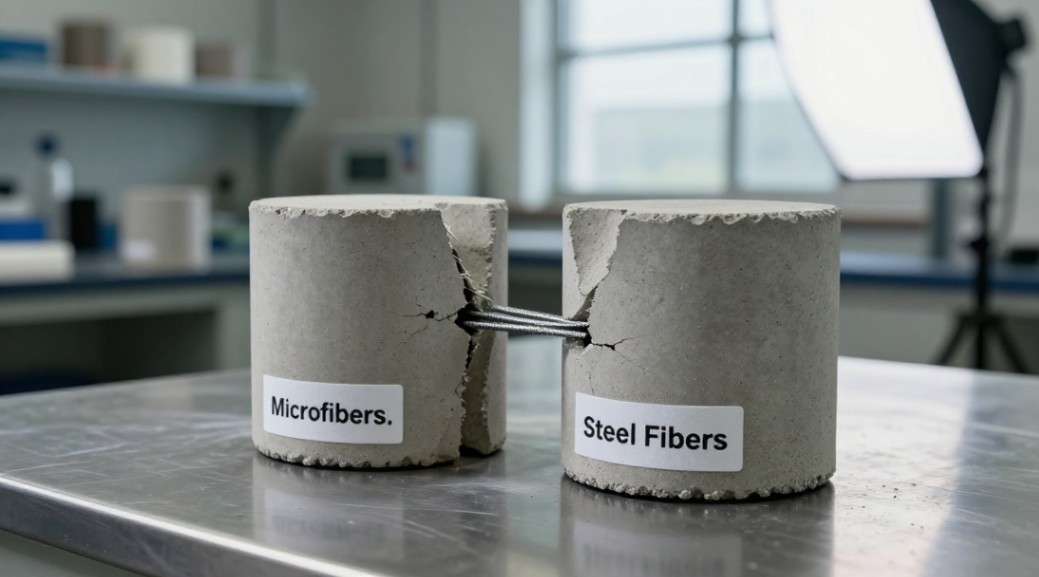
For 90% of architects and contractors battling shrinkage cracks, micro fibers for shrinkage reduction in concrete are the superior, targeted solution. The data is clear. The mechanism is proven. The next step is to test it. Specify a trial batch on your next project. Compare the finished surface to a non-fibered control section. The absence of those hairline cracks will be all the proof you need. Consult your ready-mix supplier with these specifications in hand and demand a mix that performs from the moment it leaves the truck.
Supplier
We are the global leader in lightweight concrete and advanced engineered foam solutions. Known globally for its commitment to research, innovation, and applied expertise, we have been providing engineered foam solutions since the early 2012’s.
We can supply high-quality concrete admixture and foam concrete related products all over the world.
The company has a professional technical department and quality supervision department, a well-equipped laboratory, and equipped with advanced testing equipment and after-sales customer service center.
If you are interested, please feel free and contact us.