Concrete-mesa | Concrete Admixtures, Tools, and Production Machines

The Liquid Concrete Water Reducing Admixture Guide: Control Slump, Boost Strength
What Is a Liquid Concrete Water Reducing Admixture?
You’ve finished the pour. The slump test is perfect. But three days later, your core samples show inconsistent strength. Your water-cement ratio wasn’t as low as you thought. The concrete batch lost workability, so the crew added water on-site, undermining the entire design mix. This is the hidden cost of poor slump control. Liquid concrete water reducing admixtures are the precise chemical tool designed to solve this. These formulations are not just “additives”; they are engineered surfactants that chemically disperse cement particles. This dispersion unlocks the water trapped within flocculated cement agglomerations, making it available for lubrication. The result? You achieve the required slump with significantly less mixing water.
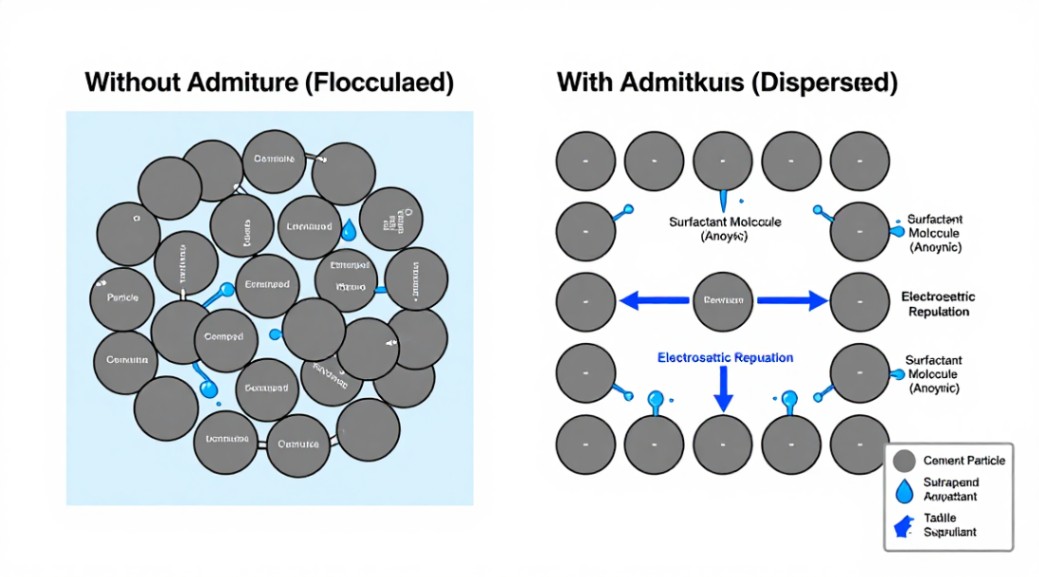
How Do Water Reducing Admixtures Actually Work?
Think of cement particles as tiny magnets. In water, they clump together, trapping water inside these clusters. A water reducer is a surface-active agent. Its molecules have a hydrophilic (water-loving) head and a hydrophobic (water-repelling) tail. The hydrophobic tail adsorbs onto the cement particle surface. The hydrophilic head points outward into the water, creating a negative electrostatic charge. Like-charged particles repel each other. This repulsive force breaks apart the flocs, releasing the entrapped water. This process, known as deflocculation or dispersion, is the core mechanism. It transforms a stiff, unworkable mix into a fluid one without adding a single extra liter of water. This precise control is what separates adequate concrete from superior, high-performance concrete.
Chemical Dispersion in Action
The efficiency of dispersion depends on the admixture’s chemical family. Lignosulfonates, a common mid-range type, provide moderate dispersion. Polycarboxylate Ether (PCE)-based high-range water reducers (superplasticizers) offer superior dispersion through a comb-like polymer structure that provides steric hindrance, a more powerful and longer-lasting effect than simple electrostatic repulsion.
Key Benefits Beyond Just Water Reduction
- Increased Compressive Strength: Reducing the water-cement (w/c) ratio is the most effective way to increase strength. For every 0.01 reduction in w/c ratio, you can expect a 3-5% gain in 28-day compressive strength. This is not a marginal improvement; it is foundational.
- Reduced Permeability: A lower w/c ratio creates a denser, less porous cement paste matrix. This dramatically reduces the ingress of water, chlorides, and sulfates, which are the primary causes of corrosion and chemical attack. Durability improves exponentially.
- Improved Workability & Finishability: The concrete flows more easily, filling complex forms and around dense rebar cages without honeycombing. This leads to a better surface finish, reducing labour for patching and grinding.
- Sustainability Advantage: Using a water reducer allows for the same strength with less cement. Since cement production is a major source of global CO2 emissions, this represents a direct path to reducing the carbon footprint of a concrete structure.
Choosing the Right Type for Your Project
Not all water reducers are the same. Selecting the wrong type can lead to rapid slump loss, setting problems, or cost overruns.
Mid-Range Water Reducers (MRWR)
Typically lignosulfonate or gluconate-based. They provide a 5-10% water reduction. Use them for general ready-mix concrete where moderate workability improvement is needed and a standard set time is acceptable. They are cost-effective for everyday applications.
High-Range Water Reducers (HRWR) / Superplasticizers
Primarily based on Polycarboxylate Ether (PCE) technology. They enable 12-40% water reduction. These are essential for high-strength concrete, self-consolidating concrete (SCC), and applications requiring long-distance transport with minimal slump loss. PCEs offer better slump retention control compared to older naphthalene or melamine-based superplasticizers.
Critical Application Guidelines and Best Practices
Failure in admixture performance is almost always a result of improper use, not a product defect.
Dosage: Precision is Non-Negotiable
Dosage is measured as fluid ounces per 100 pounds of cementitious material (fl oz/cwt) or milliliters per kilogram (mL/kg). Under-dosing yields no benefit. Over-dosing can cause severe retardation, excessive air entrainment, or segregation where the paste separates from the aggregate. Always follow the manufacturer’s recommended dosage based on your cement type and mix design. Start with a trial batch.
Batching and Mixing Sequence
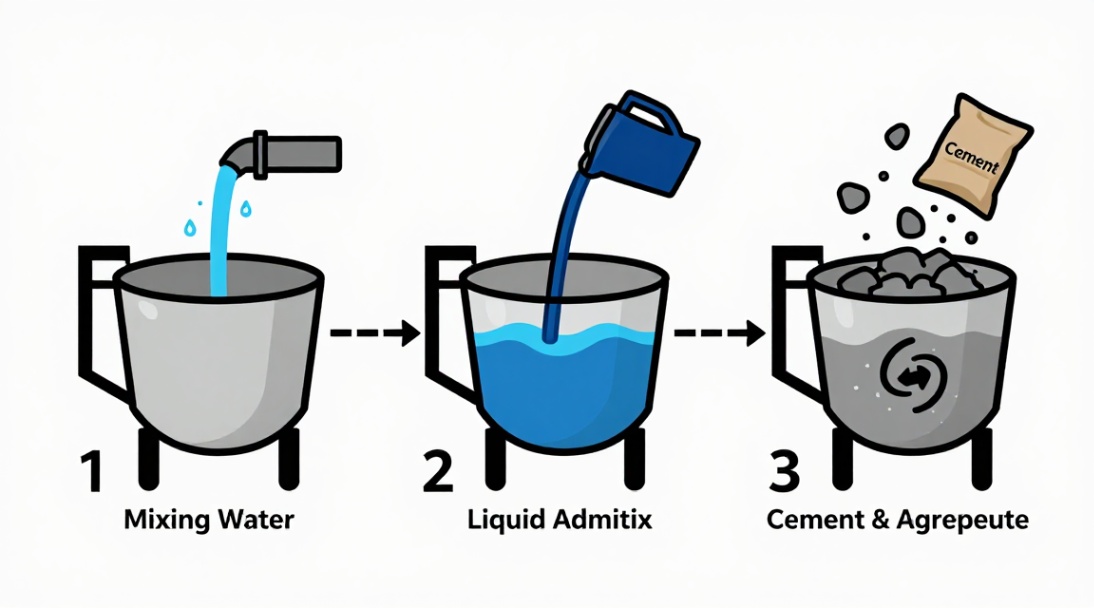
The sequence matters. For optimal performance, introduce the liquid water reducing admixture into the mixing water or with the initial batch water. Adding it last, directly onto dry cement or semi-mixed concrete, can lead to uneven dispersion and “hot spots” of high concentration. Ensure adequate mixing time-typically 1-2 minutes after all materials are in the drum-to achieve homogeneity.
Compatibility with Other Admixtures
You will often use water reducers alongside retarders, accelerators, or air-entraining admixtures (AEAs). Never assume compatibility. PCE superplasticizers can interact with some AEAs, reducing air content. Always conduct compatibility tests in the lab with your specific materials and combination of admixtures before going to the field. Sequential addition in the truck mixer is often required.
Solving Common On-Site Problems
Rapid Slump Loss: This is the most frequent complaint. In hot weather or with certain cements, slump can disappear in 30 minutes. Solution: Use a superplasticizer formulated for slump retention, or consider a delayed addition method where a portion of the admixture is added at the job site. Retarders can also be combined strategically.
Excessive Retardation: The concrete won’t set. This is usually caused by over-dosage, cold weather amplifying the effect, or incompatible cement-admixture chemistry. Solution: Review dosage, ensure ambient temperatures are accounted for, and verify compatibility with your cement supplier.
Segregation or Bleeding: Water pools on the surface. This indicates a mix that is too wet or has poor sand grading. The water reducer did not cause this; it revealed an underlying mix design flaw. Adjust the aggregate gradation and sand content.
The Bottom Line for Your Next Project
A liquid concrete water reducing admixture is not a magic potion. It is a precision instrument for controlling the single most important variable in concrete: the water-cement ratio. Its value is proven in data-higher strength, lower permeability, reduced cement content, and improved constructability. The industry trend is clear: moving from generic mid-range products to advanced, tailored PCE superplasticizers that offer targeted performance for specific challenges like slump retention in ready-mix or flowability in precast.
Do not treat it as a commodity. Partner with a technical supplier who provides full data sheets, dosage software, and on-site support. The upfront investment in proper selection and testing eliminates costly field corrections and performance failures. Specify performance, not just a product name. Your concrete’s durability depends on it.

Ready to achieve precise control over your concrete mixes? Stop guessing with water content. Contact our technical team today for a free mix design review and specification guidance. We provide the high-performance liquid concrete water reducing admixtures and the expert support you need to build stronger, more durable structures. Request your consultation now.
Supplier
We are the global leader in lightweight concrete and advanced engineered foam solutions. Known globally for its commitment to research, innovation, and applied expertise, we have been providing engineered foam solutions since the early 2012’s.
We can supply high-quality concrete admixture and foam concrete related products all over the world.
The company has a professional technical department and quality supervision department, a well-equipped laboratory, and equipped with advanced testing equipment and after-sales customer service center.
If you are interested, please feel free and contact us.