Concrete-mesa | Concrete Admixtures, Tools, and Production Machines

Concrete Foaming Agent: 7 Critical Mistakes That Ruin Your Lightweight Mix (And How to Avoid Them)
Your Lightweight Concrete Just Failed. Here’s Why.
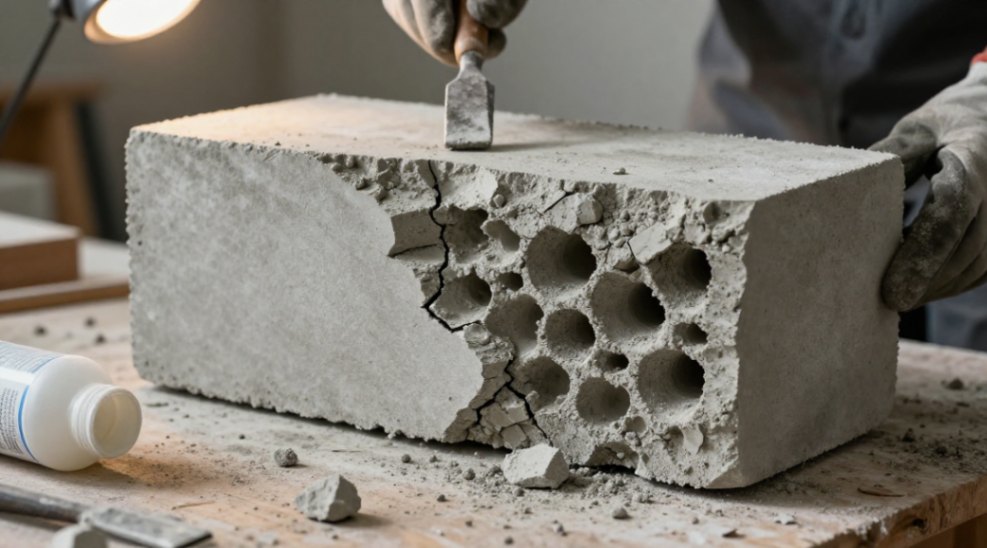
You’ve been there. You mix a perfect batch of lightweight concrete. You pour it. You wait. And what comes out? A crumbly, honeycombed mess. The density is shot. The strength is a joke. You are now staring at thousands of dollars down the drain. The culprit? Almost always, it’s your concrete foaming agent. Or more precisely, how you misused it. This isn’t theory. This is what I’ve seen on job sites for twenty years. Let’s fix it.
What is a Concrete Foaming Agent Really?
Stop thinking of it as a magic potion. It’s not. A concrete foaming agent is a surfactant. A surfactant reduces surface tension in water. Think of soap suds. That’s the basic principle. You introduce air into a cement slurry. The foaming agent stabilizes those bubbles. No stabilization, no stable foam, no lightweight concrete. The chemical composition varies. Synthetic agents (alkyl ether sulfates) are cheap and aggressive. Protein-based agents (hydrolyzed keratin) give finer, stronger bubbles. Plant-based agents (saponins) are eco-friendly but slower. Choose wrong, and you lose.
How Do Foaming Agents Create Stable Air Bubbles?
You don’t just dump agent into concrete. That’s amateur hour. The correct process is: dilute the agent with water. Usually 1 part agent to 20-40 parts water by volume. Then you feed this solution into a foam generator. The generator blasts compressed air through a nozzle. It creates a dense, stable foam – like shaving cream. Then you fold this foam into the cement paste. The bubbles must stay separate. They must not coalesce. If they merge, you get big voids. Voids kill strength. A good agent produces bubbles with a diameter of 0.1–1.0 mm. Uniform. Stable. That’s the goal.
The Three Types: Which One Will Bite You?
Synthetic Foaming Agents
These are the cheapest. They are alkaliphilic (alkali-loving). That means they work well in high-pH cement. But they are sensitive to oil and grease. A greasy form release agent? Your foam collapses. Many users on Reddit report this exact failure. Stick to synthetic for clean, indoor precast work.
Protein-Based Foaming Agents
These create the toughest bubbles. They resist high shear better. They are your go-to when pumping concrete over long distances. The downside? They smell. Bad. Like wet dog. And they are more expensive. But if you need structural lightweight concrete (15-20 MPa), use protein.
Plant-Based Foaming Agents
I call these the hippie agents. They are biodegradable. Low VOC. Great for green building certifications. But they are pH sensitive. Your cement mix must be consistent. If the pH drops, your bubbles vanish. Use them for non-structural fills and insulation only.
Benefits: The Real Numbers
You want benefits? Fine. Here is what a properly foamed concrete delivers. Density reduction from 2400 kg/m3 down to 400-1800 kg/m3. Thermal conductivity slashed from 1.5 W/mK to 0.15 W/mK. Material cost for fill applications drops 30-50%. You save on structural steel. You save on foundations. But only if the foam is stable.
7 Mistakes That Will Destroy Your Foamed Concrete
I have personally investigated over fifty failed foamed concrete pours. Here is exactly what went wrong. Read this. Memorize this. Do not make these errors.
1. Using the Wrong Water-to-Foam Ratio
Your foaming agent concentrate is not the foam. You must dilute it. The typical dilution ratio is 1:20 to 1:40 by volume. Too much water? You get wet, collapsed foam. Too little? The foam is thick, dry, and won’t mix evenly. Measure your water. Do not guess. Use a volumetric bucket.
2. Forgetting the Superplasticizer
Foamed concrete needs high water content to flow. But too much water kills strength. You must use a superplasticizer (concrete water reducer). It keeps the mix fluid without extra water. Without it, your foam compresses under the weight of the paste. You lose density control. Add 0.5-1.5% by weight of cement. Always.
3. Ignoring Your Base Cement Type
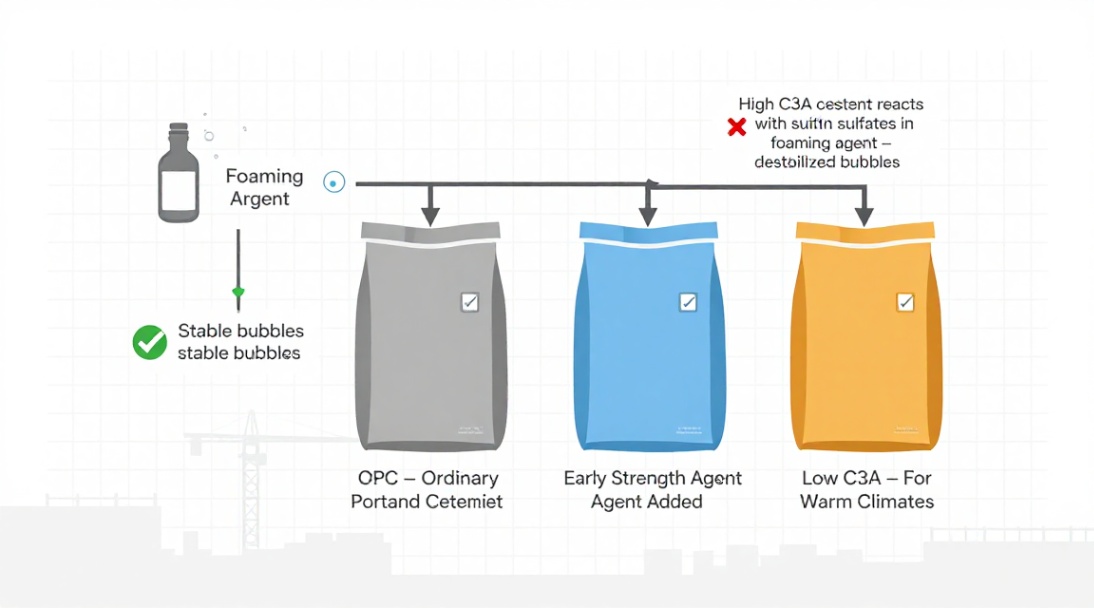
Not all cement works the same. Ordinary Portland Cement (OPC) is standard. But if you need fast demolding, add an early strength agent. If you need sulfate resistance, use special cement. For warm climates, avoid cement with high tricalcium aluminate (C3A) – it reacts with sulfates in the foaming agent and destabilizes bubbles. Check your cement datasheet.
4. Mismatching Your Foaming Agent and Mix Design
You cannot use a synthetic foaming agent for a high-density mix (1800 kg/m3) and expect easy workability. It collapses. For densities below 800 kg/m3, use protein-based. For densities 1000-1600 kg/m3, synthetic works. For structural lightweight (1600-1800 kg/m3), you need a mix of foaming agent and supplementary materials like silica fume. Plan your target density first. Choose your agent second.
5. Skipping the Foam Quality Test
You wouldn’t pour concrete without a slump test. Why would you pour foamed concrete without a foam test? Measure the foam expansion ratio. Fill a 1-liter cylinder with foam. Weigh it. The expansion ratio is (weight of 1 liter of water = 1000g) divided by (weight of 1 liter of foam). A good ratio is 20-30. If it’s below 15, your foam is collapsing. Stop. Fix your generator.
6. Using the Wrong Foam Generator
Your foam generator is not an air compressor. It is a specific device. It must have a dedicated pressure gauge (2-4 bar is typical). It must have a calibrated nozzle. Many operators buy cheap generators. They produce large, unstable bubbles. The result? Your concrete has a density variation of 100 kg/m3 across the pour. Not acceptable. Invest in a quality foam generator from a reputable supplier.
7. Overlooking Fiber Reinforcement
Foamed concrete is weak in tension. You must add fibers. Polypropylene fibers (6-12 mm length) at 0.5-1.5 kg/m3 work well. They prevent shrinkage cracking. They hold the structure together. Without fibers, your lightweight concrete cracks under its own weight during curing. End of story.
Comparison: Foaming Agent vs. Air-Entraining Admixture
Engineers confuse these two. They are not the same. Air-entraining admixtures (AEA) create tiny, discrete bubbles (0.01-0.3 mm) to improve freeze-thaw resistance. They are added directly to the concrete mix. They produce concrete with 4-8% air by volume. Foaming agents create much larger bubbles (0.1-2 mm) and can entrain 20-80% air. Use AEA for frost protection. Use foaming agents for lightweight concrete. Do not swap them.
Storage and Handling: The Don’ts
- Do not store foaming agent in direct sunlight. Heat degrades the surfactant. Keep below 40°C.
- Do not mix different brands of foaming agent. They can react and form a gelatinous mess.
- Do not use expired agent. Most have a shelf life of 6-12 months. Check the date.
- Do not contaminate the agent with oil, diesel, or form release agents. Even 1% contamination kills foam stability.
Environmental Impact: What You Need to Know
Plant-based foaming agents are biodegradable. They break down in 28 days. Synthetic and protein-based agents require wastewater treatment. Do not discharge foaming agent solution into storm drains. It’s illegal in many jurisdictions. Use eco-friendly alternatives for projects with green certification (LEED, BREEAM). Your choice matters.
Quality Control: The Three Tests You Must Run
Foam Stability Test
Take a sample of foam. Fill a graduated cylinder to 1000 ml. Time how long it takes for 100 ml of liquid to drain from the foam. The longer, the better. A stable foam takes >60 minutes to drain 100 ml. If it drains in 10 minutes, reject it.
Expansion Ratio Test
Weigh a 1-liter container empty. Fill with foam. Weigh again. Expansion ratio = 1000 / (weight of foam in grams). Target 20-30.
Bubble Distribution Test
Take a cast sample of hardened foamed concrete. Cut it. Examine under a magnifying glass (or low-power microscope). You should see evenly distributed, spherical bubbles. If you see large, irregular voids, your foam quality was poor.
Your Action Plan: Do This Next
Stop guessing. Start testing. First, get your foaming agent from a supplier like TRUNNANO who provides technical data sheets. Second, calibrate your foam generator. Third, test every batch of foam before mixing. Fourth, always add superplasticizer and fiber. Fifth, document your water-to-foam ratio. This is not experimental. This is engineering. If you follow these steps, your lightweight concrete will be consistent. Your projects will be on time. Your clients will be happy. Now go do it.
Supplier
We are the global leader in lightweight concrete and advanced engineered foam solutions. Known globally for its commitment to research, innovation, and applied expertise, we have been providing engineered foam solutions since the early 2012’s.
We can supply high-quality concrete admixture and foam concrete related products all over the world.
The company has a professional technical department and quality supervision department, a well-equipped laboratory, and equipped with advanced testing equipment and after-sales customer service center.
If you are interested, please feel free and contact us.