Concrete-mesa | Concrete Admixtures, Tools, and Production Machines

Potassium Silicate in High Temperature Paints: The Corrosion-Blasting Binder You’re Using Wrong
The Raw, Unfiltered Truth on Potassium Silicate for High Temperature Paints
Potassium silicate is the inorganic binder that turns paint into a ceramic-like shield. It works because it forms a potassium-aluminosilicate glass at high temperature. This is not magic. It’s inorganic chemistry. The binder doesn’t burn, char, or release VOCs. It vitrifies. It fuses. The result? A coating that laughs at 1000°C.
Fragmented Q&A: Busting Myths, Fixing Formulations
Why use potassium silicate instead of silicone resin?
Potassium silicate forms a true ceramic bond. Silicone resins are just tough organics. They degrade around 400°C, leaving behind a silica skeleton. Potassium silicate starts inorganic and stays that way, offering superior adhesion and thermal shock resistance. As one veteran formulator put it: ‘Silicone buys you time. Silicate buys you permanence.’ The difference is fundamental.
What’s the key to its chemical reaction for heat resistance?
The reaction is straightforward but critical. On heating, the water-based silicate binder loses moisture. Upon reaching temperatures typically above 400-600°C, it begins to chemically react with the substrate (often steel) and the fillers (like aluminum oxide, zircon). This forms a network of strong, covalent -Si-O-M- (M being metal) bonds. It doesn’t just stick on the surface; it chemically integrates with it.
What temperature range can I realistically expect?
Continuous service from 500°C to 1100°C, with short-term peaks higher. Durability isn’t just about heat. It’s about thermal cycling. A good formulation will survive hundreds of heat-up/cool-down cycles without flaking. The data from independent lab reports often shows failure at the steel substrate before the coating itself spalls.
Step-by-Step: How do I apply potassium silicate paints correctly?
First, prepare the surface like a surgeon. This step is 70% of the battle. Grit-blast steel to a clean, white metal finish (Sa 2.5 or better). No oil, rust, or old coating. Profiles of 50-100 microns are ideal.
Second, mix the paint aggressively and constantly. The fillers settle fast. Use a drill mixer. For application, airless spray gives the best film build and uniformity. You need to achieve a wet film thickness that will cure to your target dry film thickness.
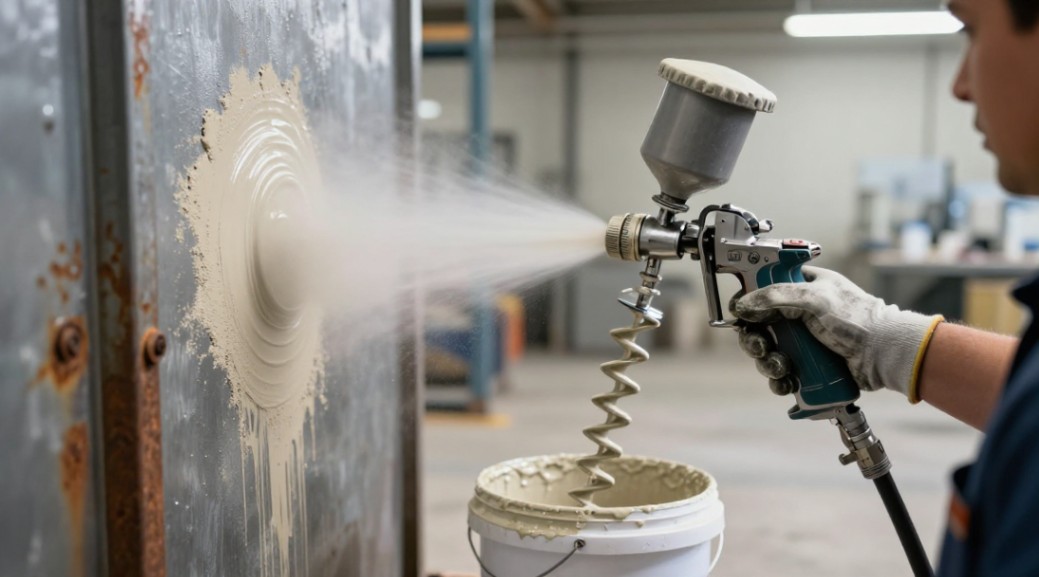
Third, cure it with heat, not hope. Air drying forms a weak gel. True strength requires heat curing. For a robust coating, bake the applied paint. Ramp to 250-300°C and hold for 30-60 minutes. This drives off residual water and initiates the chemical bonding. In the field, the first few operational heat cycles complete the process.
What about safety? Isn’t potassium silicate caustic?
Yes, the liquid binder is alkaline (pH 11-12.5). This isn’t a latex paint. Wear gloves and eye protection. Control dust when sanding cured coatings. The finished, cured ceramic coating is inert and non-toxic. This is a trade-off: you handle a safe chemical during application to create a coating that emits zero harmful fumes in service.
Where does this actually work in the real world?
- Exhaust Systems: Diesel engine manifolds, turbocharger housings.
- Industrial Furnaces: Internal heat shields, burner quarls.
- Power Generation: Boiler casing, ductwork, catalytic converter housings.
- Foundry Equipment: Ladles, troughs exposed to molten metal splash.
It’s not for everything. Don’t use it on aluminum or galvanized steel; the alkaline binder will attack the substrate.
Formulation Tip: The Biggest Mistake Everyone Makes
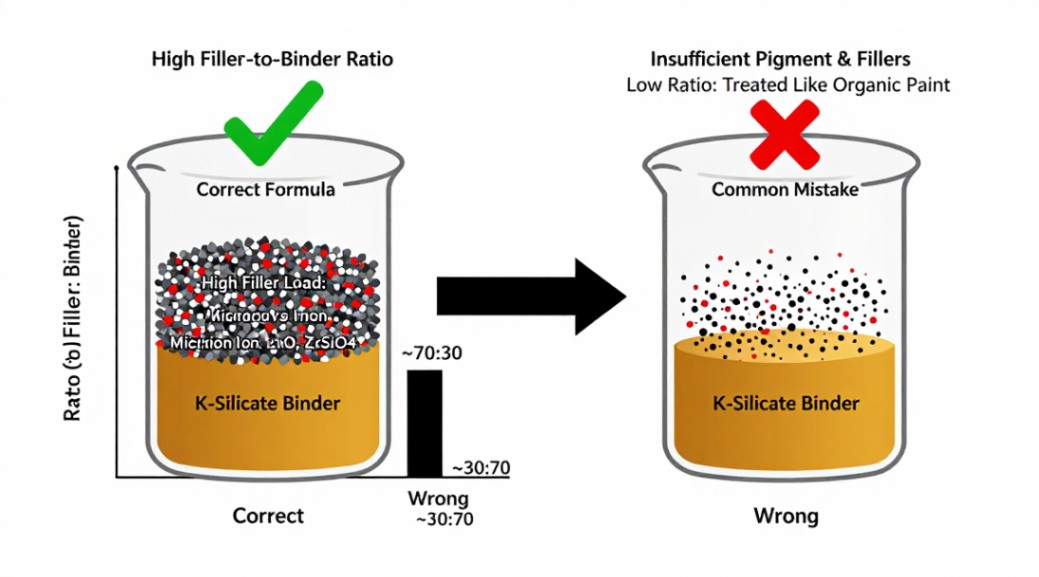
People under-pigment. They treat it like an organic paint. Wrong. You need a high filler-to-binder ratio. Load it with thermally stable opacifiers and reinforcing agents like micaceous iron oxide, zinc oxide, or ceramic-grade zirconium silicate. The pigment particles are the body; the potassium silicate is the skeleton. Getting this ratio wrong is why most DIY attempts fail.
The Final Firing Order: What To Do Next
Stop experimenting with failing organic mixes. If you’re protecting metal above 450°C, the inorganic path is the only rational choice. Get a small batch of a proven potassium silicate for high temperature paints base binder. Run a pilot test on a scrap piece of your actual substrate. Follow the steps: blast, spray, cure. Prove it to yourself. The long-term performance-resistance to corrosion under insulation, zero VOC emissions, and lifespan measured in years, not months-is the only justification you need.
Supplier
We are the global leader in lightweight concrete and advanced engineered foam solutions. Known globally for its commitment to research, innovation, and applied expertise, we have been providing engineered foam solutions since the early 2012’s.
We can supply high-quality concrete admixture and foam concrete related products all over the world.
The company has a professional technical department and quality supervision department, a well-equipped laboratory, and equipped with advanced testing equipment and after-sales customer service center.
If you are interested, please feel free and contact us.