Concrete-mesa | Concrete Admixtures, Tools, and Production Machines

Stop Air from Ruining Your Waterproofing: The No-Fluff Guide to Defoamers for Cementitious Coatings
Selecting the right defoamer for cementitious waterproofing coatings is a non-negotiable first step that most contractors get wrong. They treat it as an afterthought, a magic potion to fix a frothy bucket. That’s a mistake you can’t afford. The right defoamer doesn’t just remove bubbles; it directly dictates the final density, waterproof integrity, and surface finish of your coating. Get this wrong, and you’re not applying waterproofing-you’re installing a network of future leaks. Let’s strip away the marketing nonsense and talk about what actually works.
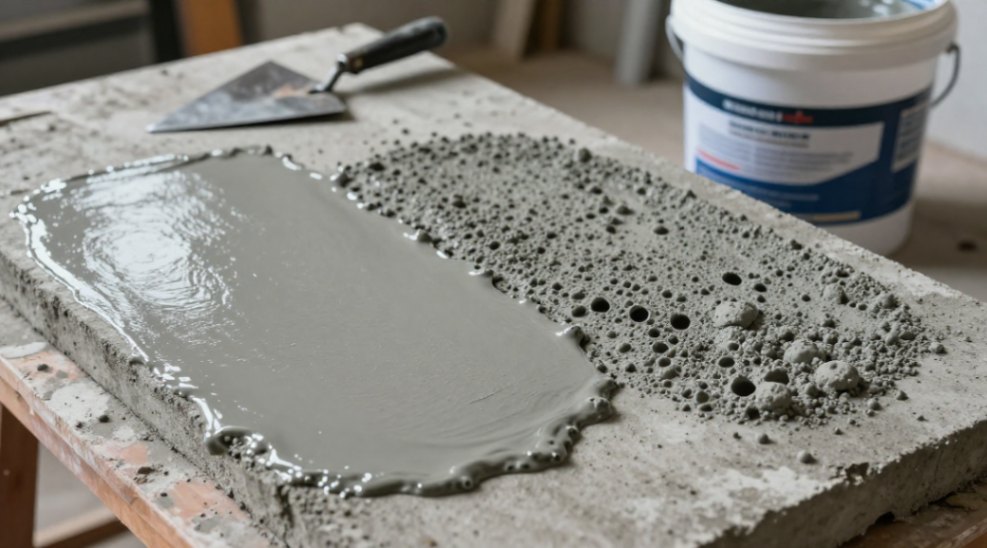
The Unseen Enemy: Why Air is Your Coating’s Worst Nightmare
Think of your freshly mixed coating. Surfactants from dispersants, thickeners, and polymers are working hard. They lower surface tension, making application easier. But they also trap air. During high-shear mixing and application, this air gets beaten into a stable foam. This isn’t benign. Each bubble is a void. When the coating cures, these voids become permanent defects. Pinholes. Craters. A sponge-like matrix. Waterproofing is about creating a monolithic, impermeable barrier. Foam guarantees you fail. I’ve seen projects where crews blamed the cement or the additive, only to find their tank-mixed slurry was 30% air by volume. The coating was doomed before it left the drum.
Demystifying the Chemistry: It’s Not Just “Anti-Foam”
Defoamers work through two brutal, physical mechanisms: bridging and spreading. A defoamer droplet enters the bubble wall. Its low surface tension causes it to spread rapidly, destabilizing the film and causing rupture. The chemistry defines its personality. Mineral oil-based defoamers are the old workhorses-cost-effective but can migrate or lose effectiveness over time. Silicone-based defoamers are powerful, often too powerful; a slight overdose can cause fish-eyes and cratering, killing adhesion. The advanced players are polymer-based. These are engineered for compatibility, offering persistent defoaming without the surface defects. Forget brand loyalty. Your choice hinges on your specific formulation’s surfactant package.
The Three-Step Protocol for Flawless Incorporation
This is where theory meets the trowel. Adding defoamer incorrectly is as bad as using the wrong one.
Step 1: Pre-Dilution is Non-Optional. Never add a concentrated defoamer directly into a high-shear mixer. It will glob up, become inefficient, and create coating inhomogeneity. Dilute it first. For a powder defoamer, pre-blend it with a small portion of your cement or filler powder. For a liquid, dilute it with the non-aqueous portion of your liquid additives or a compatible solvent like propylene glycol. A 1:5 or 1:10 dilution is typical. This ensures even distribution.
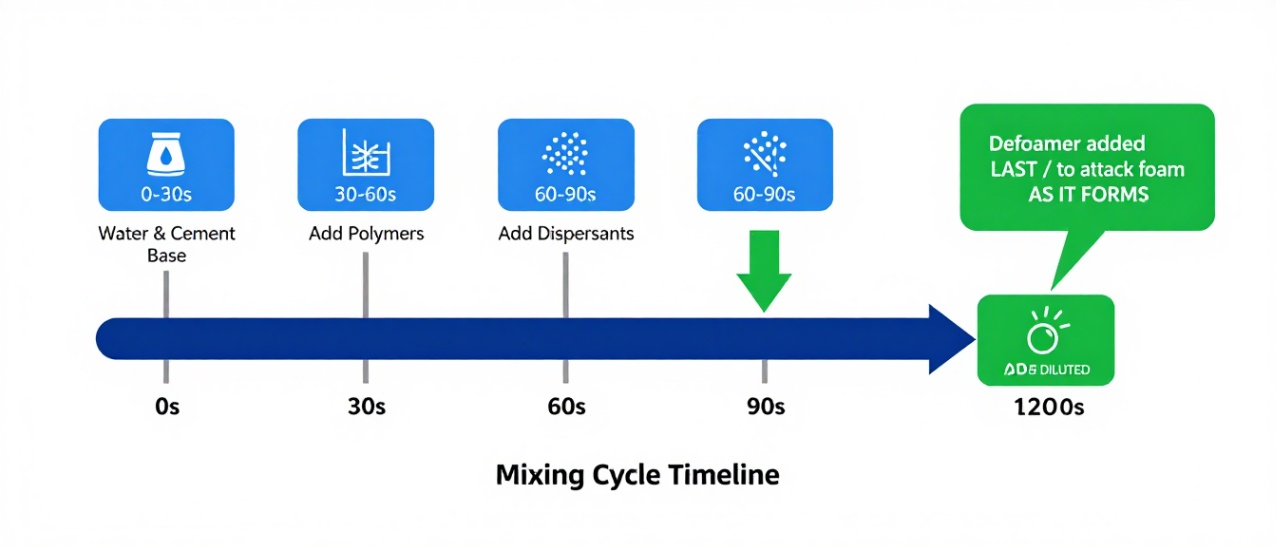
Step 2: Time the Addition Perfectly. Add your diluted defoamer late in the mixing cycle, after all other liquid components (polymers, dispersants) are in. Why? Because these other additives are the foam generators. Adding the defoamer last allows it to attack the foam as it’s being created, not after a stable foam structure has already formed. For batch mixing, add it in the final 60-90 seconds.
Step 3: Dose with Precision, Not Hope. Start at 0.1% to 0.3% by total weight of the liquid components. This is a starting point, not a rule. On Reddit and contractor forums, a common complaint is “the defoamer worked in the bucket but pinholes appeared during curing.” That’s a classic sign of under-dosing. The defoamer killed the big foam but lacked the persistence to handle microfoam released during setting. Conduct a simple density test: mix your standard batch, pour it into a graduated cylinder, note the volume, then let it de-aerate. The density increase tells you your air content. Adjust the dose until the wet density is within 2% of the theoretical, air-free density.
Navigating the Trade-Offs: Density, Finish, and Long-Term Bond
A perfectly de-aerated coating is denser. This improves compressive strength and reduces permeability-the core goals. But here’s the counterintuitive part: removing all air can slightly reduce workability and impact the coating’s ability to bridge hairline cracks. You’re trading absolute impermeability for some stress-relief capability. My rule? For below-grade tanks and blind-side applications, maximize density. For above-grade plazas or decks with movement, accept a minimal, controlled air content for flexibility. Furthermore, the wrong defoamer can plate out on the substrate. This creates a weak boundary layer. Always test adhesion-pull-off tests are mandatory-with your full system, including the defoamer, before a large-scale pour.
Cutting Through the Hype: Your Selection Checklist
Ignore data sheets that only talk about “foam reduction.” You need answers to these questions:
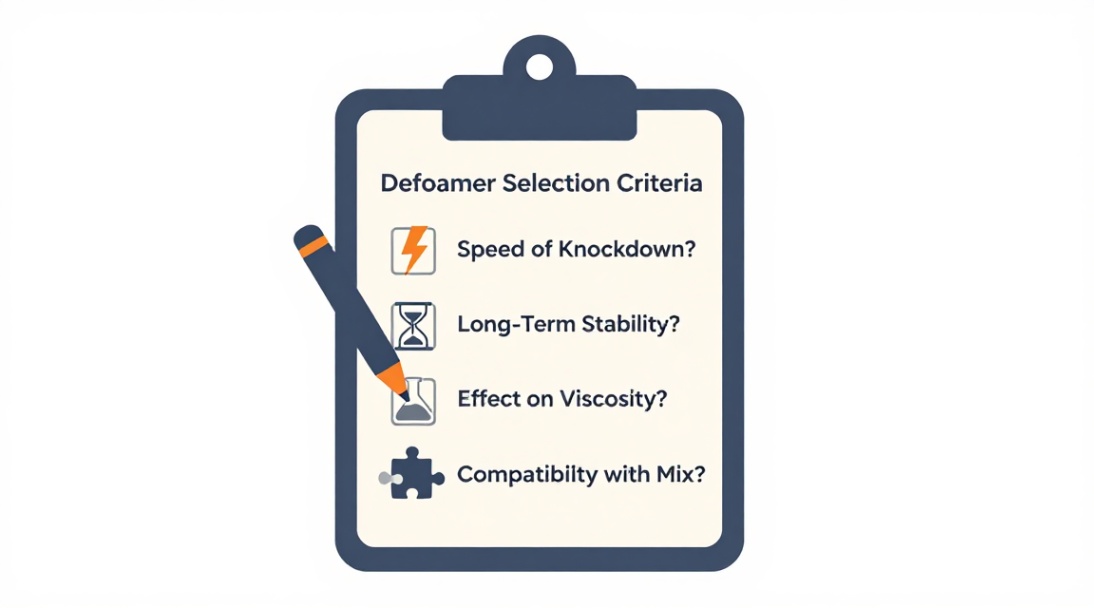
- Compatibility: Does it cause separation, seeding, or viscosity change in your specific blend after 24 hours of storage?
- Persistence: Does it work only during mixing (knock-down) or continue to work during application and curing (long-term effectiveness)?
- Surface Impact: At a 50% overdose, does it cause craters or pinholing? A robust defoamer has a wide safe dosing window.
- Standard Tests: Does it perform in ASTM C869/C869M (for grouts) or similar density/air-content tests relevant to coatings?
The industry norm is to buy a generic defoamer. Break the norm. Treat the defoamer for cementitious waterproofing coatings as a performance-defining raw material, not a commodity. Test it as rigorously as your polymer. Demand sample quantities and run full-scale mock-ups. The difference between a 20-year warranty and a callback lawsuit often sits in that small, unassuming bottle of defoamer. Your next step isn’t to buy a product. It’s to take your current formulation, mix three batches with three different defoamer types at two dosage levels, and document the density, finish, and adhesion. The data won’t lie.
Supplier
We are the global leader in lightweight concrete and advanced engineered foam solutions. Known globally for its commitment to research, innovation, and applied expertise, we have been providing engineered foam solutions since the early 2012’s.
We can supply high-quality concrete admixture and foam concrete related products all over the world.
The company has a professional technical department and quality supervision department, a well-equipped laboratory, and equipped with advanced testing equipment and after-sales customer service center.
If you are interested, please feel free and contact us.