Concrete-mesa | Concrete Admixtures, Tools, and Production Machines

The Nano-Silica UHPC Trap: Avoid These 5 Costly Mistakes in Your High-Stakes Projects
The Promise and the Peril
Last year, a project manager for a major infrastructure firm watched a multi-million dollar test pour self-destruct. The Ultra-High Performance Concrete mix, modified with a premium nano-silica modifier, seized up in the truck. The crew added water. The mix regained fluidity for ten minutes, then permanently hardened. The resulting block of concrete, riddled with weak pockets and honeycombs, had a compressive strength 40% below specification. The culprit wasn’t the nano-silica itself. It was how it was used. This isn’t an isolated incident. I’ve spent two decades navigating the fine line between breakthrough performance and catastrophic failure with advanced concrete modifiers. Let’s ensure your project doesn’t become a cautionary tale.

Warning 1: Treating Nano-Silica Like Silica Fume
This is the single most common and dangerous mistake. Silica fume particles measure in microns. Nano-silica particles are 50 to 100 times smaller. This difference is not linear. It’s exponential in its impact on the cementitious matrix. You cannot substitute one for the other and expect a predictable outcome. The wrong choice will either fail to deliver the required performance spike or create a rheological disaster that no amount of superplasticizer can fix. The key distinction lies in their mechanism. While both are pozzolanic, nano-silica’s primary power comes from its filler effect, packing into spaces between cement grains that other materials cannot reach.
Critical Parameter Comparison: Nano-Silica vs. Traditional Modifiers
To visualize the trap, here’s a breakdown of how key UHPC properties respond to different modifiers. Note the narrow optimal band for nano-silica for ultra high performance concrete.
| Property / Modifier | Nano-Silica (Optimal Dosage) | Silica Fume (Standard) | Over-dosed Nano-Silica (>4%) |
|---|---|---|---|
| Primary Action | Pore Refinement & CH Consumption | Pozzolanic Reaction | Particle Agglomeration |
| Workability (Slump Flow) | Sharp initial drop, manageable with SP | Moderate drop | Rapid, irreversible loss |
| Early Strength (24h) Gain | +20-35% | +10-15% | Unpredictable, often lower |
| Ultimate Compressive Strength | +15-25% | +10-20% | Plateaus or decreases |
| Key Risk | Dispersion & Dosage Precision | Consistent supply quality | Weak points, wasted material |
Warning 2: Neglecting the Mixing Protocol
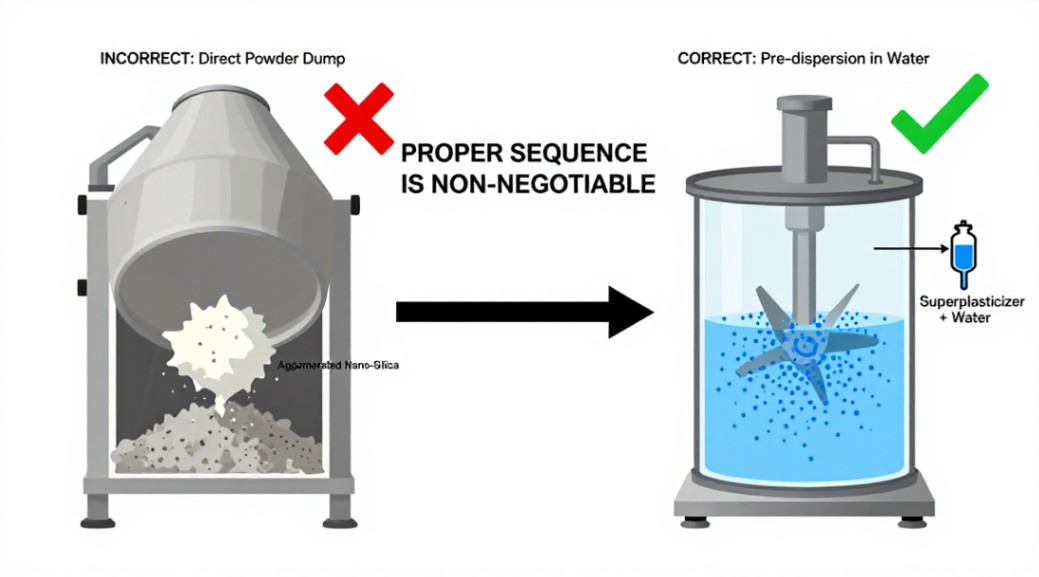
You cannot simply dump nano-silica powder into a ready-mix truck and expect a miracle. Many lab technicians on forums like ResearchGate have reported failed replications of published studies for this exact reason. The nanoparticles possess massive surface energy. They want to clump together. Agglomerated nano-silica acts as a defect, not a reinforcement. You must use a high-shear mixer. The correct sequence is non-negotiable: disperse the nano-silica in the mixing water, often with a portion of the superplasticizer, before introducing cement and other solids. This ensures you activate the particles’ surface, not create dry lumps that will never disperse.
Warning 3: Ignoring the Superplasticizer Relationship
Adding a nano-silica modifier changes everything. The nano-silica’s enormous surface area will adsorb a significant portion of your polycarboxylate-based superplasticizer (PCE). If you do not adjust the PCE dosage upward by 0.2-0.5% (by weight of binder), you will lose all workability. However, here is the counter-intuitive warning: do not over-compensate. Excess PCE can lead to severe segregation and bleeding in UHPC, especially with high steel fiber content. You must find the new equilibrium point through trial batches. Many failed field applications trace back to this uncalibrated interaction.
Warning 4: Chasing Dosage Without Data
More is not better. The optimal dosage for most nano-silica in UHPC applications lies between 1% and 3% by weight of cement. Exceeding 4% typically yields diminishing returns or negative effects. Strength gains plateau as agglomeration increases. More critically, autogenous shrinkage can skyrocket, leading to early-age microcracking that compromises the very durability you sought to enhance. You are not buying bulk filler. You are introducing a reactive, precision nano-technology. Base your dosage on a performance target-be it 24-hour early strength for rapid repair or chloride resistance for a marine environment-not on a vague hope for “maximum strength.”
The Path to Success
Avoiding these pitfalls requires a methodical approach. First, source a colloidal nano-silica suspension if possible; it bypasses the dry dispersion challenge. Second, treat every new project formulation as a unique experiment. Run a full factorial design of small-scale tests to map the interaction between your specific cement, PCE, fibers, and nano-silica. Third, implement strict quality control on the batching sequence. Document every step. The goal is to leverage nano-silica’s power to refine the microstructure, producing a concrete that is not just strong, but predictably and durably so across the entire structure. For those specifying materials, a reliable, professionally pre-formulated nano-silica enhanced UHPC mix design can be a safer starting point than attempting in-house modification without dedicated expertise. Consult with specialists who can provide validated mix protocols and technical data sheets specific to your project’s requirements.
Supplier
We are the global leader in lightweight concrete and advanced engineered foam solutions. Known globally for its commitment to research, innovation, and applied expertise, we have been providing engineered foam solutions since the early 2012’s.
We can supply high-quality concrete admixture and foam concrete related products all over the world.
The company has a professional technical department and quality supervision department, a well-equipped laboratory, and equipped with advanced testing equipment and after-sales customer service center.
If you are interested, please feel free and contact us.