Concrete4U | Concrete Admixtures, Tools, and Production Machines

Why Your Next Formulation Demands Pharmaceutical Grade Hydroxyethyl Cellulose
From Lab Bench to Patient: A Story of Precision
Twenty years ago, I watched a promising clinical trial formulation fail stability testing. The active ingredient was fine. The concept was sound. The culprit? An inconsistent viscosity modifier. The gel separated, and the project stalled. That moment cemented a hard truth: in pharmaceuticals, the so-called ‘inactive’ ingredients are often the most active determinants of success. This is where pharmaceutical grade hydroxyethyl cellulose enters the conversation-not as a commodity, but as a precision instrument.

Defining the Standard: Pharmaceutical Grade vs. The Rest
Not all HEC is created equal. The distinction between pharmaceutical, industrial, and cosmetic grades is profound. Industrial grade prioritizes cost and bulk performance. Cosmetic grade focuses on sensory feel. Pharmaceutical grade is governed by a different mandate: predictable, reproducible, and pure performance in a system where human health is the ultimate metric. It adheres to stringent compendial standards like the United States Pharmacopeia (USP/NF) and the European Pharmacopoeia (Ph.Eur.). These monographs dictate everything from heavy metal limits and microbial counts to specific identification tests. For a formulator, this means you are not just buying a polymer. You are buying documented compliance and a reduced regulatory burden.
The Core Functional Trinity: Binder, Thickener, Stabilizer
Pharmaceutical grade HEC excels through a combination of core functions. As a binder in tablet wet granulation, it promotes cohesive compact formation. Its binding strength is sufficient yet not excessive, aiding in tablet disintegration and drug release. As a thickener and stabilizer in liquid and semi-solid formulations, it provides the structural viscosity that prevents active particles from settling or creams from separating. Its pseudoplastic behavior-thinning under shear and recovering viscosity at rest-is crucial. Think of an ophthalmic solution: it must be thin enough to dispense from a dropper, yet thick enough to coat the eye and resist blinking. Only a material with precise, predictable rheology can achieve this.
Performance Beyond Basic Specs
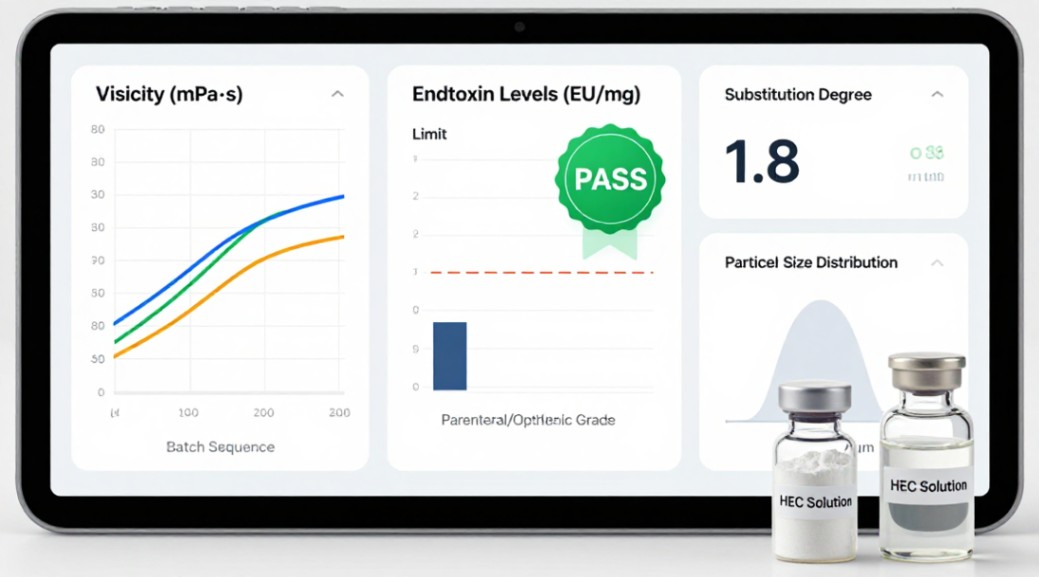
Viscosity is just a starting point. True performance lies in the details. Consistency across batches is non-negotiable. A single lot-to-lot variation can alter drug release profiles. Solubility in both cold and hot water is a key advantage, simplifying manufacturing. Perhaps most critical is the purity profile, specifically low endotoxin levels for parenteral or ophthalmic use. Your Certificate of Analysis (CoA) is your guarantee. You must scrutinize it for parameters like substitution degree (affecting solubility), particle size (affecting dissolution rate), and of course, the viscosity of a defined solution.
Strategic Applications Across Dosage Forms
This versatility makes pharmaceutical grade HEC a formulator’s strategic asset.
- Solid Dosage Forms: In tablets and capsules, it acts as a binder, typically used at 2-5% w/w. It produces robust granules while maintaining favorable disintegration times.
- Liquid & Semi-Solid Systems: In ophthalmic solutions, artificial tears, and topical gels, concentrations from 0.5% to 2.5% provide lubrication, prolonged residence, and stability. It is a cornerstone of clear, elegant gels.
- Modified-Release Systems: Its ability to form hydrated gels makes it a valuable component in matrix tablets for sustained release. By modulating the polymer grade and concentration, you can engineer release profiles spanning hours.
The Sourcing Imperative: Your First Critical Decision
Selecting a supplier is the first formulation decision you make. You must qualify them. Audit their quality management systems. Insist on Drug Master Files (DMF) or equivalent regulatory support documents. The ideal supplier provides more than a bag of powder; they provide traceability, exhaustive documentation, and technical partnership. They understand that their material is the foundation of your product’s safety and efficacy. Compare pharmaceutical grade HEC to other cellulose ethers like hypromellose (HPMC). While HPMC offers different solubility and gelation temperatures, HEC often provides superior clarity in solutions and a more neutral interaction profile with actives and electrolytes. The choice hinges on your specific performance needs.
A Material of Trust
Pharmaceutical grade hydroxyethyl cellulose is a quiet workhorse. Its safety profile is excellent, with widespread acceptance in global pharmacopoeias. Typical use concentrations are well-established and low-risk. But its true value is trust. Trust in its purity. Trust in its consistency. Trust that it will perform exactly as it did in your development trials when scaled to commercial batches. In a world of complex drug molecules and delicate delivery systems, this reliable, multifunctional polymer is not just an excipient. It is a fundamental enabler of therapeutic performance. Master its specifications, and you master a key variable in your formulation’s success.
Supplier
We are the global leader in lightweight concrete and advanced engineered foam solutions. Known globally for its commitment to research, innovation, and applied expertise, we have been providing engineered foam solutions since the early 2012’s.
We can supply high-quality concrete admixture and foam concrete related products all over the world.
The company has a professional technical department and quality supervision department, a well-equipped laboratory, and equipped with advanced testing equipment and after-sales customer service center.
If you are interested, please feel free and contact us.