Concrete-mesa | Concrete Admixtures, Tools, and Production Machines

The High Viscosity HPMC Trap: Why Your Concrete is Cracking and Mortar is Sagging
Your Data is Lying to You: The Uncomfortable Truth About ‘Premium’ HPMC
Manufacturer data sheets tout incredible viscosity numbers, like 100,000 mPa·s. It feels premium. It commands a higher price. So you spec it for everything-tile adhesive, mortar, plaster. This is a critical error. Lab viscosity has a tenuous, often inverse, relationship to real-world performance. One stubborn fact: a well-formulated, mid-grade HPMC often outperforms a poorly applied ultra-high-grade one. Here’s what you’re getting wrong.
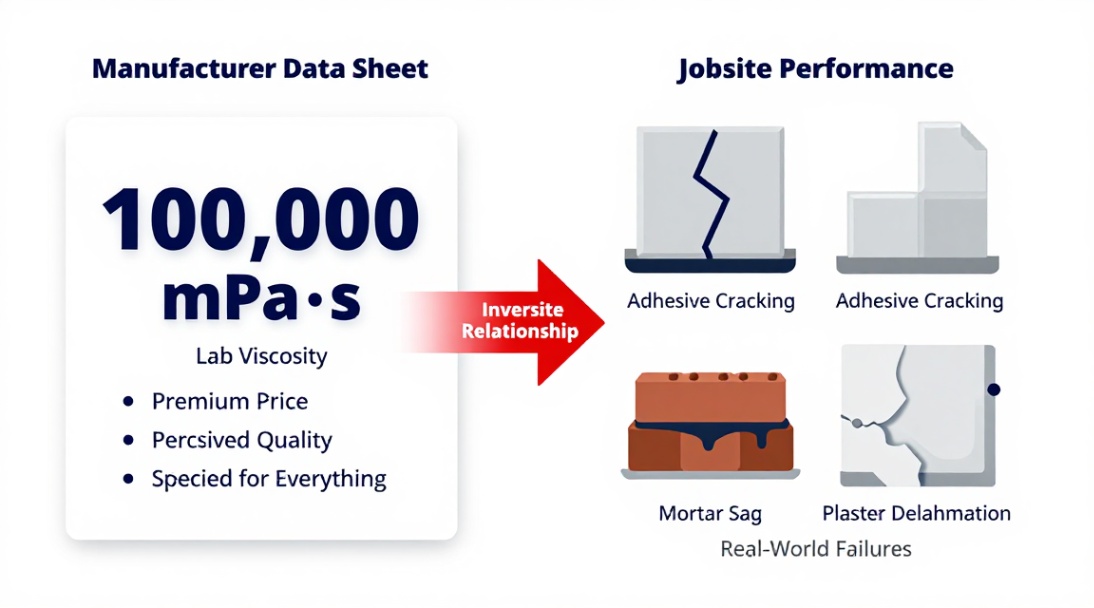
Mistake #1: The “Max Viscosity” Fallacy in Mortars and Plasters
You think high viscosity equals superior water retention. This is only half true. Water retention depends on film formation and hydration kinetics, not just thick soup. An overly viscous mix traps air, creates poor particle packing, and yields a weak, porous final structure.
What Reddit Users Really Say
“Our crew switched to a ‘super high-visc’ HPMC for render. Workability tanked. It was like spreading cold glue. We lost two days scraping it off.” This is a common refrain. The goal is optimal rheology, not maximum viscosity.
- NEVER assume a 100,000 mPa·s grade is ‘better’ than a 60,000 grade for standard applications.
- ALWAYS prioritize the right viscosity window for your sand gradation and cement type.
- WARNING: Ultra-high viscosity HPMC can drastically reduce yield, making your mix uneconomical and difficult to pump.
Mistake #2: Killing Sag Resistance in Tile Adhesives
High viscosity HPMC for construction chemicals provides essential body and anti-sag. But overdose it, and you create a false security. The adhesive feels thick, so you apply it thinner. Bad move. Sag resistance comes from a balance of viscosity, water retention, and polymer-modified cohesion (often from Redispersible Polymer Powder – RPP).
The Synergy You’re Ignoring
HPMC and RPP are partners. HPMC provides lubricity and water retention; RPP provides tensile strength and adhesion. A brutal truth: if you’re relying solely on HPMC viscosity to fight sag on large-format tiles, your formulation is already failing. The high viscosity can actually impede proper wetting and keying of the RPP film.
- NEVER compensate for a lack of RPP by jacking up HPMC viscosity.
- ALWAYS test the open time and adjustability as a system, not just initial grab.
- WARNING: Thixotropy is more important than static viscosity. Your adhesive must be smooth to trowel yet hold its shape.
Mistake #3: The Lumpy, Unmixable Disaster
High viscosity HPMC powders are notorious for forming fish-eyes and gelatinous lumps if introduced incorrectly. You cannot just dump it into the mixer. These lumps become permanent weak points, hidden until the wall cracks.
The Non-Negotiable Mixing Protocol
This isn’t a suggestion; it’s a requirement for functional material.
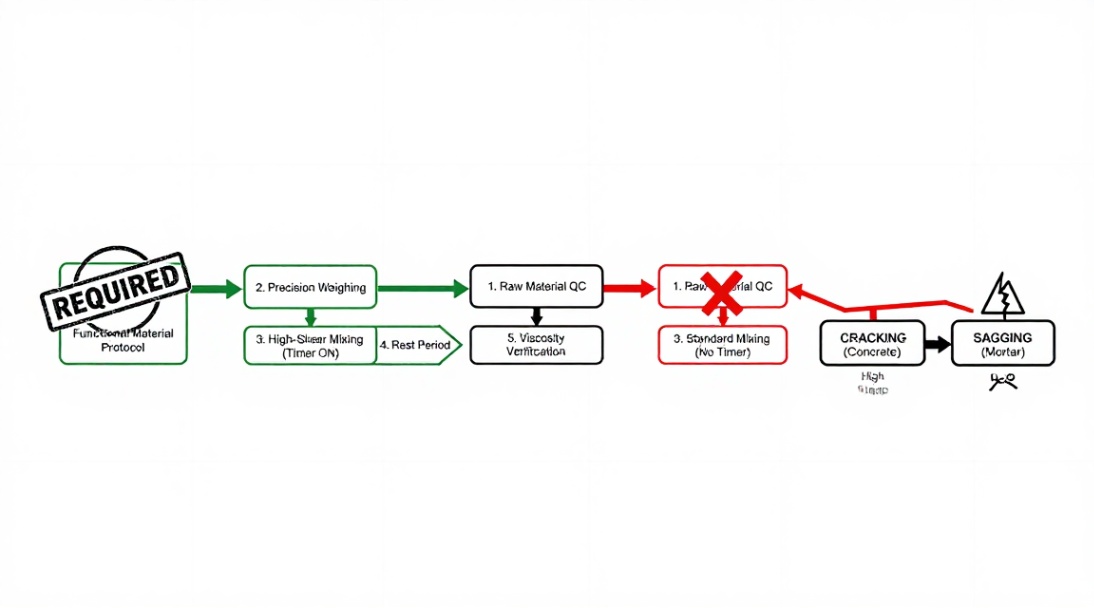
- Dry-blend the HPMC powder thoroughly with other fine powders (cement, filler) first. This dilutes it.
- Add your aggregates (sand) to the mixer, then the pre-blended powder mix.
- Start mixing with the majority of your formulation water. Never add HPMC directly to standing water.
Mistake #4: Chasing Paper Specs Over Real-World Performance
You audit a Certificate of Analysis for viscosity and ash content. Good. But are you testing the final mortar? Key specifications like gel temperature (the point at which the HPMC thermal gelation occurs) are more critical for jobsite performance in hot climates than a perfect 2% solution viscosity.
A high gel temperature HPMC maintains its viscosity and water retention in summer heat. A standard one will thin out, causing rapid slump and plaster shrinkage. Know the difference.
Mistake #5: Ignoring the Sustainability & Efficiency Angle
Using too much high viscosity HPMC is wasteful and counterproductive to green building goals. Its superior water retention should enable lower water-cement ratios, leading to higher final strength and durability. If you’re not achieving this, you’re just making expensive mud. The right grade, at the right dosage, improves mix efficiency, reduces waste, and enhances the longevity of the structure-that’s true sustainability.
The Bottom Line: Precision Over Power
High viscosity HPMC for construction chemicals is a precision tool, not a blunt force instrument. Its role is to enable superior workability, controlled hydration, and robust physical properties. Misapplied, it becomes the primary point of failure.
Stop guessing. Stop over-specifying. Your next project shouldn’t be a costly experiment. You need a partner who understands the nuance, not just a supplier pushing the highest-margin powder.

ACTION REQUIRED: Demand a technical consultation from a specialist who asks about your sand, your climate, and your application method before they ever mention a viscosity number. Let’s audit your current formulation. Submit your toughest project challenge, and we will provide a targeted analysis and a sample of the correctly specified HPMC grade for your exact needs. Click here to start the conversation.
Supplier
We are the global leader in lightweight concrete and advanced engineered foam solutions. Known globally for its commitment to research, innovation, and applied expertise, we have been providing engineered foam solutions since the early 2012’s.
We can supply high-quality concrete admixture and foam concrete related products all over the world.
The company has a professional technical department and quality supervision department, a well-equipped laboratory, and equipped with advanced testing equipment and after-sales customer service center.
If you are interested, please feel free and contact us.