Concrete-mesa | Concrete Admixtures, Tools, and Production Machines

Redispersible Powder for Flexible Cementitious Coatings: The Unconventional Truth
What is Redispersible Polymer Powder (RDP)?
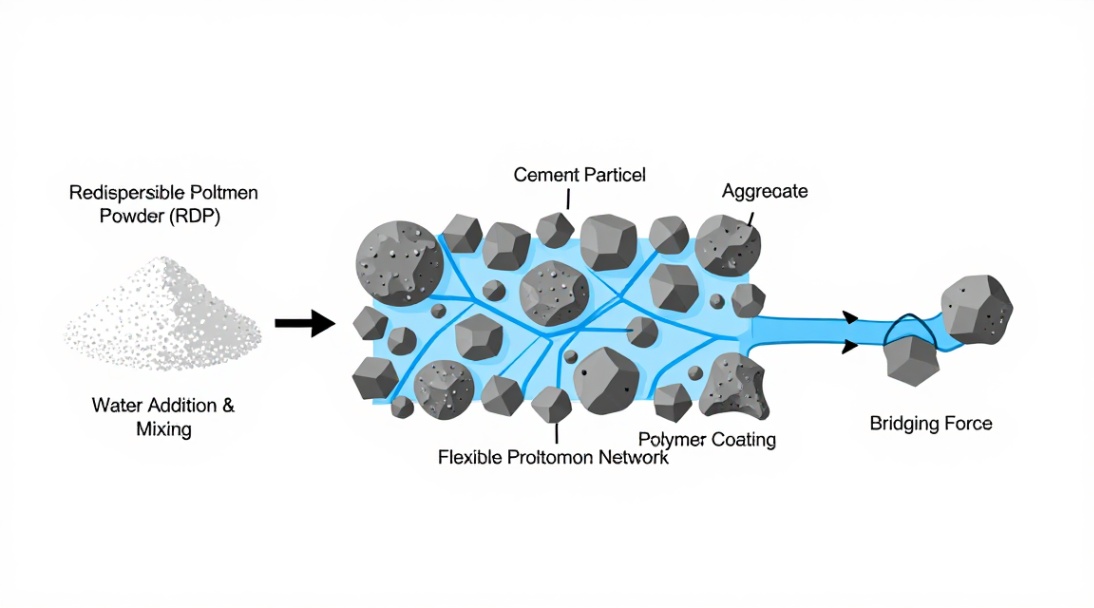
Redispersible polymer powder (RDP) is a functional polymer additive for cementitious mixes. It transforms brittle cement into a tough, flexible composite material. Forget vague “enhancements”. RDP fundamentally changes the matrix. When water hits the powder during mixing, it re-disperses into a polymer latex that coats cement particles and aggregates. After curing and drying, this latex forms a flexible, interpenetrating polymer network within the hardened cement structure. This network provides bridging forces. It is the core technology behind modern flexible cementitious coatings.
Debunking 5 Common Myths About RDP
The industry is rife with oversimplifications. Let’s set the record straight.
- Myth 1: “RDP is just glue.” Wrong. It is a system modifier. It provides cohesive strength, bridges microcracks, and improves stress distribution. Liquid adhesives cannot do this.
- Myth 2: “More RDP means more flexibility.” A dangerous misconception. Exceed the optimal dosage (typically 2-5% by weight of cement) and you compromise strength, increase cost, and can cause film formation issues.
- Myth 3: “All RDP types are the same.” False. The polymer base (Vinyl Acetate Ethylene, Styrene Acrylic) dictates performance. VAE offers great balance. Styrene Acrylic provides superior water resistance. Your project’s Tg requirement decides.
- Myth 4: “RDP eliminates the need for proper joint design.” No. It manages stress within the coating layer. It does not replace control joints or substrate preparation. It works with them.
- Myth 5: “Mixing procedure doesn’t matter.” Catastrophic error. Always add RDP to the dry mix first. Blend thoroughly with cement and aggregates before adding water. Adding it last creates lumps and destroys performance.
The Core Benefits: Why RDP Dominates
Redispersible powder for flexible cementitious coatings delivers a specific package of properties liquid additives cannot match.
- Crack Bridging & Flexibility: The polymer film stretches. It absorbs substrate movement and thermal stresses without brittle failure.
- Adhesion to Difficult Substrates: It bonds to concrete, wood, EPS/XPS insulation, and existing paints. The polymer film acts as a universal primer.
- Improved Abrasion & Impact Resistance: The composite is tougher. It withstands foot traffic, light vehicles, and incidental impacts.
- Water Resistance & Reduced Permeability: The polymer network blocks capillary pores. It significantly lowers water absorption, protecting the substrate and steel reinforcement.
- Enhanced Workability: It acts as a lubricant. Mortar becomes creamier, easier to trowel, and less prone to sag on vertical surfaces.
Critical Technical Parameters You Must Check
Do not buy on price alone. Demand this data from your supplier.
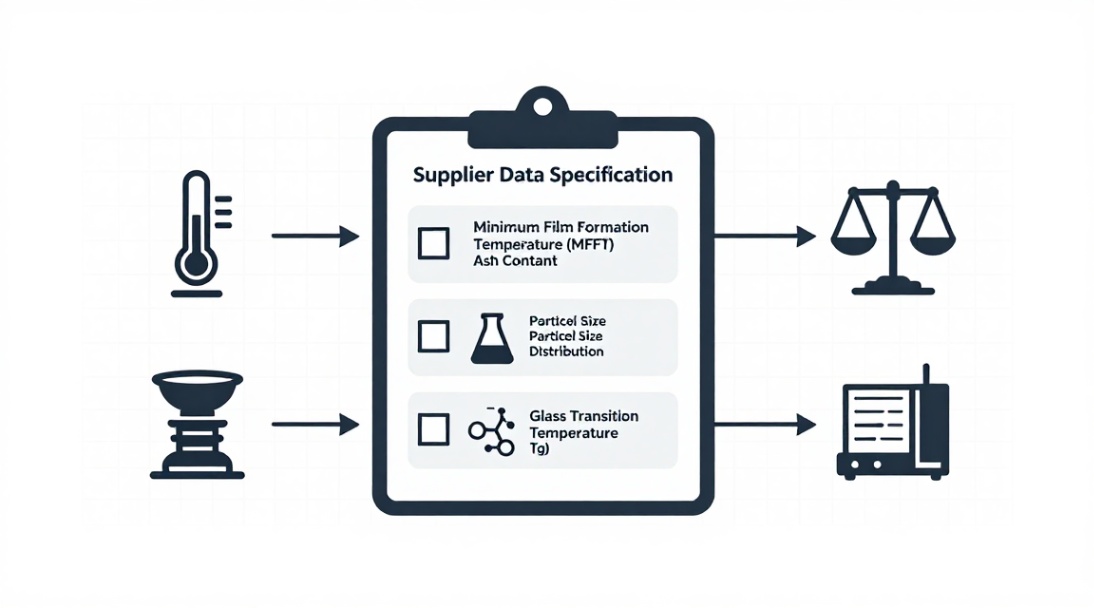
- Glass Transition Temperature (Tg): This defines flexibility. A lower Tg (e.g., -5°C to +5°C) means better low-temperature flexibility but potentially softer film. A higher Tg improves hardness and scrub resistance. Choose based on climate and application.
- Minimum Film Forming Temperature (MFFT): Can the polymer form a continuous film at your application temperature? If site temp is 5°C and MFFT is 10°C, the film will be powdery and fail. Always check.
- Ash Content: Lower is usually better. High ash content means more filler, less active polymer.
- Particle Size & Distribution: Affects dispersibility. Fine, uniform powder disperses faster and more completely.
- Protective Colloid System: Usually PVA. This affects redispersibility and final water resistance.
User Feedback & Real-World Application Scenarios
On professional forums, consensus is clear. Contractors report that specifying the correct redispersible powder for flexible cementitious coatings is the single biggest factor in preventing callback repairs. Common successful applications include:
- Concrete Bridge Decks & Parking Garages: Handles thermal cycling and live load deflection. A user on a contractor board stated, “Switched to a VAE-based RDP mix for parking deck overlays. Zero reflective cracks in 3 years, where our old formula failed in 18 months.”
- Exterior Insulation and Finish Systems (EIFS): The base coat and finish rely on RDP for crack resistance and adhesion over foam.
- Waterproofing Membranes & Tile Adhesives: Provides the essential flexibility for substrate movement and watertight integrity.
- Repair Mortars for Cracking Substrates: The repair material must be more flexible than the original concrete. RDP makes this possible.
Stop Experimenting. Use a Proven System.
Blending cement, sand, and RDP from scratch is for labs, not job sites. Inconsistent results cost money. You need a pre-designed, factory-controlled system. Our FlexCoat Pro series of one-component, polymer-modified cement powders delivers guaranteed performance. Simply add water and mix. We have solved the formulation puzzle for you.
Do not waste another dollar on failed coatings or trial mixes. Request a free 25kg sample of FlexCoat Pro for your next project. Test it against your current method. The difference in flexibility, adhesion, and workability will be obvious within the first trowel pass. Contact our technical team today to specify the correct grade (Pro-5 for standard flexibility, Pro-10 for extreme movement joints). Your reputation depends on the materials you use.
Supplier
We are the global leader in lightweight concrete and advanced engineered foam solutions. Known globally for its commitment to research, innovation, and applied expertise, we have been providing engineered foam solutions since the early 2012’s.
We can supply high-quality concrete admixture and foam concrete related products all over the world.
The company has a professional technical department and quality supervision department, a well-equipped laboratory, and equipped with advanced testing equipment and after-sales customer service center.
If you are interested, please feel free and contact us.