Concrete-mesa | Concrete Admixtures, Tools, and Production Machines

3 Industry Truths About Early Strength Additives You Won’t Find in the Datasheet
A Cold Lesson in Timing
Years ago, I was on a bridge deck repair project in late fall. The schedule was tight. The temperature was dropping. We used a standard high performance concrete early strength additive to accelerate our set. It worked – too well. We got our strength in 12 hours, but a network of fine cracks appeared within days. We had confused speed with performance. That project taught me that these additives aren’t just a ‘go faster’ button. They are precision tools for a complex material. Today, their use is surging, but the underlying reasons are shifting. Let’s look at why.

1. The Real Driver Isn’t Just Speed, It’s Economic Pressure
Everyone talks about faster formwork removal. That’s the obvious benefit. But the data points to a deeper trend. A 2023 industry report from the Global Concrete Alliance highlighted a 40% increase in specifications requiring high early-age strength for precast elements. Why? The economics of modern construction have changed.
- Factory Efficiency: Precast plants are throughput machines. Cutting cure times from 24 hours to 8 means you can triple your mold usage. This directly lowers capital cost per unit.
- Risk Mitigation: In fast-track commercial projects, a single day’s delay can cascade into six-figure penalties. Early strength isn’t a luxury; it’s a schedule insurance policy.
- Labor Optimization: It allows crews to pour in the afternoon, strip and set the next morning, and maintain a predictable, efficient workflow. This predictability is now more valuable than raw speed.
As Dr. Elena Martinez, a materials specialist, noted recently: ‘We’re not just accelerating concrete. We’re accelerating the entire financial model of a project.’
2. The Chemical Mechanisms Tell a Story of Trade-Offs
Understanding how these additives work explains why my bridge deck cracked. You can’t bypass chemistry.
The Classic: Chloride-Based Accelerators
Calcium chloride is the old standard. It works by drastically increasing the rate of silicate hydration. It’s effective and cheap. But we all know the rule: never use it with embedded steel. The corrosion risk is real and well-documented. Its role is now largely confined to non-reinforced applications like sidewalks in cold weather, and its use is declining.
The Modern Standard: Non-Chloride Accelerators
These are typically nitrate, nitrite, thiocyanate, or alkanolamine based. They offer a more balanced acceleration of both silicate and aluminate phases. The key insight here? They provide strong early strength, but you must watch the dosage. Overdosing can lead to:
- Excessive, rapid heat generation.
- Increased drying shrinkage (the cause of my cracking).
- A potential reduction in the final 28-day strength if not formulated correctly.
The Niche Player: Nucleation Seeds
This is a fascinating trend. These additives, like specific forms of calcium silicate hydrate, don’t participate directly in the reaction. Instead, they act as ‘seed’ particles, giving the hydration products a perfect place to start growing. Think of it as providing a template for strength. The result is often a more uniform microstructure and better long-term durability alongside early strength. They are gaining traction in high-stress applications where durability is as critical as day-one strength.
3. Application Dictates Formulation – A Decision Matrix
Choosing the right high performance concrete early strength additive is a series of calculated decisions. There is no universal best choice.
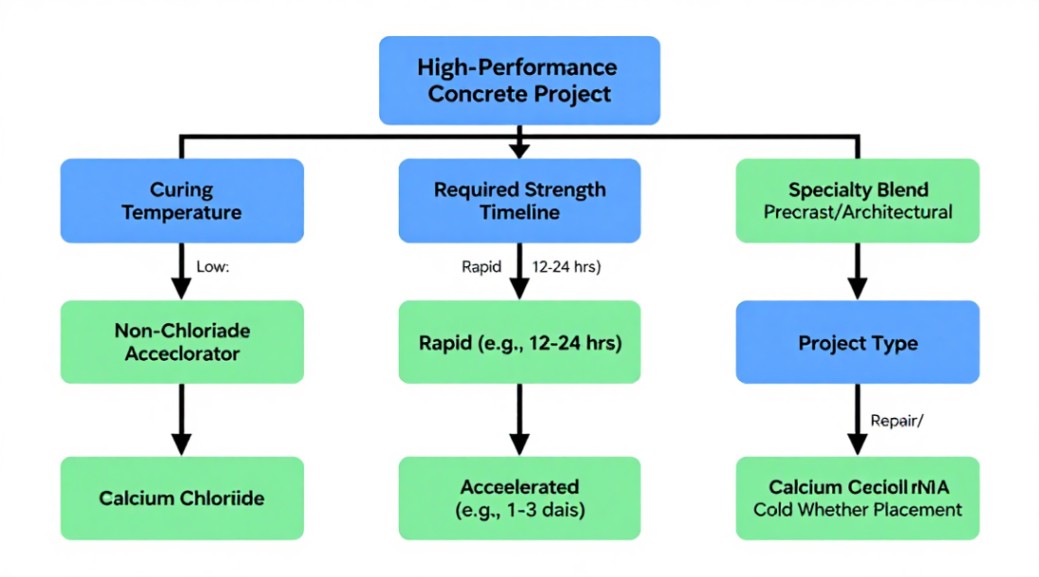
Here’s a simplified framework we use when advising teams:
| Application Area | Primary Goal | Recommended Additive Type | Critical Watch-Out |
|---|---|---|---|
| Precast Production | Maximize mold turnover, achieve demolding strength in 8-12 hours. | Non-chloride accelerator (alkanolamine or nitrate-based). | Ensure compatibility with superplasticizers. Monitor heat evolution. |
| Cold Weather Concreting (above -5°C) | Prevent freezing, achieve safe strength before thermal cycles. | Non-chloride accelerator, often combined with a water reducer. | Never use chloride. Pair with proper insulation, not just the admixture. |
| Fast-Track Slabs & Floors | Early strength for post-tensioning or loading (18-24 hours). | Combination: Mid-range water reducer + non-chloride accelerator. | Control shrinkage. Use shrinkage-reducing admixtures if needed. |
| High-Durability Repairs | Rapid return to service without compromising longevity. | Nucleation seed technology or specialty rapid-setting cements. | Requires meticulous surface prep. Often a proprietary system. |
4. The Non-Negotiable Protocol for Success
Failure almost always comes from deviating from a disciplined process. Here is the bare-minimum protocol we enforce.
Dosage & Batching is Everything
The dosage is not a suggestion. It’s a prescription.
- Measure by Volume, Not Guesswork: Dosage is typically 1-3% by weight of cementitious material. Use a dedicated dosing pump or calibrated measuring container.
- Batching Order Matters: Add the early strength additive to the mixing water, or with the initial water charge. Never dump dry powder on top of mixed concrete.
- Mix, Then Mix Again: Ensure a minimum of 90 seconds of mixing after admixture addition for full dispersion.
Testing is Your Proof, Not a Formality
You cannot eyeball concrete strength. Your quality control plan must include:
- Job-Specific Trial Batches: Before the pour, test your exact mix design with the chosen additive at the planned dosage. Cast cylinders.
- Early-Age Testing: Break cylinders at your target time (e.g., 12, 18, 24 hours) to verify you hit the required psi or MPa.
- Final Strength Check: Always test 28-day strength to ensure ultimate performance wasn’t sacrificed.
Follow ASTM C494 / C1581 or equivalent EN standards for testing performance. Your supplier’s data sheet is a starting point, but your site conditions are the final authority.

Moving Forward with Confidence
The trend is clear: high performance concrete early strength additive technology is becoming more sophisticated and more specialized. The old ‘one-size-fits-all’ accelerator is obsolete. Success lies in matching the chemical mechanism to your specific economic and performance goals, then executing with precision. Start with a clear objective. Is it mold turnover? Cold weather protection? A fast-track schedule? Let that goal guide your selection, inform your testing protocol, and dictate your site practices. That’s how you move from just making concrete faster, to building better, more reliably, and more profitably.
Supplier
We are the global leader in lightweight concrete and advanced engineered foam solutions. Known globally for its commitment to research, innovation, and applied expertise, we have been providing engineered foam solutions since the early 2012’s.
We can supply high-quality concrete admixture and foam concrete related products all over the world.
The company has a professional technical department and quality supervision department, a well-equipped laboratory, and equipped with advanced testing equipment and after-sales customer service center.
If you are interested, please feel free and contact us.