Concrete4U | Concrete Admixtures, Tools, and Production Machines

HEC for Water Based Adhesives and Sealants: 5 Formulation Mistakes That Ruin Performance
You’re Probably Using HEC Wrong in Water-Based Formulations
That’s the harsh truth. Hydroxyethyl Cellulose (HEC) is the go-to thickener for water based adhesives and sealants, but most formulators sabotage their own work before the batch is even finished. We see the same critical errors repeated in labs and on production floors. Get these five things wrong, and your adhesive will fail. Here’s what not to do.
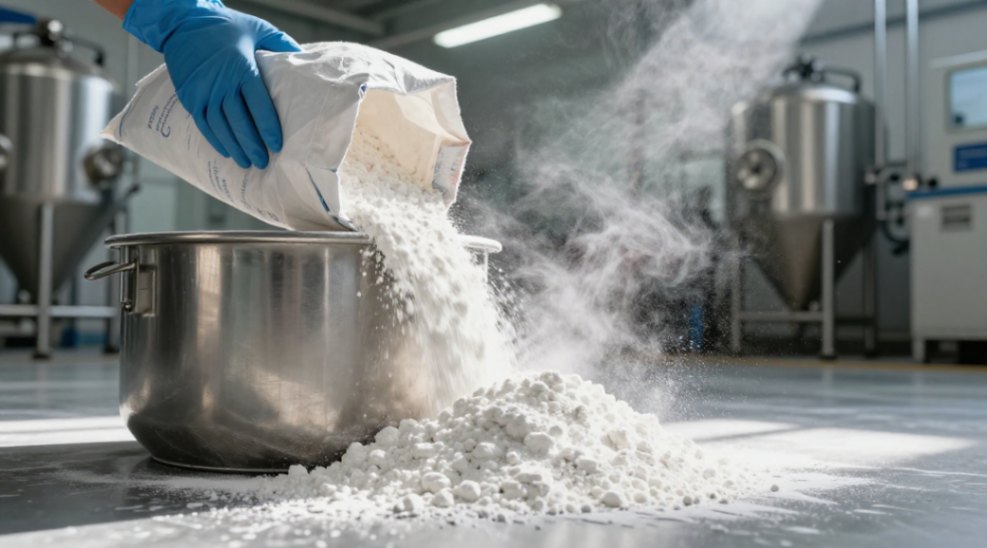
Mistake #1: Dumping HEC Powder Directly into Water
This is the cardinal sin. HEC particles hydrate on contact. Dump them in, and you create a gel-coated lump. The powder inside stays dry, floating in a slimy matrix. Your viscosity will be inconsistent. Your batch will be full of “fisheyes.” It’s a waste of material and time.
- What to do instead: Use a high-shear vortex. Start your mixer. Add HEC powder slowly to the vortex’s “eye.” The intense shear disperses each grain before it can clump. No vortex? Pre-blend HEC with a non-aqueous powder like glycol or a portion of your filler. This coats the particles and delays hydration until full dispersion.
Mistake #2: Ignoring the Viscosity Grade for Your Application
Not all HEC grades are equal. A low-viscosity grade in a gap-filling sealant will cause sag. A high-viscosity grade in a sprayable adhesive will clog nozzles. Selecting the wrong grade guarantees poor application properties.
Quick HEC Grade Selection Guide
Match the grade to the job. Think about your target viscosity and how the product will be applied.
- High-Viscosity HEC (100,000+ mPa.s): For non-sag sealants, high-build coatings, and trowel-applied adhesives. Provides exceptional stand-up.
- Medium-Viscosity HEC (30,000-60,000 mPa.s): The workhorse for general-purpose adhesives, caulks, and brushable compounds. Balances flow and body.
- Low-Viscosity HEC (5,000-15,000 mPa.s): For sprayable adhesives, thin films, and systems where easy pumping and levelling are critical.
Mistake #3: Killing Your Viscosity with High pH or Salt Too Early
HEC builds viscosity through hydrogen bonding in water. Two common formulation components destroy this: high pH (>10) and multivalent salts (e.g., calcium chloride). Adding them before HEC is fully hydrated and dissolved will permanently cripple thickening efficiency. You’ll never reach target viscosity.
- The safe sequence: 1) Disperse and fully hydrate HEC in neutral pH water. 2) Achieve your target base viscosity. 3) Only then carefully adjust pH or add ionic components. This locks in the polymer network first, protecting it.
Mistake #4: Forgetting That HEC is a Food Source
HEC is a refined polysaccharide. In a water-based system, it’s a gourmet meal for bacteria and fungi. Ignoring biocides leads to viscosity loss, bad odor, pH drift, and eventual system putrefaction. Your shelf-stable product becomes a science experiment.
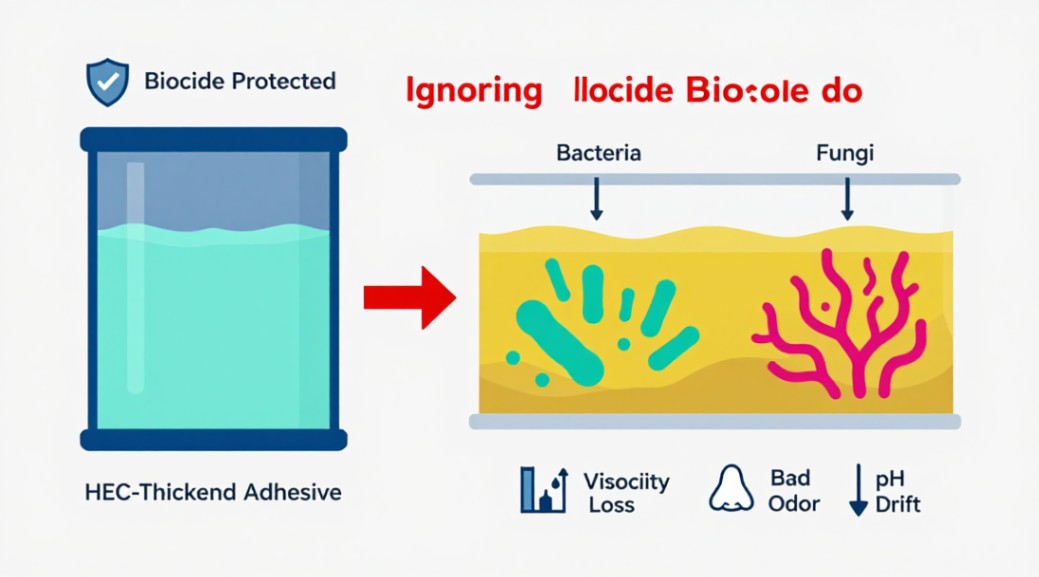
You must incorporate a broad-spectrum, compatible preservative system. Don’t just add it; ensure it’s effective at the final product pH. Test for long-term stability. This isn’t optional for water based adhesives and sealants using HEC.
Mistake #5: Assuming HEC Alone Controls Open Time
HEC excels at water retention. This slows water evaporation from the film, which can extend open time. But open time is a complex dance between evaporation, absorption, and polymer setting. Relying solely on HEC is a mistake. In porous substrates, water gets sucked away too fast.
- The strategic approach: Use HEC as the first line of defense for water retention. Then, combine it with humectants like glycols to further slow evaporation. This one-two punch gives you precise, reliable control over your adhesive’s working life.
The Right Way to Think About HEC
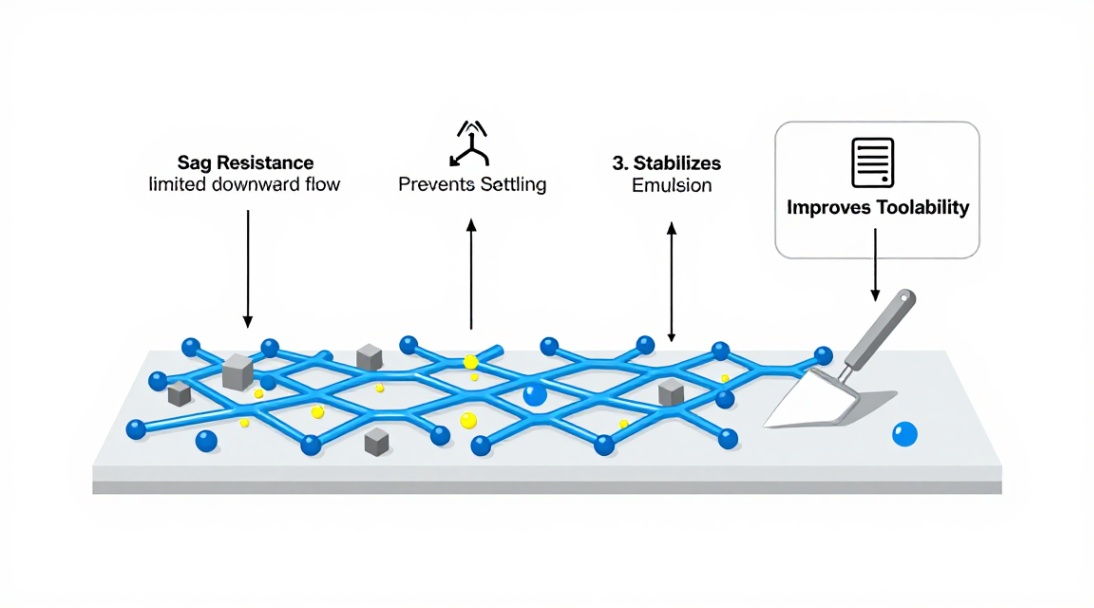
Stop treating HEC as a simple thickener. It’s a performance architect. When used correctly in water based adhesives and sealants, it builds in sag resistance, improves toolability, prevents settling of fillers, and stabilizes the emulsion. It’s cost-effective and sustainable. But its power is unlocked by method, not magic. Avoid these five pitfalls. Your formulations will become consistently reliable, high-performing, and predictable. That’s the real goal.
Now, audit your last formulation. Check your process. The fix is straightforward, and the results are immediate.
Supplier
We are the global leader in lightweight concrete and advanced engineered foam solutions. Known globally for its commitment to research, innovation, and applied expertise, we have been providing engineered foam solutions since the early 2012’s.
We can supply high-quality concrete admixture and foam concrete related products all over the world.
The company has a professional technical department and quality supervision department, a well-equipped laboratory, and equipped with advanced testing equipment and after-sales customer service center.
If you are interested, please feel free and contact us.