Concrete-mesa | Concrete Admixtures, Tools, and Production Machines

The Critical Guide to Non-Chloride Superplasticizers: Avoiding Costly Concrete Corrosion
The Hidden Danger in Your Concrete
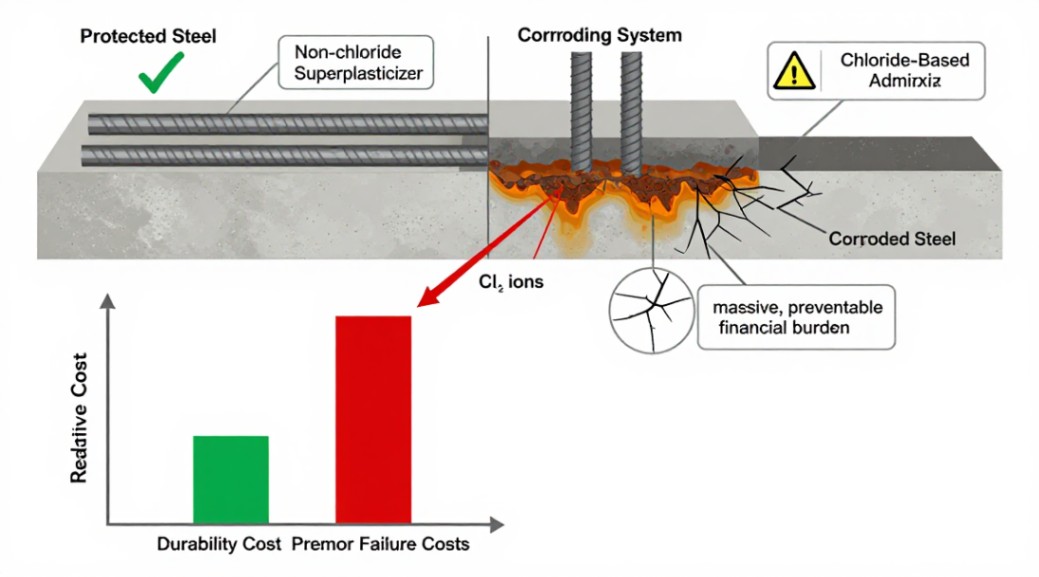
A widespread industry misunderstanding persists. Many professionals mistakenly believe all water-reducing admixtures are created equal. They are not. The lingering use of chloride-based additives, often for short-term cost savings, directly contradicts modern durability standards. Industry failure analyses consistently point to chloride-induced corrosion as a primary culprit in over 40% of premature reinforced concrete deterioration. This statistic represents a massive, preventable financial burden. The logic is simple and non-negotiable: introducing chlorides into a reinforced concrete matrix systematically attacks the steel. A non-chloride superplasticizer admixture provides high-performance water reduction without this fundamental chemical attack.
Essential Questions Answered
1. What is the #1 mistake to avoid with superplasticizers?
The single greatest error is prioritizing initial material cost over long-term structural integrity. Selecting an admixture based solely on a lower price per liter often leads to the specification of chloride-bearing products. The few cents saved per cubic meter of concrete become irrelevant when facing repair costs that are orders of magnitude higher. Never compromise on the chloride content specification. Always demand certified non-chloride superplasticizer admixture documentation.
2. How do chlorides actually destroy reinforced concrete?
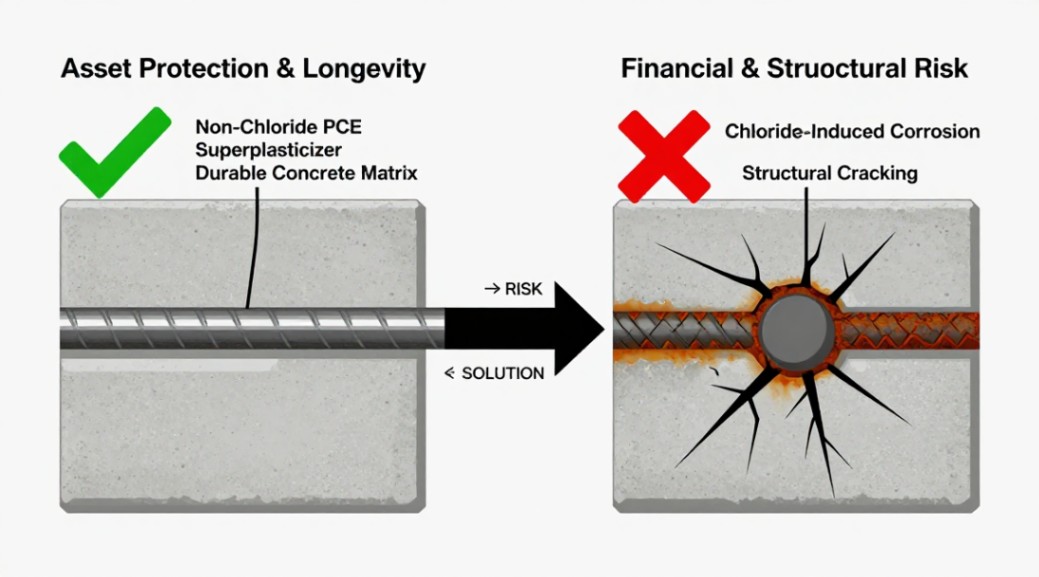
Chloride ions are small, aggressive, and highly mobile. They penetrate the concrete‘s pore solution. Upon reaching the steel reinforcement, they depassivate the protective oxide layer. This initiates electrochemical corrosion. The rust occupies more volume than the original steel, generating immense internal tensile stresses. The concrete cracks and spalls. This process accelerates in the presence of moisture and oxygen. A non-chloride superplasticizer eliminates this entire failure pathway at its source.
3. What are the primary chemical types of non-chloride superplasticizers?
- Polycarboxylate Ether (PCE): The modern benchmark. Offers superior water reduction (up to 40%), excellent slump retention, and allows for low water-to-cement ratios. Its comb-like polymer structure provides steric hindrance, dispersing cement particles effectively.
- Sulfonated Naphthalene Formaldehyde (SNF): A reliable, established technology. Provides good water reduction through electrostatic repulsion. Generally offers less slump retention than PCEs.
- Sulfonated Melamine Formaldehyde (SMF): Similar in mechanism to SNF, with comparable performance characteristics. Both SNF and SMF are formaldehyde-based, a consideration for some specifications.
4. How does dosing a non-chloride superplasticizer differ from standard practice?
Incorrect dosing is a critical operational error. The required dosage is not a fixed value; it is a function of cement chemistry, desired workability, and ambient conditions. Under-dosing fails to achieve target slump, leading to poor consolidation. Over-dosing can cause excessive retardation, segregation, or air entrainment issues. Always follow the manufacturer’s recommended dosage range, typically between 0.5% and 2.5% by weight of cementitious material. Conduct site trials for the specific mix design before full-scale production.
| Parameter | Standard Practice | Critical Check for Non-Chloride Superplasticizer |
|---|---|---|
| Dosage Basis | Volume (ml/100kg cement) | Always verify dosage is by weight of cementitious material (%). |
| Addition Point | With mixing water | Delayed addition (1-2 minutes after initial mix) often optimizes efficiency. |
| Key Test | Slump test | Monitor setting time and early strength gain alongside slump. |
| Compatibility | Assumed | Must test with your specific cement and any secondary admixtures (e.g., air-entrainer). |
5. Are non-chloride superplasticizers compatible with all cements and other admixtures?
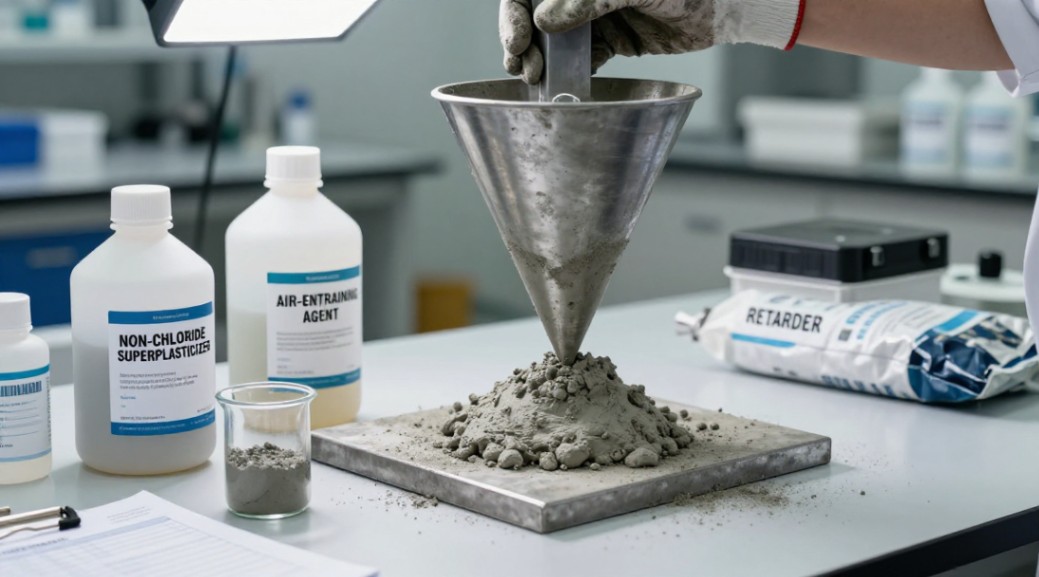
No, and assuming compatibility is a major pitfall. Cement fineness, alkali content, and C3A levels significantly influence admixture performance. Furthermore, combining a non-chloride superplasticizer with an air-entraining agent, retarder, or accelerator requires systematic evaluation. Incompatibility can manifest as rapid slump loss, excessive air, or severe retardation. The rule is simple: never use a new combination in critical structural concrete without laboratory and field mock-up testing.
6. What are the绝对不能做 (absolute must-not-do) actions?
- Never use chloride-based superplasticizers in reinforced, prestressed, or post-tensioned concrete.
- Never assume all “superplasticizers” are chloride-free. Scrutinize the technical data sheet.
- Never overdose in an attempt to fix a poorly designed concrete mix.
- Never add the admixture directly to dry cement; always ensure it is diluted in the mix water or added to the wet batch.
- Never store admixtures in unlabeled containers or in extreme temperatures, which can degrade performance.
7. How do non-chloride superplasticizers contribute to sustainable construction?
They enable high-performance, durable concrete with a lower water-to-cement ratio. This directly results in higher compressive strength, reduced permeability, and dramatically extended service life. A structure that lasts 80 years instead of 30 represents the ultimate in resource efficiency. The lifecycle cost analysis is unequivocal: the marginally higher initial cost of a premium non-chloride superplasticizer admixture is offset many times over by avoided maintenance, repairs, and premature replacement.
The Logical Choice for Permanent Structures
The evidence is clear. The reasoning is sound. Incorporating chlorides into a system designed to protect steel is a fundamental engineering contradiction. Modern non-chloride superplasticizer admixture technology, particularly PCE-based formulations, provides the necessary high workability and strength without introducing a corrosive agent. The long-term financial and structural risk of using chloride-bearing alternatives is simply too great. For any project where longevity, durability, and asset protection are priorities, the specification is non-negotiable.
Do not gamble with your structure’s lifespan. To implement this correctly, you require a product engineered for zero chloride content and maximum performance. Consult with our technical team for a specification review and to procure the correct, certified non-chloride superplasticizer admixture for your next project. Contact us today for product data sheets and mix design support.
Supplier
We are the global leader in lightweight concrete and advanced engineered foam solutions. Known globally for its commitment to research, innovation, and applied expertise, we have been providing engineered foam solutions since the early 2012’s.
We can supply high-quality concrete admixture and foam concrete related products all over the world.
The company has a professional technical department and quality supervision department, a well-equipped laboratory, and equipped with advanced testing equipment and after-sales customer service center.
If you are interested, please feel free and contact us.