Concrete-mesa | Concrete Admixtures, Tools, and Production Machines

Choosing Structural Synthetic Fibers for Floors: A Clear Guide to Tougher Concrete
A Material Revolution Hidden in Plain Sight
Did you know the single biggest cause of premature industrial floor failure isn’t heavy loads? It’s uncontrolled cracking. For decades, we’ve accepted this as a given, pouring thousands of tons of steel mesh into concrete slabs as a necessary, albeit flawed, defence. But the data from real-world floors tells a surprising story. In many demanding environments, a well-designed concrete slab reinforced with structural synthetic fiber for industrial floors can outperform its steel-reinforced counterpart. This isn’t about minor improvements. It’s a fundamental shift in how we think about reinforcing concrete. The choice between traditional steel and modern synthetic fibers isn’t just about materials; it’s about philosophy. One relies on a rigid grid waiting for cracks to form, while the other creates a three-dimensional, omnipresent defense system within the concrete itself. Let’s walk through this comparison logically, so you can decide which path leads to the durable, low-maintenance floor your project truly needs.
Understanding the Core Contenders
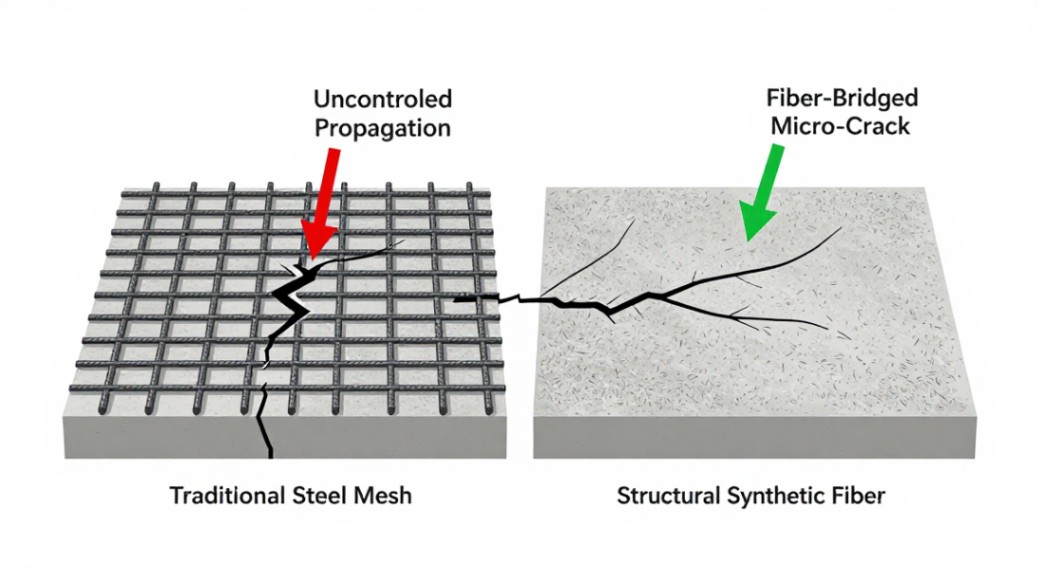
First, we must clear up a common point of confusion. Not all fibers are created equal. The market is flooded with ‘microfibers’ or ‘secondary fibers,’ which are short, thin strands designed to combat plastic shrinkage cracks as the concrete first sets. They play a supporting role. Structural synthetic fibers are a different breed entirely. They are engineered polymers-typically high-tenacity polypropylene, polyethylene, or sophisticated hybrid blends-with a specific length, geometry, and tensile strength. Their sole purpose is to act as the primary reinforcement, taking on the structural stresses that would traditionally be handled by welded wire mesh or rebar. They bridge cracks after the concrete has hardened, transferring loads and maintaining the slab’s integrity. This distinction is crucial. You are comparing a localized, two-dimensional steel grid to a limitless, three-dimensional synthetic network dispersed throughout every cubic metre of concrete.
The Performance Showdown: A Logical Breakdown
Let’s put these two systems side by side and think through their mechanics. Your goal is a floor that resists cracking, handles impact, and distributes loads effectively for decades.
Crack Control: Steel mesh sits passively. A crack must find the mesh and be narrow enough for the steel to engage. If the crack forms between wires, the mesh does little. Structural fibers, however, are everywhere. Any crack, anywhere, immediately intersects thousands of fibers that bridge its faces. This leads to superior control of both plastic shrinkage and long-term drying shrinkage cracks, resulting in tighter, finer crack widths.
Impact and Abrasion Resistance: This is where the fiber’s logic shines. When a heavy object is dropped, the local concrete experiences intense stress. Steel mesh, lying in a plane, offers minimal resistance to this out-of-plane impact. The synthetic fiber network, being three-dimensional, helps contain the damage, reducing spalling and cratering. It adds intrinsic toughness to the concrete matrix itself.
Construction Practicality: Here, the comparison becomes stark. Installing steel mesh requires precise placement on chairs, coordination with concrete trucks, and careful walking during the pour to avoid displacement. It’s labor-intensive and prone to error. Structural synthetic fibers are simply batched into the concrete truck at the plant or on site. Their dispersion is automatic with mixing, eliminating placement errors and saving significant time. The floor is reinforced from the moment the first scoop of concrete is placed.
Making the Choice: A Practical Decision Framework
So, when do you choose one over the other? It’s not a mystery. Follow this logic.
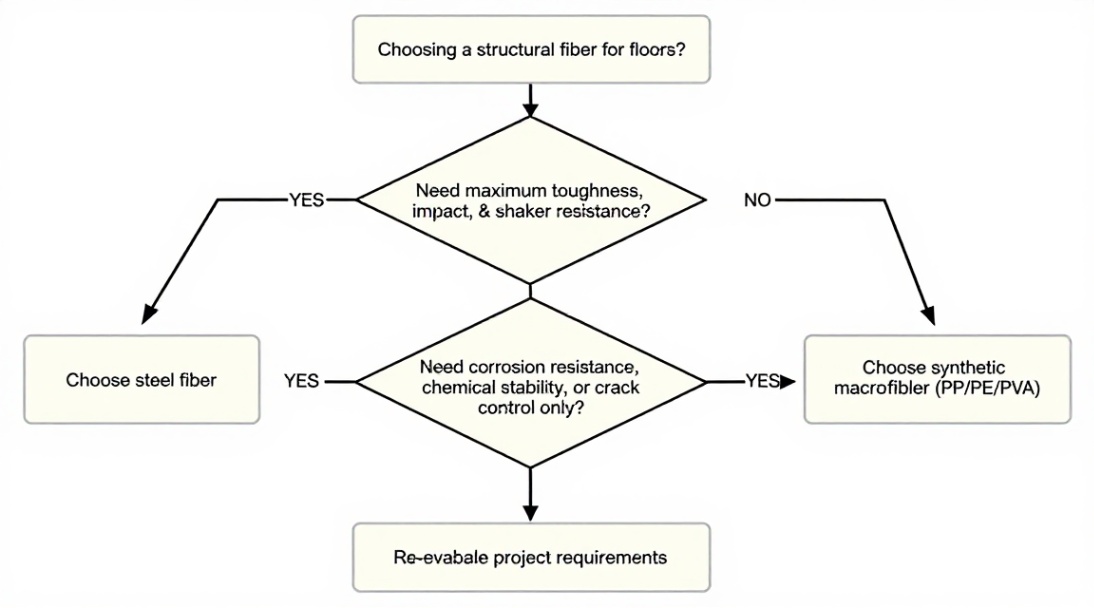
Lean strongly towards structural synthetic fibers for industrial floors when your priority is a monolithic, joint-free or long-joint bay floor with superior crack control. They are ideal for warehouses with high-volume racking, manufacturing plants with dynamic loads, and logistics centers where fast-track construction is critical. The fibers excel in slabs-on-grade where shrinkage cracking is the primary concern and where their three-dimensional reinforcement perfectly counters the unpredictable nature of crack formation.
Steel reinforcement remains the necessary choice for applications requiring a specific, designed structural capacity in bending, such in elevated slabs or where large, predictable tensile forces are engineered. It is also currently the default for very large, singular point loads that require detailed structural calculation beyond pure slab-on-grade design.
The financial logic is compelling. While the material cost of fibers may be higher per square meter, you must factor in the total installed cost. Eliminating mesh purchase, delivery, placement labour, and inspection often results in a cost-neutral or even reduced total cost. The long-term return on investment comes from reduced maintenance-fewer cracks mean less water and chemical ingress, less spalling, and a longer service life before resurfacing is needed.
The Path to a Successful Fiber-Reinforced Floor
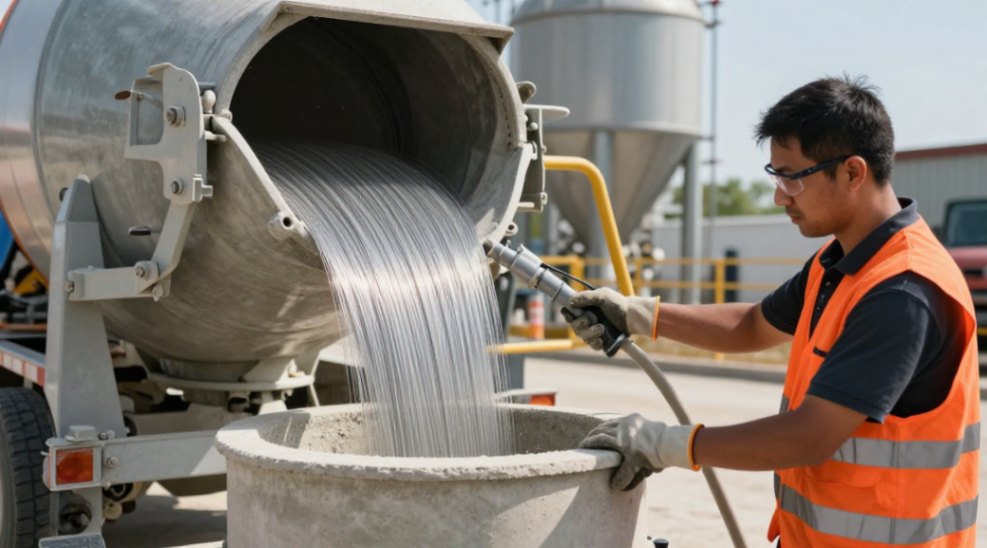
Choosing fibers is only the first step. Success depends on precise integration. The process is straightforward but demands attention. First, select a fiber dosage based on the engineered design, typically measured in kilograms per cubic meter of concrete. The most critical phase is batching. The fibers must be added to the mixer at a controlled rate, either at the ready-mix plant or via a specialized dispenser on-site, to prevent balling. A minimum mixing time, usually 5 to 8 minutes at full drum speed, ensures complete and uniform dispersion. The concrete mix design itself is key; it must have a cohesive, workable consistency, often using a well-graded aggregate and potentially a slight adjustment to the sand content to accommodate the fibers. Placement and finishing proceed as normal, with a slight emphasis on not overworking the surface, which can bring fibers to the top. Finally, proper curing is non-negotiable. A consistent curing membrane or wet-curing method for the full recommended period allows the concrete to gain strength and the fiber-concrete bond to develop fully, unlocking the system’s designed performance.
| Process Step | Key Action | Critical Parameter |
|---|---|---|
| Design & Specification | Determine required fiber dosage and type. | Dosage (kg/m³), Fiber Length & Material |
| Batching | Add fibers to mixer evenly. | Controlled feed rate, avoid manual dumping |
| Mixing | Ensure complete, uniform dispersion. | 5-8 minutes of high-speed mixing post-addition |
| Mix Design | Adjust for workability with fibers. | Cohesive slump, optimized sand/aggregate ratio |
| Placement & Finishing | Place, vibrate, and finish concrete normally. | Avoid over-finishing which can surface fibers |
| Curing | Protect slab to ensure strength gain. | Apply curing compound immediately; maintain for 7+ days |
Your Next Logical Step
You now have a clear, logical framework. The era of defaulting to steel mesh for every industrial floor is over. For the majority of slab-on-grade applications, structural synthetic fiber for industrial floors presents a technologically superior, economically sound, and practically simpler solution. It directly targets the root cause of floor deterioration. My advice is to bring this comparison to your next project meeting. Discuss the true load requirements and construction sequence with your engineer and contractor. Ask for a side-by-side cost analysis that includes all labor. Consider running a trial panel if you’re hesitant-pour two sections, one with mesh and one with a properly specified synthetic fiber, and test them. Seeing is believing. The goal isn’t to follow tradition, but to build a floor that lasts. This modern approach offers a compelling path to get you there.
Supplier
We are the global leader in lightweight concrete and advanced engineered foam solutions. Known globally for its commitment to research, innovation, and applied expertise, we have been providing engineered foam solutions since the early 2012’s.
We can supply high-quality concrete admixture and foam concrete related products all over the world.
The company has a professional technical department and quality supervision department, a well-equipped laboratory, and equipped with advanced testing equipment and after-sales customer service center.
If you are interested, please feel free and contact us.