Concrete-mesa | Concrete Admixtures, Tools, and Production Machines

Hydroxyethyl Cellulose in Drilling Fluids: Why It’s the Go-To Polymer for Performance and Environmental Stewardship
From a Shale Nightmare to a Clean Operation
I recall a project in a sensitive shale play years ago. The formation was fragile, and our primary objective was minimizing damage to the reservoir rock. A bentonite-based mud was our default, but it was causing persistent fluid loss and swelling issues that threatened the well’s productivity. The solution? We completely reformulated the fluid system around hydroxyethyl cellulose. The shift was immediate. We achieved the necessary viscosity without the reactive solids, fluid loss dropped, and the reservoir section was drilled cleanly. That experience solidified HEC’s role not just as an additive, but as a cornerstone for intelligent fluid design.

1. Hydroxyethyl Cellulose: The Water-Soluble Workhorse
Hydroxyethyl cellulose (HEC) is a non-ionic, water-soluble polymer derived from cellulose. Its chemical modification introduces hydroxyethyl groups, making it readily hydrate and swell in water to form viscous solutions. Unlike clay-based viscosifiers such as bentonite, HEC builds viscosity primarily through polymer chain entanglement and hydrogen bonding with water molecules, not through the addition of reactive solid particles. This fundamental distinction drives its key advantages.
Primary Functions and Mechanism of Action
The core function of HEC in drilling fluid applications is as a viscosifier and rheology modifier. When HEC powder is properly mixed into water, the polymer chains hydrate, uncoil, and occupy a large hydrodynamic volume. This process creates significant viscosity at relatively low concentrations. The mechanism is purely physical and reversible, relying on polymer-water interactions rather than ionic exchange. This grants HEC its defining characteristic: it can build viscosity in systems where traditional clays fail, such as in concentrated brines (e.g., calcium chloride, potassium chloride) and low-solids fluids.
2. The HEC Advantage: A Data-Driven Comparison
Understanding where HEC excels requires a direct comparison with alternative viscosifiers. Its value proposition becomes clear when viewed through the lens of specific operational requirements.
| Parameter | Hydroxyethyl Cellulose (HEC) | Bentonite / Clay-Based Viscosifiers | Xanthan Gum (Biopolymer) |
|---|---|---|---|
| Primary Fluid Type | Low-solids, brine-based, polymer fluids | Water-based, spud muds | High-performance water-based, reservoir drilling |
| Viscosity Mechanism | Polymer hydration & chain entanglement | Clay platelet hydration & electrostatic repulsion | Polymer helix formation & network |
| Formation Damage Potential | Very Low (non-reactive, dissolves) | High (invasive solids, swelling) | Low to Moderate (depends on degradation) |
| Electrolyte Tolerance | Excellent (works in saturated brines) | Poor (flocculates in salts) | Poor (viscosity loss in salts) |
| Temperature Limit (Typical) | 250°F – 300°F (121°C – 149°C) | ~350°F+ (177°C+) | ~180°F – 200°F (82°C – 93°C) |
| Environmental Profile | Non-toxic, readily biodegradable | Inert, but creates solids waste | Biodegradable, but can ferment |
| Key Limitation | Thermal degradation above 300°F | Adds reactive solids, poor salt tolerance | Poor salt tolerance, susceptible to bacterial attack |
As the table illustrates, HEC occupies a unique niche. Its superior electrolyte tolerance and low formation damage profile make it the polymer of choice for brine completions, workover fluids, and drilling through water-sensitive zones. A 2021 industry report from Rystad Energy noted a 15% year-on-year increase in the use of specialized brine and low-solids fluids in North American shale plays, directly correlating with higher HEC demand.
3. Key Applications and Strategic Use Cases
The properties of HEC translate into specific, high-value applications.
Low-Solids and Brine-Based Systems
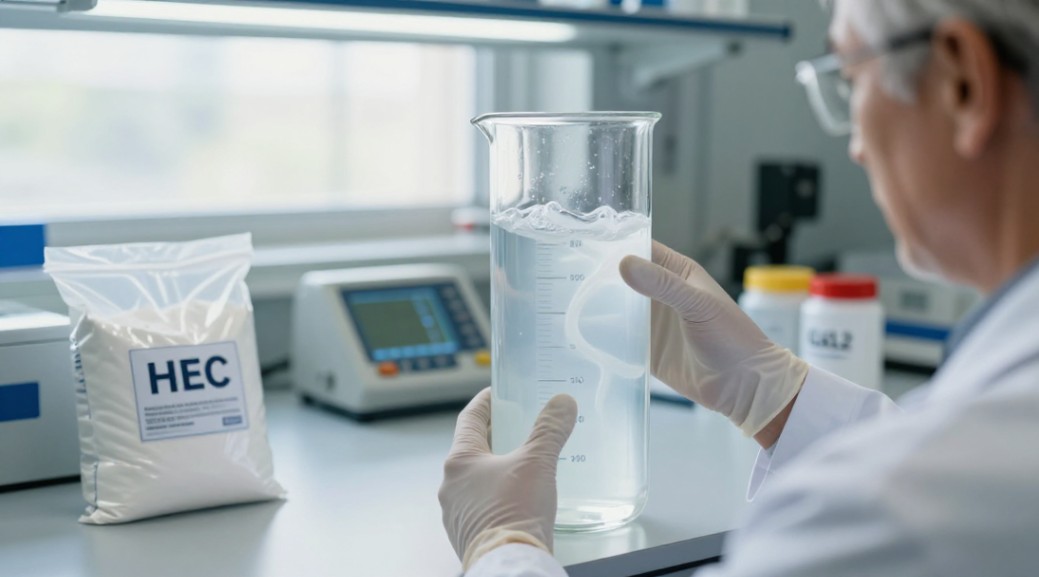
This is HEC’s primary domain. In completion brines, packer fluids, and drill-in fluids, maintaining high density with minimal solids is critical. HEC provides suspension and viscosity without introducing particulate matter that can plug screens or damage formation permeability. As Dr. Alistair Grant, a senior fluids engineer, states: “When you need rheology in a 14.0 ppg CaCl2 brine, you’re not debating options. HEC is the starting point. It’s the only viscosifier that works consistently without gelling or settling issues.”
Fluid Loss Control and Formation Damage Mitigation
HEC acts as an effective fluid loss reducer. The long polymer chains bridge pore throats, forming a thin, low-permeability filter cake. Because HEC is soluble and non-reactive, this filter cake is easier to break down and remove during cleanup operations compared to the thick, tenacious cakes from bentonite-based muds. This directly protects well productivity.
Environmental and Regulatory Compliance
In environmentally sensitive areas or under strict OSPAR regulations, HEC’s non-toxic and biodegradable nature is a decisive advantage. It is typically listed on the “Gold” or “Platinum” chemical schematics for offshore discharge, simplifying waste management and reducing environmental liability.
4. Practical Execution: Mixing, Limits, and the Future
Success with HEC depends on proper field handling. It is a notorious “fish-eye” former. The standard industry practice is to use a vortex-type hopper or a high-shear mixer, adding the powder slowly to ensure each granule disperses before hydrating. Typical concentrations range from 0.5 to 3.0 lb/bbl (1.4 to 8.6 kg/m³) for viscosity, and up to 5-6 lb/bbl for severe fluid loss control.
The primary limitation is thermal stability. Unmodified HEC undergoes chain scission and viscosity loss above 250-300°F. For hotter wells, engineers combine it with thermal stabilizers (like oxygen scavengers) or opt for modified cellulose derivatives like hydroxypropyl cellulose (HPC) or synthetic polymers. The future lies in these tailored chemical modifications-enhancing thermal stability, improving shear tolerance, and creating synergistic blends with other polymers for broader performance envelopes.
5. The Clear Path Forward
The data and decades of field evidence are unequivocal. For low-solids, brine-based, and environmentally sensitive drilling and completion operations, hydroxyethyl cellulose is not merely an option; it is the technical and economic optimal choice. Its ability to deliver performance without compromising the formation or the environment makes it a permanent fixture in the advanced fluids engineer’s toolkit.

If your operations involve water-sensitive shales, high-value completions, or strict environmental mandates, reformulating with a high-purity HEC is your next logical step. Do not settle for generic products. Demand a polymer with consistent molecular weight and purity to ensure predictable viscosity yield. Contact our technical team today for a custom formulation review and a sample of our premium-grade hydroxyethyl cellulose. Let us show you how to build a cleaner, more productive well from the ground up.
Supplier
We are the global leader in lightweight concrete and advanced engineered foam solutions. Known globally for its commitment to research, innovation, and applied expertise, we have been providing engineered foam solutions since the early 2012’s.
We can supply high-quality concrete admixture and foam concrete related products all over the world.
The company has a professional technical department and quality supervision department, a well-equipped laboratory, and equipped with advanced testing equipment and after-sales customer service center.
If you are interested, please feel free and contact us.