Concrete4U | Concrete Admixtures, Tools, and Production Machines

How HPMC Specifically Solves Masonry Mortar Workability Problems
The Objective Answer on HPMC for Mortar Workability
For masons and formulators seeking a measurable improvement in the wet-state performance of masonry mortar, Hydroxypropyl Methylcellulose (HPMC) is the definitive functional additive. This cellulose ether directly modifies rheology. It is not magic. It is chemistry that addresses the three fundamental workability parameters: water retention for consistent hydration, internal lubrication for smooth application, and controlled viscosity for vertical stability. The choice, therefore, is not whether to use a workability additive, but which type provides the optimal balance of properties for a specific job. Let’s compare HPMC to its primary alternatives, like traditional air-entraining agents or methylcellulose (MC), through the lens of two decades of field application and feedback from working crews.
Understanding the Core Mechanism
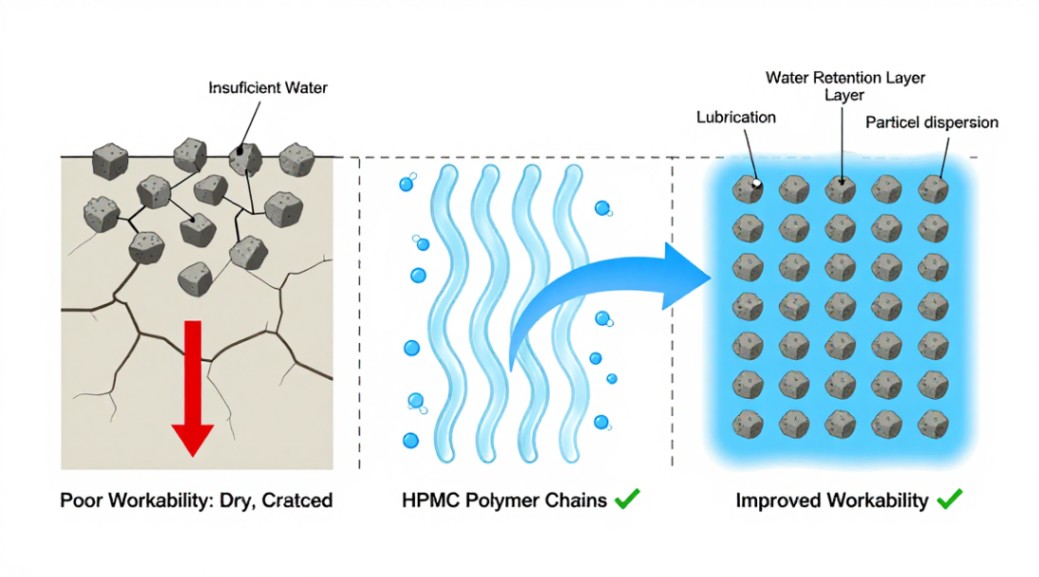
HPMC is a non-ionic cellulose ether derived from refined wood pulp or cotton. In construction chemistry, its function is precise. When added to a dry mortar mix, its polymer chains hydrate upon contact with water during mixing, forming a protective colloid around cement particles. This process delivers three simultaneous effects. First, it drastically increases water retention capacity. The gel structure physically hinders water from rapidly migrating into absorbent masonry units or evaporating. This ensures the cement has sufficient water for complete hydration, even in hot, dry conditions or with highly porous bricks. The result is consistent strength development and eliminates the weak, crumbly mortar that fails at the brick interface.
Second, HPMC acts as an efficient lubricant. The hydrated polymer molecules reduce inter-particle friction between sand and cement grains. This dramatically improves the mortar’s spreadability and “butteriness.” Masons report the trowel feel is smoother, requiring less physical effort to achieve a full, even bed joint. Third, it provides structured viscosity. The solution thickens, granting the mortar cohesive body. This cohesion is what combats sag or slumping on vertical applications, a property often termed anti-sag. The mortar stays where it’s placed, allowing the mason to build several courses without constant readjustment.
A Practical Comparison: HPMC vs. Common Alternatives
To make an informed choice, one must weigh HPMC against other workability modifiers. Traditional air-entraining agents (like Vinsol resin or synthetic detergents) improve workability by incorporating microscopic air bubbles. These bubbles act as ball bearings, enhancing frost resistance in freeze-thaw cycles. However, they trade strength for workability; each 1% increase in air content can reduce compressive strength by approximately 5%. For load-bearing structural masonry, this is a significant compromise. HPMC, in contrast, improves workability without relying on entrained air, preserving the designed compressive and flexural strength of the mortar.
Comparing HPMC to its close relative, Methylcellulose (MC), reveals subtler distinctions. MC offers excellent water retention and thickening. Yet, many users in technical forums and on platforms like Reddit’s r/Construction or specialized masonry boards note a key difference: HPMC generally provides better slip resistance and open time. “We switched to an HPMC-based mix for our high-end residential brickwork,” one contractor shared. “The mortar stays open longer on the hawk in the sun, but it still grabs the brick firmly without sliding. With some MC products, we fought slippage, especially with larger format units.” This feedback highlights HPMC’s balanced profile-sufficient lubricity for application, yet rapid development of adhesive grab.
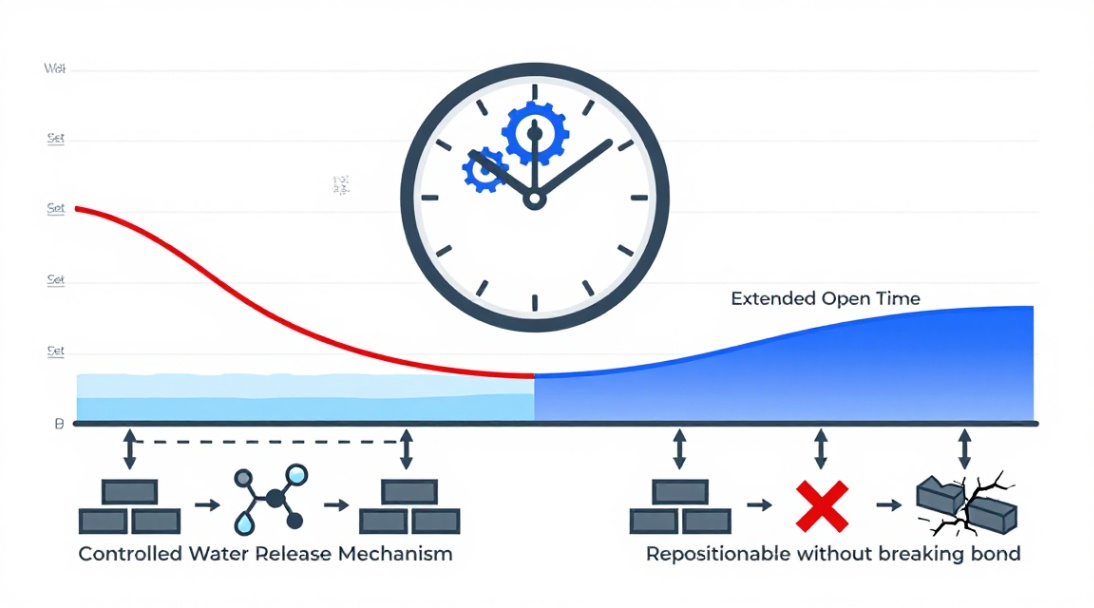
The open time, or adjustment time, is where HPMC truly shines for masons. It creates a longer window during which a brick or block can be repositioned without breaking the initial bond. This reduces waste from setting units incorrectly and improves alignment accuracy. The mechanism is controlled water release. The gel releases water slowly, delaying the stiffening of the cement paste. This is a direct, controllable benefit, not a vague promise.
Implementation and Best Practices
Realizing these benefits requires correct usage. The performance of HPMC in masonry mortar hinges on two controllable factors: dosage and viscosity grade selection. Dosage is typically between 0.1% to 0.3% by weight of the total dry mortar mix. A starting point of 0.2% is common for standard brickwork. Exceeding this range can excessively retard set times and introduce unwanted stickiness. The viscosity grade, measured in mPa·s for a 2% aqueous solution, dictates the thickening power. For general masonry mortars, a medium viscosity grade (around 15,000 to 40,000 mPa·s) offers the best balance of workability and anti-sag. Low viscosity grades (below 10,000 mPa·s) are better for spray applications, while very high grades (above 60,000 mPa·s) are used for thick-bed tile adhesives where supreme slip resistance is critical.
| Key Parameter | Typical Range for Masonry Mortar | Primary Effect |
|---|---|---|
| Dosage (by weight of dry mix) | 0.1% – 0.3% | Controls water retention and workability intensity |
| Viscosity Grade (2% solution) | 15,000 – 40,000 mPa·s | Governs thickness, cohesion, and anti-sag performance |
| Open Time Extension | 15 – 30 minutes | Allows for unit adjustment without breaking bond |
Mixing procedure is non-negotiable. HPMC must be uniformly dispersed in the dry powder blend before adding water. Adding it directly to water will cause the formation of insoluble lumps-hydrated polymer on the outside shielding dry powder inside. Always blend HPMC thoroughly with the cement, lime, and sand in the dry state. Use a mechanical mixer for consistency. When water is added, mix for a minimum of 3-5 minutes to ensure full hydration and development of the polymer’s functionality. A properly mixed HPMC-mortar will have a uniform, creamy consistency without streaking.
Clarifying Misconceptions and Compatibility
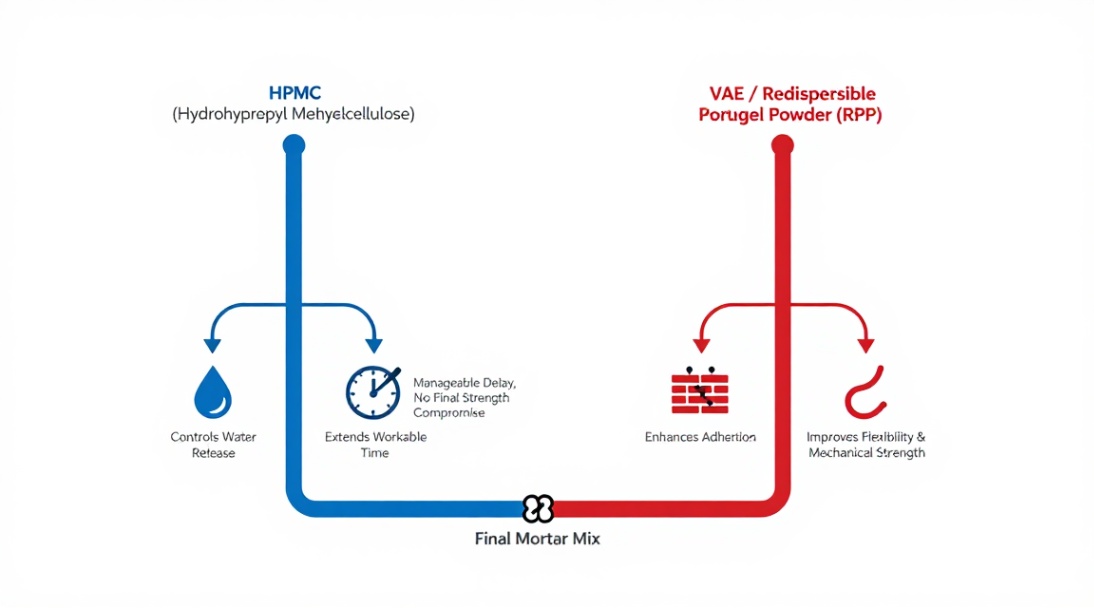
A persistent myth suggests HPMC severely retards final set. This is a dosage-dependent effect, not an inherent flaw. At recommended dosages, the delay is manageable and often beneficial, extending working time. The final strength is not compromised; the curing process is simply more controlled. HPMC is highly compatible with other standard mortar additives. It works synergistically with redispersible polymer powders (RPPs) like Vinyl Acetate Ethylene (VAE). The HPMC manages water and workability, while the RPP enhances adhesion, flexibility, and mechanical strength. It is also fully compatible with modern air-entraining agents when specific frost resistance is required, allowing formulators to engineer a precise multi-property mortar.
The practical benefit for the mason on the wall is efficiency and quality. Reduced water loss means fewer premature stiffening events, leading to less discarded mortar at the end of the day. Improved cohesion means less cleanup from slumped mortar. The enhanced lubricity and open time translate directly to more square meters laid per day with less physical strain and a superior finished appearance-tight, full joints without voids. The objective data from job sites confirms this: crews using properly formulated HPMC-mortars report a quantifiable reduction in material waste and rework, alongside improved morale due to a more predictable, easier-to-use material. The choice becomes clear when the full spectrum of performance is analyzed.
Supplier
We are the global leader in lightweight concrete and advanced engineered foam solutions. Known globally for its commitment to research, innovation, and applied expertise, we have been providing engineered foam solutions since the early 2012’s.
We can supply high-quality concrete admixture and foam concrete related products all over the world.
The company has a professional technical department and quality supervision department, a well-equipped laboratory, and equipped with advanced testing equipment and after-sales customer service center.
If you are interested, please feel free and contact us.