Concrete-mesa | Concrete Admixtures, Tools, and Production Machines

Mastering Superplasticizer Dosage: The Key to Consistent Concrete Workability & Strength
Introduction: The Dosing Dilemma
Do you ever feel like you’re guessing when you add a superplasticizer to the truck? You know you need it to hit that high slump for pumping, but the concrete sometimes gets too sticky. Or the slump fades before you can finish the pour. You’re not alone. Finding the sweet spot for superplasticizer dosage for concrete mix is one of the most common challenges on site. Too little, and the crew struggles. Too much, and you risk segregation or delayed setting. Let’s clear up the confusion. After decades in the field, I can tell you that precision dosing isn’t just about workability; it’s the cornerstone of predictable strength and long-term durability.
The Superplasticizer’s Role: More Than Just Water Reduction
A superplasticizer is a high-range water reducer. Its primary job is to disperse cement particles. Think of it as a lubricant for your mix. By neutralizing the natural attraction between cement grains, it frees up water that was otherwise locked up. This allows for two primary benefits: significant water reduction at equal slump, or a dramatic increase in slump at a constant water-cement ratio. The chemical backbone of modern superplasticizers, predominantly Polycarboxylate Ether (PCE), offers superior slump retention and lower dosage requirements compared to older sulfonated naphthalene or melamine formaldehyde types.
The Core Dosage Variables: What Really Drives Your Numbers
The typical starting point for superplasticizer dosage is 0.5% to 2.0% by weight of cementitious material. But that’s a vast range. Hitting the optimal number isn’t guesswork. It’s a direct calculation based on your specific mix parameters.
The most critical factors are your cement content and the admixture’s solids concentration. Always calculate dose based on the active solids in the superplasticizer, not the liquid volume. A 20% solids solution behaves very differently from a 40% solution. Other key influencers include:
- Cement Chemistry: High C3A or alkali content can absorb more admixture, demanding a higher dosage.
- Supplementary Materials: Fly ash or slag can alter the required dose, often reducing it.
- Temperature: Hot weather accelerates slump loss, sometimes requiring a slight increase or a different PCE formulation.
- Target Workability: A 150mm slump for a slab needs less than a 200mm+ slump for a complex column.
The High Cost of Getting It Wrong: Under vs. Over Dosage
Let’s make the consequences clear. Improper dosage directly impacts your concrete’s performance, cost, and schedule.
| Scenario | Immediate Concrete Effects | Long-Term & Project Risks |
|---|---|---|
| Under-Dosing | Insufficient slump, poor workability, harsh mix. Increased water demand to achieve placement slump. | Lower compressive strength (higher w/c ratio). Reduced durability (permeability). Increased labor for placement and finishing. |
| Over-Dosing | Excessive slump, severe segregation, bleeding. Delayed setting times, excessive retardation. | Surface defects (scaling, dusting). Formwork pressure issues. Extended finishing windows, schedule delays. Potential strength reduction in segregated areas. |
Application-Specific Dosage Strategy
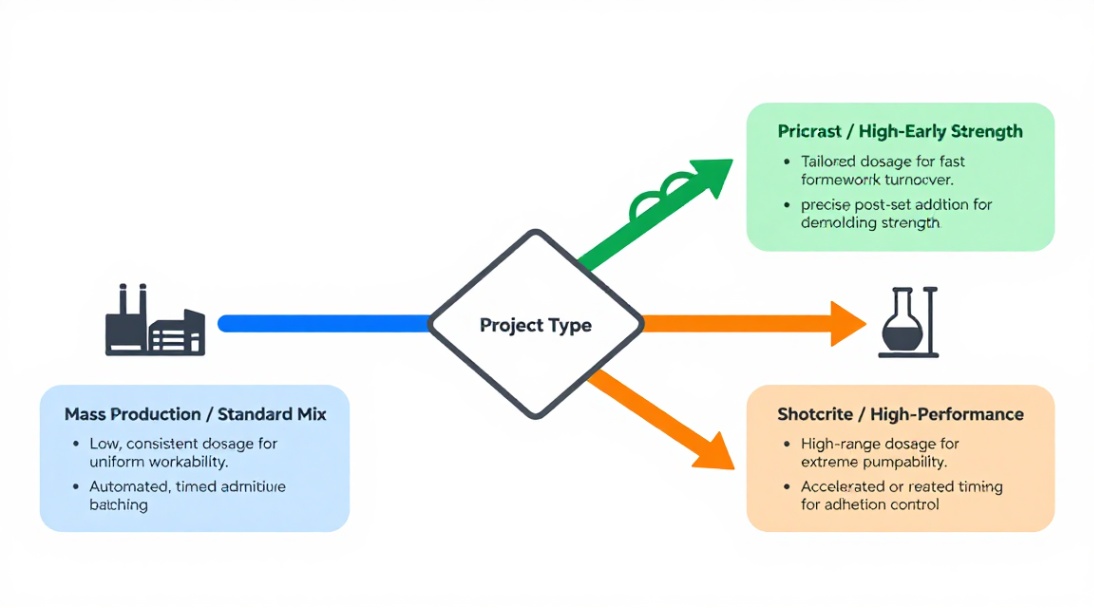
Your project type dictates your dosage approach. A one-size-fits-all mentality leads to problems.
| Application | Typical Dosage Focus | Key Consideration |
|---|---|---|
| Ready-Mix Concrete | Balance of slump retention and set time. Often dosed for 1-2 hour workability window. | Compatibility with plant mixers and transit time. Reliable, consistent performance is paramount. |
| Precast / Prestress | Early high-strength development. Very low w/c ratios. Often higher dosages for maximum water reduction. | Fast demolding cycles. Minimal segregation at high fluidity for intricate molds. Some plants use our performance monitoring system for batch-to-batch consistency. |
| Self-Consolidating Concrete (SCC) | High dosage to achieve extreme flow without segregation. Viscosity-modifying admixtures are often paired. | Strict stability requirements. Robust quality control testing (slump flow, V-funnel) is non-negotiable. |
| Mass Concrete / Foundations | Moderate dosage for placeability. May prioritize retarding side-effect to manage heat. | Controlled fluidity for large volumes. Avoiding cold joints without causing excessive formwork pressure. |
The Non-Negotiable Step: Compatibility Testing
Never assume a superplasticizer will work perfectly with your cement and other admixtures. A lab or field compatibility test is cheap insurance. Mix your proposed materials and observe the fresh concrete over 60-90 minutes. Look for rapid slump loss, false set, or excessive retardation. This step, often overlooked, prevents catastrophic failures on pour day.
Practical Field Control and Safety
On-site, you must be nimble. If slump is lost, you can often add a small secondary dose. The general rule? Do not exceed 1/3 to 1/2 of the initial total dose. Mix thoroughly for at least 5 minutes of drum rotation. More is not better. For safety, treat concentrated superplasticizers with respect. Wear gloves and eye protection. They are alkaline and can irritate skin. Never add undiluted concentrate directly to dry cement.
From Theory to Practice: A Dosage Optimization Case
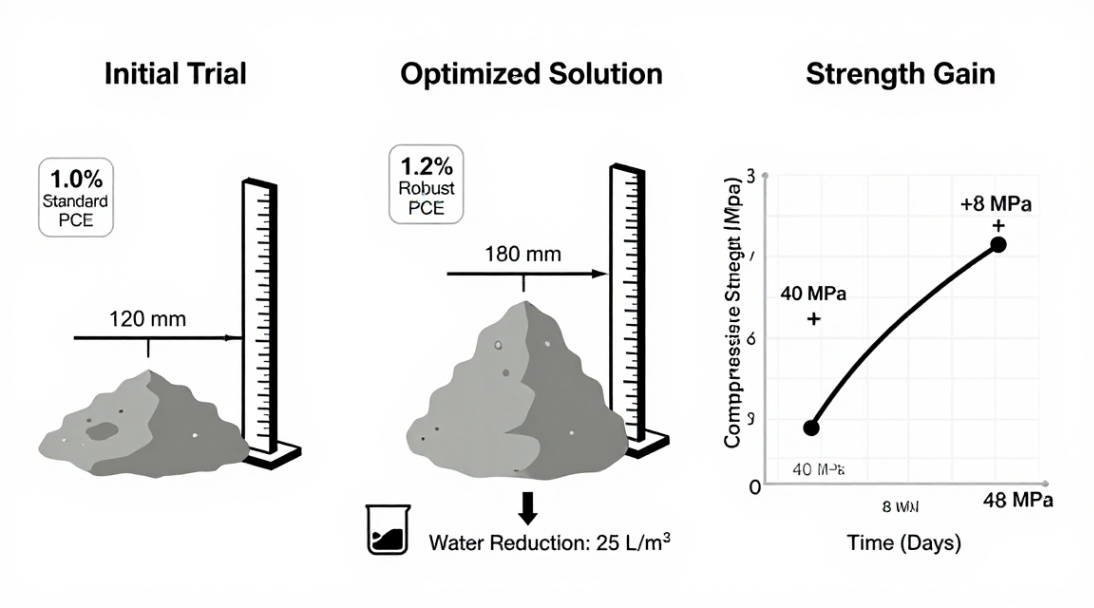
Consider a 40 MPa precast wall panel mix with 400 kg/m³ of cement. The initial trial used 1.0% of a standard PCE superplasticizer, achieving a 120mm slump. The target was 180mm for easy flow around reinforcement. Simply increasing the dose to 1.4% caused slight bleeding. The solution? We switched to a more robust PCE formulation designed for higher cement contents at a 1.2% dosage. The result was a stable 180mm slump, a water reduction of 25 liters/m³, and a 7-day strength increase of 8 MPa. The right chemistry at the right dose made all the difference.
Your Path to Confident Dosing
Mastering superplasticizer dosage for concrete mix transforms it from a black art into a controlled science. Start with your supplier’s recommended range. Respect the variables of your specific materials. Always conduct a compatibility test. And remember, the goal is the minimum effective dose to achieve your performance targets. This approach saves money, ensures quality, and gives you predictable results. For your next project, don’t just order a superplasticizer-develop a dosing plan. Your concrete, and your team, will thank you for it.
Supplier
We are the global leader in lightweight concrete and advanced engineered foam solutions. Known globally for its commitment to research, innovation, and applied expertise, we have been providing engineered foam solutions since the early 2012’s.
We can supply high-quality concrete admixture and foam concrete related products all over the world.
The company has a professional technical department and quality supervision department, a well-equipped laboratory, and equipped with advanced testing equipment and after-sales customer service center.
If you are interested, please feel free and contact us.