Concrete-mesa | Concrete Admixtures, Tools, and Production Machines

Stop Pouring Money into Steel: The Only Industrial Floor Guide You’ll Ever Need
The Myth of Steel Reinforcement
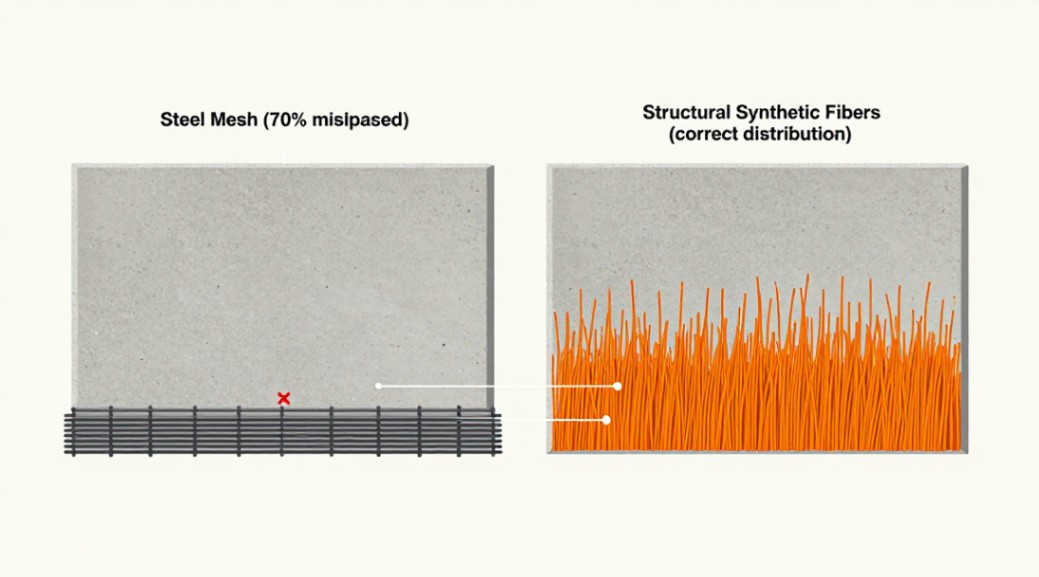
Here’s a number that will make you rethink every concrete pour you’ve ever supervised: seventy percent of steel mesh in industrial floors ends up in the wrong position. Think about that for a second. The steel you paid for to control cracking is literally sitting at the bottom of the slab, doing nothing useful. Yet the industry keeps pushing it. Why? Because it’s tradition. That is a terrible reason to waste money. Let’s fix this. This guide is your step-by-step manual for replacing that outdated system with structural synthetic fiber for industrial floors. By the time you finish reading, you will know exactly how to specify, dose, and install a fiber-reinforced slab that outperforms steel mesh in crack control, impact resistance, and long-term durability. No fluff. Just the process.
1. Know Your Four Fiber Types
First step is understanding what you are actually buying. The market throws four categories at you: micro polypropylene, macro polypropylene, nylon, and macro synthetic blends. Most contractors grab the cheapest bag. Big mistake. For an industrial floor that takes forklift traffic daily, you need macro synthetic fibers. Micro fibers handle plastic shrinkage in the first few hours, but they do nothing for post-crack flexural strength. Want a slab that holds together after a crack forms? You need macro fibers. Polypropylene dominates the macro category because it resists alkali and UV degradation better than nylon. Nylon absorbs water, which can cause long-term bond issues in the slab. Rule number one: for load-bearing capacity, spec macro polypropylene structural synthetic fiber for industrial floors with a length of at least 38 millimeters. Shorter fibers simply pull out of the concrete matrix. They don’t bridge the crack. They just sit there, useless.
2. Calculate Your Dosage by Performance, Not by Cost
Dosage rates are where most people fail. They look at the price per pound and choose the lowest number. That is a trap. The standard dosage for a typical industrial slab – say a warehouse aisle with a 6-inch slab – is 4 to 6 kilograms per cubic meter of concrete. That sounds like a lot. It is not. But here is the counterintuitive part: if you go below 3 kilograms, you get zero structural benefit. The fibers simply cannot form enough of a network to hold crack faces together. You have to hit a threshold. The data from ACI 544 is clear. Below that threshold, the post-crack flexural strength is essentially the same as plain concrete. You get a slightly tougher slab, but it still fails in a brittle mode. Above that threshold, the slab behaves like a ductile material. It cracks, but it holds. Second rule: never guess the dosage. Get the fiber manufacturer’s certified dosage chart for your specific slab thickness and subgrade conditions. If they can’t provide it, find another supplier.
3. Mix It Right: The Dispersion Problem
This is the mechanical step. You can buy the best structural synthetic fiber for industrial floors in the world, but if you dump it into the truck wrong, it will turn into a useless clump. The standard procedure works, but only if you follow it precisely. Step one: add the coarse aggregate first. Step two: add the fiber bags while the drum is rotating at mixing speed. Step three: add the cement and sand. Step four: add water last. The critical error is adding fibers after the water. They float, they clump, and you get bird nests in your concrete. Step five is the one everyone skips: mix for at least five minutes after all materials are in the drum. Not three minutes. Five. Then check a sample. Take a trowel full of concrete, wash it in a bucket of water, and count the fibers. You should see uniform distribution across the sample. If you see clusters, reject the load. Yes, you can reject a ready-mix truck. Do it. Your floor depends on it.
4. Slab Thickness and Joint Spacing: The Direct Trade-Off
Here is where the cost savings hit hard. With steel mesh, you need expansion joints every 15 feet. With a properly dosed structural synthetic fiber for industrial floors, you can push that to 25 feet. Why? The fibers provide continuous post-crack restraint. They hold the crack tight, so you don’t need as many saw cuts to control random cracking. Joints are the weakest point in any industrial floor. They fail, they spall, and they cost a fortune to maintain. Every foot of joint you eliminate is pure profit. Furthermore, you can reduce slab thickness by up to 15 percent compared to a plain concrete slab with the same load rating. The fibers stitch the concrete together after cracking, so the slab acts like a composite section. That means a 5-inch fiber-reinforced slab can carry the same forklift load as a 6-inch plain slab. Do the math on that concrete volume savings over a 100,000 square foot warehouse. It is not small.
5. The Fire Resistance Fact
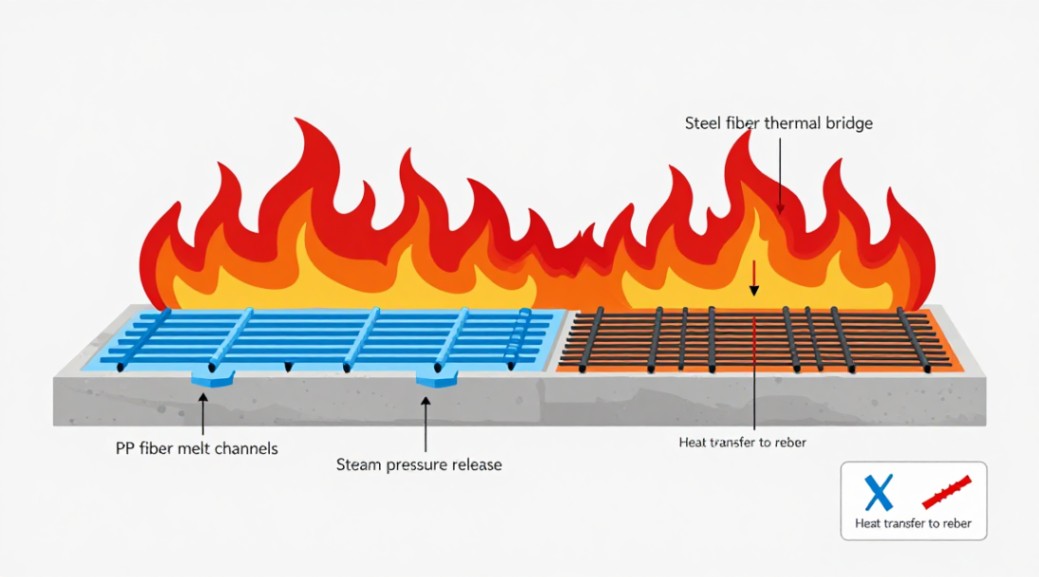
Everyone asks about fire. The concern is that polypropylene fibers melt at around 160 degrees Celsius. Yes, they melt. And that is a good thing. When a fire hits the slab, the fibers melt and create tiny channels. Those channels allow steam pressure to escape. Without them, the concrete can spall explosively. In a fire test compliant with EN 14889-2, slabs with macro polypropylene fibers showed zero explosive spalling at temperatures up to 1000 degrees Celsius. Steel fibers, by contrast, can create thermal bridges that actually accelerate heat transfer to the reinforcement. For an industrial floor in a logistics center or factory, the fire resistance rating often improves with the synthetic option. Third rule: never use steel fibers in a fire-exposed slab unless you have specific protective design measures. Synthetics handle fire better.
6. Compare Head-to-Head: Synthetic vs. Steel Fiber vs. Steel Mesh
Let me be blunt. Steel mesh is a labor nightmare. You pay for the mesh, you pay to place it, and then you pay to fix the cracks that form anyway because the mesh is too low in the slab. Steel fibers solve the dispersion problem, but they have two issues: they rust at the surface, and they increase the concrete’s density, which can cause settlement issues in fresh concrete. Surface rust on steel fibers creates unsightly stains in industrial floors. Structural synthetic fiber for industrial floors eliminates both problems. No corrosion. No staining. Lower density. The handling advantage is enormous. You dump bags into the truck at the plant. No mesh laying. No tying. No cutting. The labor savings alone range from 30 to 50 percent on the reinforcement installation cost. Performance-wise, synthetic fibers match steel fibers in post-crack flexural strength when dosed correctly. The key difference is the modulus of elasticity. Steel is stiffer. But for industrial floor applications, you do not need the extra stiffness. You need crack control and toughness. Synthetics provide that at a lower cost and with zero corrosion risk.
7. The Installation Day Workflow
Here is the step-by-step for the actual pour. Step one: confirm the concrete supplier has the correct dosage mixed in the plant. Step two: on-site, do a quick dispersion test on the first truck. Step three: place the concrete using a laser screed. Do not use a vibrating screed that pulls fibers to the surface. A laser screed with a forward-moving head keeps the fibers evenly distributed. Step four: do not overwork the surface. Excessive floating and troweling can push fibers down, creating a weak surface layer. One pass with a bull float, let it bleed, then a power trowel finish. Step five: apply a liquid curing compound immediately. Because synthetic fibers reduce plastic shrinkage, you have a slightly longer window, but do not rely on it. Cure properly. Step six: saw cut joints within 12 hours. Even with extended joint spacing, you still need cuts. The fibers control the cracks that do form, but the cuts give you a clean line. If you wait longer than 24 hours, the concrete may have already cracked randomly.
8. Long-Term Durability: What the Data Shows
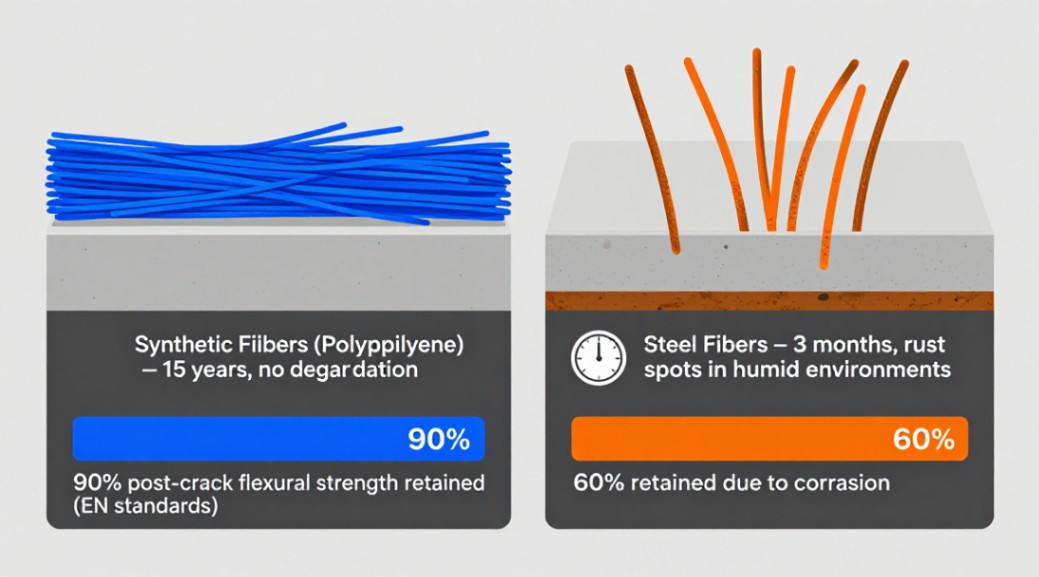
I have inspected floors installed 15 years ago with first-generation synthetic fibers. They still hold up. The alkali environment of concrete does not degrade virgin polypropylene. UV degradation is a non-issue for fibers embedded inside the slab. Surface fibers, if exposed due to poor finishing, can yellow, but that is cosmetic only, not structural. Compare that to steel fibers at the surface, which develop rust spots within three months in humid environments. The long-term performance data from the European EN standards shows that synthetic fiber-reinforced slabs maintain 90 percent of their post-crack flexural strength after 10 years of industrial traffic. Steel mesh slabs lose over half their structural capacity if the mesh corrodes due to chloride exposure. For a logistics center or a factory floor that sees chemical spills or deicing salts, the choice is clear. Structural synthetic fiber for industrial floors wins on durability.
Your Next Move
You have the guide. Now test it. Take a small slab, spec the correct macro polypropylene fiber at 5 kilograms per cubic metre, follow the mixing and finishing steps above, and then load-test it. Compare it to a steel mesh control slab. You will see the difference. The fiber slab will show tight micro-cracks instead of wide macro-cracks. It will take impact without spalling. And it will cost you less. Do not take my word for it. Pull up ASTM C1116 and ACI 544. Read the test protocols. Then run your own trial. The industry will keep selling you steel mesh because it makes them money on labor. You now know better. Use this data. Pour smarter.
Supplier
We are the global leader in lightweight concrete and advanced engineered foam solutions. Known globally for its commitment to research, innovation, and applied expertise, we have been providing engineered foam solutions since the early 2012’s.
We can supply high-quality concrete admixture and foam concrete related products all over the world.
The company has a professional technical department and quality supervision department, a well-equipped laboratory, and equipped with advanced testing equipment and after-sales customer service center.
If you are interested, please feel free and contact us.