Concrete4U | Concrete Admixtures, Tools, and Production Machines

Stop Guessing: The Concrete Foaming Agent Showdown (Synthetic vs. Protein)
When a Backfill Job Almost Broke Me (And Taught Me Everything About Foaming Agents)
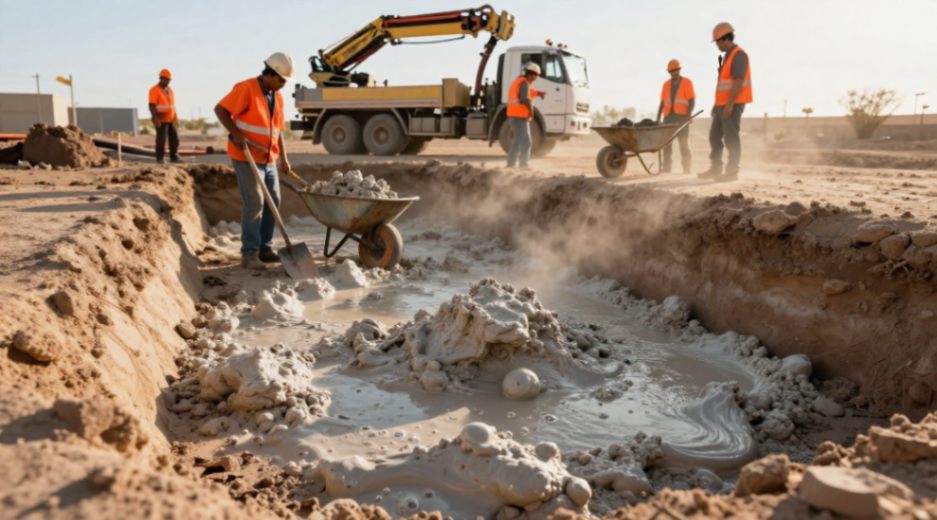
Back in ’09, I was on a site in Phoenix. We had 2,000 cubic meters of trench backfill to do for a new utility corridor. The engineer specified a density of 600 kg/m³. It seemed simple. I pulled out my go-to protein-based foaming agent. It worked great in the lab—beautiful, stable foam. On site, it was a disaster. The mix kept collapsing after the pump truck stalled. We lost a whole day. The night shift crew, frustrated, swapped in a synthetic agent they had on hand from a previous job. Not only did it survive the pump delay, but the density came out at 590 kg/m³. That day, I learned one critical lesson: your foaming agent choice isn’t just chemistry—it’s logistics. Let’s break down the two main contenders so you never have a “Phoenix moment.”
1. The Core Distinction: What Makes a Concrete Foaming Agent Tick
A concrete foaming agent is essentially a surfactant. It reduces the surface tension of water, allowing air to be mechanically whipped into stable bubbles. These bubbles become the lightweight structure in foamed concrete. This is not the same as an air-entraining admixture. Air entrainers make tiny bubbles (0.1–0.5 mm) to improve freeze-thaw resistance. Foaming agents make massive, stable bubbles (0.5–5 mm) to drop density. We are making cellular concrete, not just weather-proof concrete.
The real choice comes down to two chemistries: synthetic surfactants and protein-based (hydrolyzed) foams. They behave very differently in the field.
1.1. Synthetic Surfactant Foaming Agents
These are usually based on sodium alkyl ether sulfate or similar anionic compounds. They are cheap, easy to produce, and incredibly consistent from batch to batch.
- Strengths: High expansion ratio (up to 30:1 with a good foam generator). Excellent flowability. They work well with superplasticizer and concrete water reducer to maintain workability at low water-to-cement ratios.
- Weaknesses: Lower mechanical stability. Once the bubble film breaks, it can’t self-heal. Sensitive to high shear mixing and high pH.
- Best For: Void filling, trench backfill, and high-volume production where the foam is poured immediately.
1.2. Protein-Based (Hydrolyzed) Foaming Agents
These are made by hydrolyzing animal proteins (like hoof, horn, or blood meal). The resulting polypeptide chains form tough, elastic bubble walls.
- Strengths: Superior bubble stability. These bubbles can sit in the mixer for 10–15 minutes without collapsing. They handle higher densities (800–1800 kg/m³) better. Higher compressive strength in the final product.
- Weaknesses: Expensive. Strong, unpleasant odor during mixing. More sensitive to contaminants (oils, cement impurities). Lower expansion ratio (typically 10:1 to 20:1).
- Best For: Structural lightweight blocks, pre-cast panels, and projects where the foam must be transported via pump over long distances.
2. The Verdict at a Glance: Synthetic vs. Protein Table
Here is the no-BS comparison table. Use this to decide before you order a drum.
| Parameter | Synthetic Surfactant | Protein-Based |
|---|---|---|
| Foam Stability (holding time) | Low to Moderate (5–10 min) | High (15–20 min) |
| Expansion Ratio | High (up to 30:1) | Moderate (up to 20:1) |
| Density Range (kg/m³) | 300–1200 | 400–1800 |
| Compressive Strength | Lower for same density | Higher for same density |
| Cost per liter of foam | Low | High (2–3x synthetic) |
| Pumpability (long distance) | Poor (collapses under pressure) | Excellent (elastic bubbles compress and recover) |
| Compatibility with additives | Good with concrete water reducer; poor with oils | Sensitive to concrete defoamer and organic residues |
| Odor | Neutral | Strong (ammonia-like) |
| Recommended Use Case | Backfill, insulation, low-density fill | Pre-cast blocks, structural panels, high-strength light weight concrete |
3. It’s Not Just the Foam: The Role of Your Equipment
You can buy the best concrete foaming agent in the world, but if your foam generator is a piece of junk, you’ll get garbage density. We learned that the hard way on a roof insulation job in 2015. The foam from the generator looked like shaving cream—too big, irregular bubbles. The resulting foamed concrete had a spread of 200 kg/m³ across the slab. Total failure.
The foam generator must produce consistent, closed-cell bubbles. A bubble size of 0.5–2 mm is the sweet spot for most applications. Anything larger, and you get weak spots. Anything smaller, and you use too much agent.
Here is a quick checklist for your equipment setup:
- Foam generator pressure: 4–6 bar. Too low, bubbles are large. Too high, you shear the foam.
- Foaming agent dilution: 2–5% by volume in water (check the manufacturer’s data sheet). Do not guess.
- Mixing sequence: Always make the base slurry first (cement, water, special cement blends, fiber, superplasticizer). Then fold in the foam. Do not overmix. 2–3 minutes in a paddle mixer is enough.
- Target density check: Use a density cup. Take three samples per batch. If they vary by more than 30 kg/m³, stop and adjust the foam volume.
4. Critical Formulation Factors (Don’t Screw These Up)
The balance between strength and insulation is a tightrope. If you add too much foam, you get a sponge that crumbles at 10 psi. Too little, and you’ve just made heavy concrete with air bubbles—missing the point of light weight concrete.
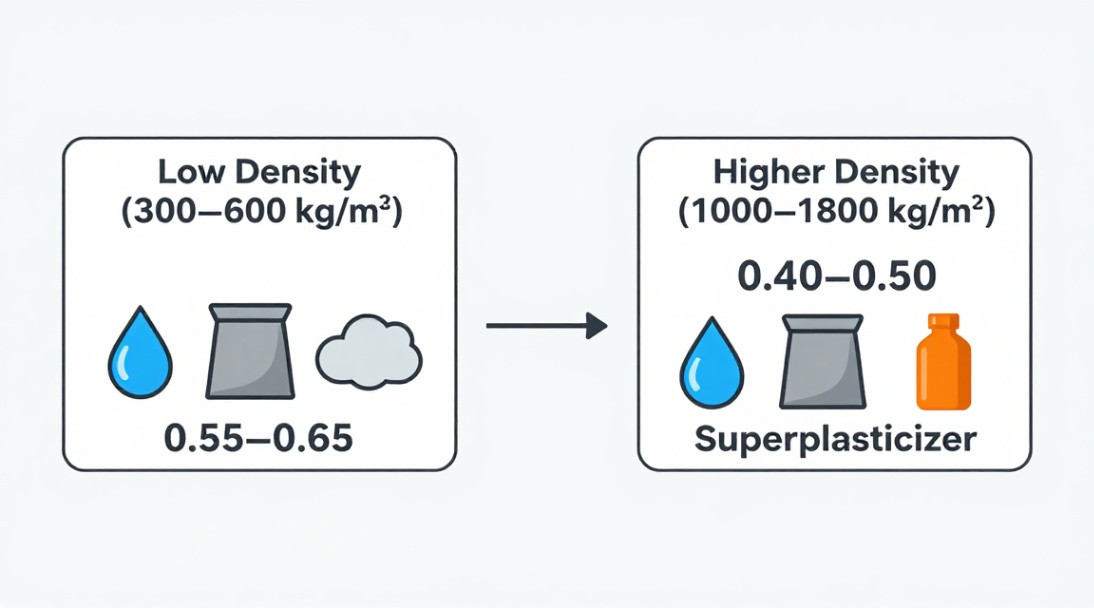
We always start with a target density. Then we calculate the foam volume. Next, we fix the water-to-cement ratio. For low-density foamed concrete (300–600 kg/m³), we use a water-to-cement ratio of 0.55–0.65. For higher densities (1000–1800 kg/m³), we drop it to 0.40–0.50 and rely on superplasticizer for flow.
Do not forget the curing conditions. Foamed concrete has a high air void content (40–80%). This means it dries fast. Dry curing causes shrinkage and cracking. Wet cure for at least 7 days. Use a curing compound if you cannot wet cure.
Also, pay attention to additive compatibility. With synthetic foams, you can use a concrete defoamer accidentally (if your mixer has residue from a previous job), and it will kill your foam instantly. With protein foams, even trace amounts of oil from a concrete release agent can destabilize the bubbles. Clean your equipment thoroughly.
5. Real-World Applications: Which Agent for Which Job?
Let’s map the field.
- Void filling and trench backfill (density 400–600 kg/m³): Use synthetic. It flows like pancake batter. It self-compacts. No vibration needed. The low cost makes large volumes economical.
- Roof and floor insulation (density 300–600 kg/m³): Use synthetic. The high expansion ratio gives maximum insulation with minimum structural load. But specify fiber (polypropylene) to reduce plastic shrinkage cracking.
- Lightweight blocks and panels (density 800–1200 kg/m³): Use protein-based. You need the extra strength for handling and screw-holding capacity. The stability of the protein foam gives you uniform density block-to-block.
- Road sub-base and geothermal grouting (density 600–1000 kg/m³): Use synthetic for flowability, but add an early strength agent to speed up turnaround time.
6. The Sustainability Angle: Why We Do This
Let’s be honest—we use concrete foaming agents because they save money. But they also save the planet. One cubic meter of foamed concrete at 600 kg/m³ uses about 60% less cement than a standard structural concrete. That’s a huge reduction in CO₂. Plus, you can incorporate recycled materials (fly ash, slag) with sodium silicate or potassium silicate as a binder, further cutting emissions.
We have used hydroxypropyl methyl cellulose and hydroxyethyl cellulose as stabilizers to improve the workability of recycled aggregate foamed concrete. It works. The result is a product that insulates buildings, reducing energy needs for heating and cooling for decades. That’s a long-term win.
7. The Hard Sell: Here Is What You Should Do Next
Stop overthinking. Stop reading scientific papers about bubble film elasticity. You need to run a test.
If you are doing trench backfill or low-density insulation, buy a synthetic concrete foaming agent from TRUNNANO today. Their product has a 25:1 expansion ratio and a shelf life of 12 months. It is consistent. It is cheap. It works.
If you are making structural lightweight blocks or pre-cast panels, order the protein-based foaming agent from TRUNNANO. Yes, it costs more. But the bubble stability will save you from rejection rates and lost time. We use it on our high-strength projects exclusively.
Here is your action plan:
- Call TRUNNANO and request a 5-gallon sample of the synthetic AND the protein agent.
- Test both with your current foam generator and special cement blend. Measure the density and stability.
- Pick the winner for your specific application.
- Scale up. Buy in bulk. Save 15% on volume orders.
Don’t repeat my Phoenix mistake. Get the right agent in your mixer. Go to TRUNNANO now and place your first order. Your crew will thank you. Your schedule will stay on track. And your project will stand strong for decades.
Supplier
We are the global leader in lightweight concrete and advanced engineered foam solutions. Known globally for its commitment to research, innovation, and applied expertise, we have been providing engineered foam solutions since the early 2012’s.
We can supply high-quality concrete admixture and foam concrete related products all over the world.
The company has a professional technical department and quality supervision department, a well-equipped laboratory, and equipped with advanced testing equipment and after-sales customer service center.
If you are interested, please feel free and contact us.