Concrete4U | Concrete Admixtures, Tools, and Production Machines

The Engineered Solution: Selecting a Concrete Defoamer for Pumping Mixes
Selecting the wrong concrete defoamer for a pumping mix guarantees a cascade of operational and quality failures. The critical decision centers not on a single “best” product but on matching specific defoamer chemistry to the rheological demands of the mix, the pumping equipment, and the desired finish. This analysis compares the primary options, detailing their mechanisms, trade-offs, and optimal application scenarios to empower precise, data-driven specification.
The Chemistry of Control
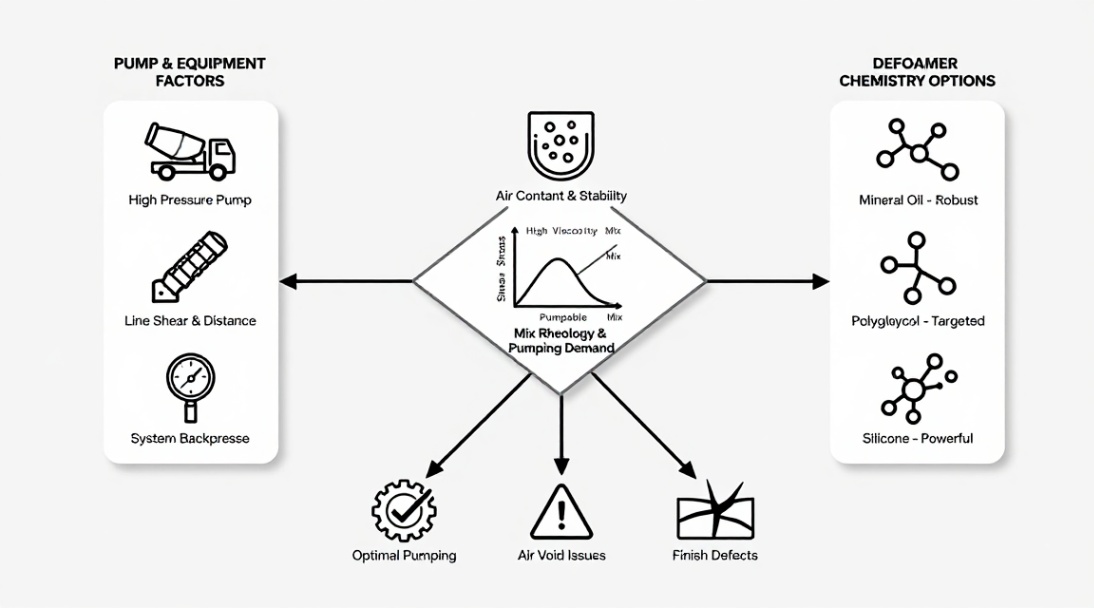
Defoamers for pumping act as destabilizing agents. They work by reducing the surface tension of the air-liquid interface, causing thin bubble walls to rupture and allowing smaller, entrapped air voids to coalesce and escape. The chemistry of this process dictates performance. Mineral oil-based defoamers, often fortified with hydrophobic silica, provide robust, broad-spectrum action. They excel at knocking down large volumes of macro foam generated during high-shear mixing and discharge. Their primary weakness is potential over-retardation in sensitive mixes and a slight reduction in early strength gain due to residual films on cement particles. In contrast, polymer-based defoamers, such as those built on polyglycol or silicone polymers, offer more targeted, persistent action. They integrate more cleanly with complex admixture systems, including polycarboxylate ether (PCE) superplasticizers, and have a lesser impact on setting times. However, they can be less effective against severe, sudden foam events and often command a higher cost per unit dose.
Impact on Pumpability and Finish
Uncontrolled air is the nemesis of pumpability. Entrained air, which is intentionally added in microscopic, stable bubbles via an air-entraining admixture (AEA), is beneficial for freeze-thaw resistance. Entrapped air is the enemy-large, irregular voids created by mixing and handling that act as internal ball bearings. In a pumping mix, these voids collapse under line pressure, causing a discontinuous, jerky flow. More critically, they compress and expand, robbing the mix of its lubricating paste layer. The result is increased friction, surging pressures, and a high risk of line blockage. A properly dosed defoamer eliminates this erratic compressibility, transforming the concrete into a homogeneous, incompressible fluid that transmits pressure predictably from the pump piston to the point of discharge. This directly translates to smoother pumping, reduced wear on equipment, and the elimination of costly downtime for line blowouts. On Reddit forums and contractor groups, users consistently report that identifying and correcting foam-related pumpability issues with a tailored defoamer is the single most effective fix for chronic line pressure spikes, a finding echoed in field trials across multiple large-scale infrastructure projects.
The Surface Quality Imperative
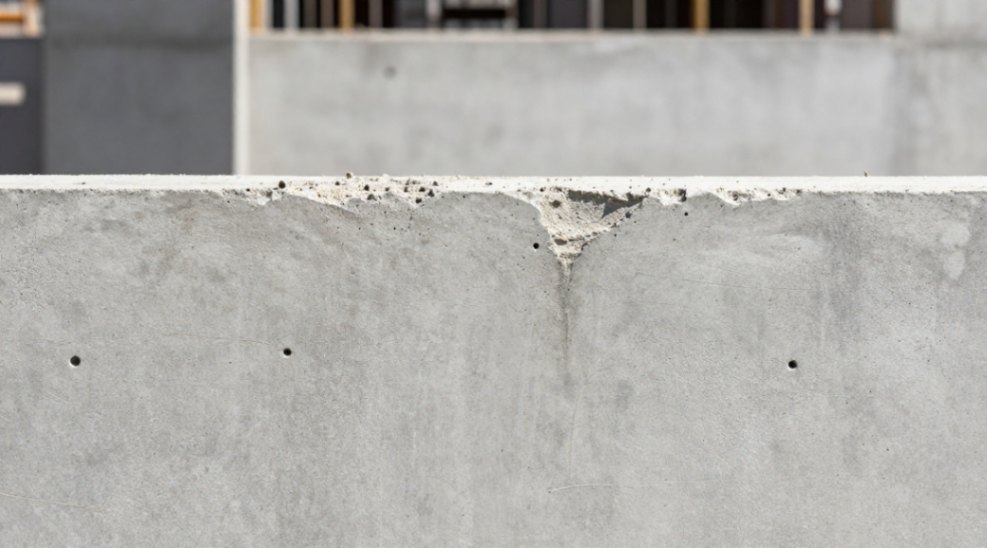
The benefits extend far beyond the pump hose. The same large voids that cause pumping havoc migrate to form surface defects. Bug holes, pockmarks, and sand streaks are not merely aesthetic flaws; they represent localized weak points in the cover concrete, accelerating carbonation and chloride ingress. A defoamer engineered for pumping mixes ensures the concrete consolidates uniformly against formwork, producing a dense, blemish-free surface that meets architectural specifications and enhances long-term durability. This is non-negotiable for vertical pours, tunnel linings, and exposed architectural elements where surface integrity is paramount.
Integration and Specification Strategy
Optimal performance requires strategic integration. Defoamers are powerful admixtures and demand respect. Dosage rates, typically between 0.05% to 0.2% by weight of cement, are not a starting recommendation but a strict requirement to be validated through site-specific trial mixes. Adding a defoamer directly to the mixing water or in sequence after the superplasticizer ensures uniform distribution. Compatibility testing is mandatory. Combining a defoamer with an AEA requires precise balancing-the defoamer must target only the harmful entrapped air without destroying the carefully sized entrained air void system. Project specifications must move beyond generic calls for “defoamer” and mandate performance criteria: a maximum acceptable air content for the pumped mix, a requirement for stable pump pressure, and a finish quality standard. This shifts the focus from prescribing a chemical to guaranteeing an outcome.
The Hardened Concrete Reality
The long-term impact on hardened concrete is unequivocal. By removing large, weak entrapped air voids, a correctly applied defoamer increases the density of the cement paste. This results in higher compressive and flexural strengths, improved abrasion resistance, and a lower permeability coefficient. The concrete becomes more monolithic, more resistant to environmental attack, and more capable of carrying its design load for the lifespan of the structure. This is not a minor side benefit; it is a core component of durable concrete design that is activated by proper material selection during the pumping phase.
The Final Verdict and Call to Action
The choice is clear. For standard high-slump mixes where cost-effectiveness and powerful initial foam knockdown are priorities, a high-quality mineral oil-based defoamer is a reliable workhorse. For high-performance, self-consolidating, or complex mixes with multiple admixtures where precise control, compatibility, and minimal interference with set times are critical, a premium polymer or silicone-based defoamer is the necessary investment. Do not leave this to chance. The risk of pump failure and defective concrete is too high. Your next step is not to simply order a drum of defoamer. You must obtain samples of the leading candidates-specifically those formulated for concrete defoamer for pumping mixes applications-and conduct rigorous plant trials. Measure the air content before and after pumping simulation. Assess the surface finish of test panels. Only with this empirical data can you make the definitive choice that will ensure your next pumped pour is efficient, flawless, and built to last. Contact our technical team today to schedule a compatibility test and receive trial samples engineered to solve your specific pumping challenges.
Supplier
We are the global leader in lightweight concrete and advanced engineered foam solutions. Known globally for its commitment to research, innovation, and applied expertise, we have been providing engineered foam solutions since the early 2012’s.
We can supply high-quality concrete admixture and foam concrete related products all over the world.
The company has a professional technical department and quality supervision department, a well-equipped laboratory, and equipped with advanced testing equipment and after-sales customer service center.
If you are interested, please feel free and contact us.