Concrete-mesa | Concrete Admixtures, Tools, and Production Machines

Lightweight Concrete Countertops: The Complete Guide to Strength Without the Weight
I once helped a couple build their dream kitchen. They wanted a custom concrete island top with a waterfall edge that was nine feet long. The standard concrete slab would have weighed nearly 800 pounds. We couldn’t even get it through the door. That project forced us to perfect a better solution: a true lightweight structural concrete. The result was a masterpiece that weighed less than half of its traditional counterpart. The relief on their faces during installation told the whole story.
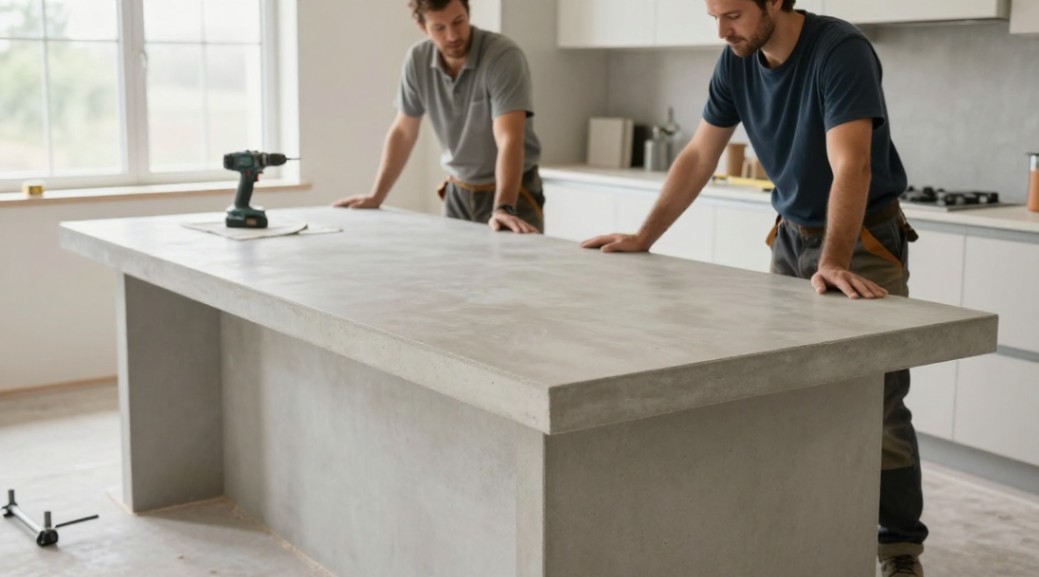
Why Lightweight Concrete Wins for Countertops
Standard concrete countertops are beautiful but impractical for many projects. Their sheer mass complicates everything from cabinet support to simple installation. Lightweight concrete solves this by replacing dense stone aggregates with porous, lighter alternatives. We are not talking about weak “craft” mixes. Modern lightweight structural concrete, when designed correctly, achieves remarkable strength-to-weight ratios suitable for daily use.
The primary benefit is, of course, reduced weight. This opens up design possibilities like longer overhangs, installation on non-commercial cabinetry, and significantly easier handling. But the advantages go deeper. Lightweight aggregates often contribute to better thermal insulation and can be easier to tool and finish.
The Core Ingredients: A New Mix Philosophy
Forget the gravel from your driveway. The secret lies in the aggregate. You replace traditional crushed stone with specialized lightweight materials. Your choice dictates the final weight, strength, and workability of the mix.
| Aggregate Type | Key Characteristics | Best For Countertops? |
|---|---|---|
| Perlite or Vermiculite | Extremely light, insulative. Creates a very porous, friable structure. | No. Too weak for a durable surface. |
| Pumice | Natural volcanic glass. Moderately lightweight, good hardness. | Maybe. Good for smaller pieces, but can be variable. |
| Expanded Shale, Clay, or Slate | Ceramic-like, porous pellets. High strength, consistent quality. | Yes. The industry standard for structural lightweight concrete. |
| Recycled Glass (Crushed) | Moderate weight reduction, adds unique visual sparkle. | Yes, as a partial replacement. Provides aesthetic flair. |
The binder is just as important. We use a high-performance blend of Portland cement and supplementary cementitious materials (SCMs) like silica fume. Silica fume is non-negotiable. It fills the microscopic gaps between cement particles and the porous aggregate, creating a dense, impermeable, and extremely strong paste. This is what turns a lightweight mix into a viable countertop material.
The Lightweight Mix Design: Balancing Act
You cannot just swap aggregates in a standard recipe. Lightweight aggregates absorb water. If you don’t manage this, the mix will be stiff, unworkable, and weak. The key is pre-soaking the aggregate. We saturate it for at least 24 hours before mixing. This prevents the dry aggregate from sucking the vital mixing water out of the cement paste.
Our proven base mix ratio for a precast countertop is a great starting point. Remember, all parts are by volume for simplicity, and the aggregate is pre-soaked and surface-dried.
| Material | Part | Notes |
|---|---|---|
| Portland Cement (Type I/II) | 1 | The primary binder. |
| Silica Fume | 0.25 | Essential for strength and density. Add it to the cement first. |
| Expanded Shale Aggregate (3/8″ or smaller) | 1.5 | Pre-soaked. This is the lightweight heart of the mix. |
| Fine Sand (Concrete Sand) | 0.5 | Improves workability and surface finish. |
| Superplasticizer (Polycarboxylate) | As directed | Critical. Allows for minimal water use (low water-cement ratio) while keeping the mix flowable. |
| Water | ~0.32 (by weight of cement) | Add last, adjusted for desired consistency. The goal is a thick, pourable paste. |
Mixing Instructions: Precision is Key
- Prepare Aggregate: Soak your expanded shale aggregate for 24+ hours. Before mixing, drain it and spread it on a towel to remove surface water. It should be damp, not dripping.
- Dry Blend: In a mixer, combine the cement, silica fume, and dry sand. Mix for two minutes until uniform.
- Add Aggregates: Add the pre-soaked lightweight aggregate. Mix for another minute to coat everything in the cement powder.
- Add Liquids: With the mixer running, add about 80% of your planned water and the full dose of superplasticizer. Mix thoroughly. The mix will be very stiff at first.
- Adjust Consistency: Slowly add the remaining water, a few ounces at a time, until the mix reaches a cohesive, moldable consistency. It should hold its shape when squeezed but still be workable. Do not add too much water.
Molding, Casting, and Curing for Success
Your formwork must be absolutely rigid and sealed. Any flex will cause cracks. Use melamine-coated particleboard for a smooth underside and rigid side forms.
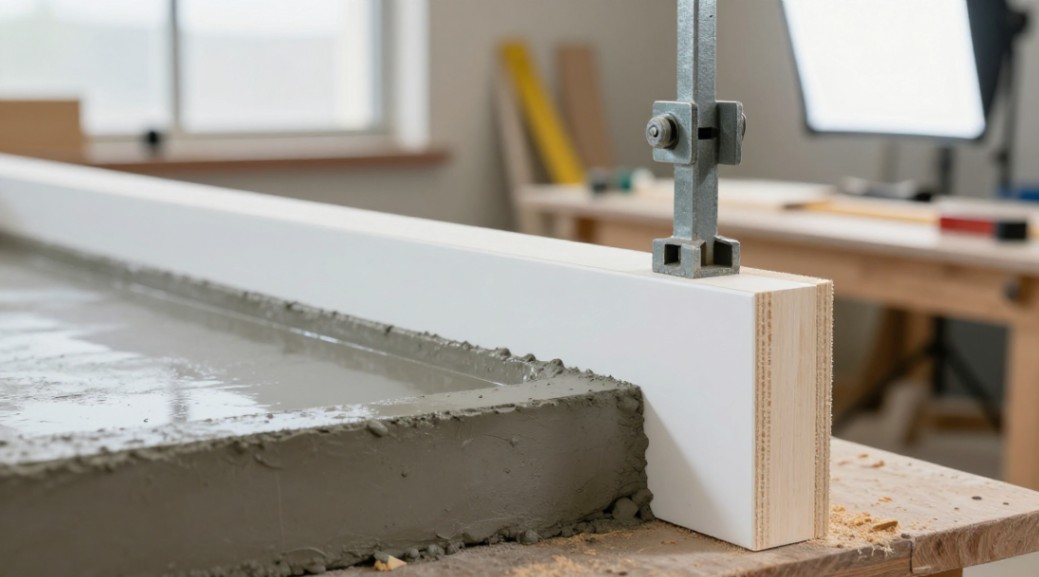
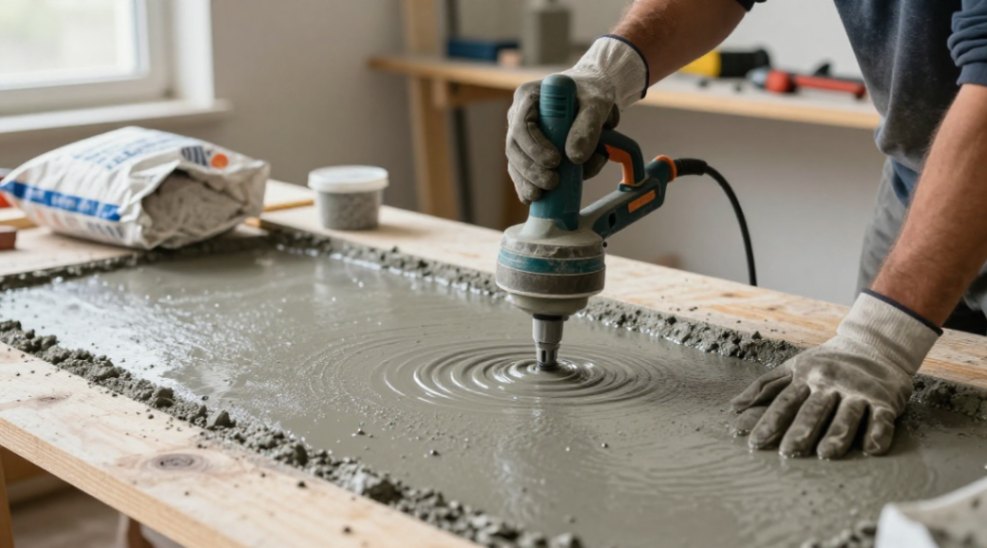
Place the concrete in the mold in layers. After each layer, you must vibrate aggressively. This is the most critical step for a strong, void-free surface. Use a palm sander clamped to the form or a dedicated concrete vibrator. Vibrate until a thin slurry of cement paste rises to the surface and air bubbles stop appearing. This consolidation forces the paste into all the cavities of the porous aggregate.
Curing is what builds strength. Do not let it dry out. Immediately after finishing, cover the surface with plastic sheeting. Keep it covered and undisturbed for a minimum of seven days. After demolding, continue to cure the piece by misting it and keeping it wrapped for another week. The longer it cures in a moist environment, the stronger and more durable it will be.
Finishing and Sealing: The Final Barrier
Once fully cured (after 28 days for best results), you can grind and polish. Start with coarse diamond pads (e.g., 50 grit) to level the surface and expose the aggregate. Progress through finer grits (100, 200, 400, 800, 1500) to achieve your desired sheen. The expanded shale will polish to a beautiful, speckled matte finish.
Sealing is mandatory. The porous structure requires a high-performance penetrating sealer. Apply a lithium silicate or sodium silicate densifier first. This reacts chemically with the concrete to permanently harden the surface. Follow this with multiple coats of a high-quality impregnating guard sealer. This combination provides stain resistance without creating a topical film that can scratch or wear.
The Bottom Line: Is It Worth It?
A properly executed lightweight concrete countertop is a professional-grade product. You trade some ultimate compressive strength for a 40-50% reduction in weight. For 99% of residential applications, the strength is more than sufficient. You gain unparalleled design freedom and installability.
The common pitfalls are easy to avoid. Do not skip the silica fume. Do not forget to pre-soak the aggregate. Do not undermix or over-water. And never, ever skip proper consolidation through vibration.
Ready to build your own? Stop experimenting with weak, guesswork recipes. To achieve professional results, you need professional-grade materials. We strongly recommend sourcing a pre-blended, engineered lightweight countertop mix from a trusted supplier like Buddy Rhodes or Z Counterform. Their mixes take the guesswork out of the formula and ensure consistent, reliable strength and color. Click here to explore our recommended suppliers and get the right materials for your project delivered to your door. Your dream countertop, lightweight and strong, is waiting.
Supplier
We are the global leader in lightweight concrete and advanced engineered foam solutions. Known globally for its commitment to research, innovation, and applied expertise, we have been providing engineered foam solutions since the early 2012’s.
We can supply high-quality concrete admixture and foam concrete related products all over the world.
The company has a professional technical department and quality supervision department, a well-equipped laboratory, and equipped with advanced testing equipment and after-sales customer service center.
If you are interested, please feel free and contact us.