Concrete-mesa | Concrete Admixtures, Tools, and Production Machines

7 Specific Ways HPMC Transforms Masonry Mortar Workability and Productivity
The Simple, Powerful Truth About HPMC in Mortar
HPMC directly improves masonry mortar workability by acting as a water-retaining lubricant, giving you more time and better control. Forget battling mortar that skins over in 10 minutes or slumps down a wall. Builders on forums from Reddit to professional trade boards consistently confirm this: HPMC is the single most impactful additive for creating a mortar that behaves exactly how you need it to.
1. Understanding HPMC: More Than Just a Powder
Hydroxypropyl Methylcellulose (HPMC) is a cellulose ether derived from natural plant fibers. In masonry mortar, it isn’t an inert filler. Think of it as the manager of your mix’s water.
- Its Primary Job: A water-retention agent.
- Its Secondary Effect: A powerful workability enhancer.
- The Result: A mortar that stays plastic, cohesive, and workable far longer than a plain mix.
1.1 The Water Retention Mechanism
HPMC molecules hydrate and swell in water, creating a protective gel network. This gel physically traps free water within the mortar matrix. It slows evaporation. This is the core of its magic.
2. A Closer Look at the 7 Key Benefits
Here’s the detailed breakdown of how that gel network translates to real-world results.
2.1 Extends Open and Tooling Time Dramatically
The most immediate benefit. Without HPMC, mortar on the hawk can stiffen rapidly, especially in hot, dry, or windy conditions. With HPMC, the workable time can double or even triple. You can lay more brick or block before the mix becomes uncooperative. As one mason shared, “It turns a frantic race into a manageable, precise job.”
2.2 Provides Superior Lubrication and Consistency
The HPMC gel lubricates the cement and sand particles. This leads to a smooth, buttery consistency. The mortar spreads effortlessly under the trowel. It requires less physical effort to achieve a perfect bed joint.
2.3 Reduces Sag and Slump on Vertical Surfaces
For a brick wall or a block core, sagging mortar is a major hassle. HPMC increases the mortar’s cohesion and thixotropy-it becomes more viscous when at rest. This means it stays put on a vertical surface without squeezing out of the joints. The wall looks cleaner immediately.
2.4 Improves Adhesion and Reduces Cracking
This is critical. By retaining water, HPMC ensures cement grains have the hydration time they need to develop full strength and bond. Premature drying is a leading cause of weak, powdery joints and plastic shrinkage cracks. HPMC virtually eliminates this. The bond between the unit and mortar is significantly stronger.
2.5 Enhances Efficiency and Reduces Waste
These factors combine for greater productivity. Less mortar is thrown away because it dried out. Masons spend less time re-tempering or struggling with a poor mix. The job moves faster and with less fatigue. Your material cost per laid unit goes down.
2.6 Allows for Greater Water Addition Flexibility
Because HPMC holds the water so effectively, you can achieve a more workable, “wet” mortar without the penalty of segregation or excessive slump. You gain finer control over your mix’s rheology.
2.7 Works in Synergy with Other Additives
HPMC plays very well with others. Combining it with a small dose of an air-entraining agent creates a mortar with even better workability, freeze-thaw resistance, and a lighter, creamier texture. It’s a classic one-two punch for high-performance mixes.
3. Practical Application: A Step-by-Step Guide
Here’s how to incorporate HPMC correctly, based on common feedback and proven methods.
3.1 Selecting the Correct Viscosity Grade
Not all HPMC is the same. For masonry mortar, you need a mid-to-high viscosity grade. Look for products labeled in the 40,000 to 75,000 mPa·s (4% solution) range. Lower viscosities won’t provide enough water retention. Higher viscosities can make the mix too stringy and slow.
3.2 Dosage Recommendations
Dosage is weight-based, not volume. A little goes a very long way.
- Standard Improvement: 0.1% to 0.2% by weight of cement. (That’s 0.1 to 0.2 kg per 100 kg of cement).
- Hot/Dry/Windy Conditions: 0.2% to 0.3% by weight of cement.
- For Very High Water Retention (e.g., lightweight blocks): Up to 0.4%.
Pro Tip: Start at 0.15%. You can adjust from there based on your specific sand, climate, and needs.
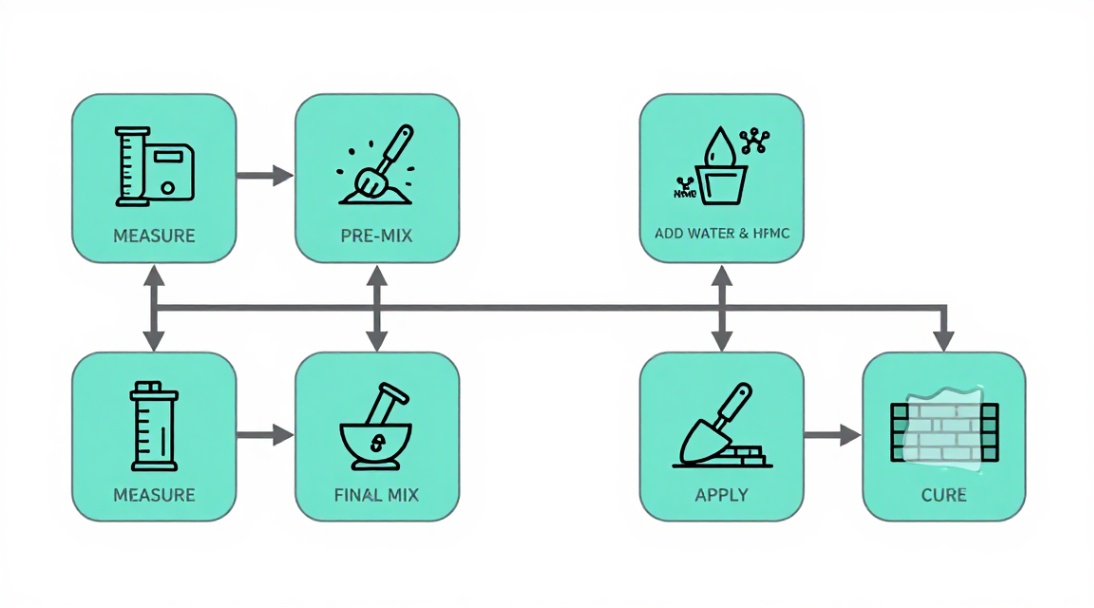
3.3 The Critical Mixing Procedure
Proper dispersion is non-negotiable. Adding HPMC incorrectly leads to lumps (“fish eyes”) that never hydrate.
- Weigh your HPMC powder accurately. Use a gram scale for small batches.
- Add the HPMC powder to the dry sand and cement in the mixer. Never add it directly to water.
- Mix the dry ingredients for 1-2 minutes. This ensures even distribution.
- Then, add approximately 90% of your mixing water. Run the mixer for 3-5 minutes.
- Pause and let the mortar sit (slake) for 2-3 minutes. This allows the HPMC to fully hydrate and start gelling.
- Mix again for 2-3 minutes, adding the remaining water as needed to achieve perfect consistency.
4. Performance Comparison: With vs. Without HPMC
To see the difference, consider this side-by-side view based on typical job site feedback.
| Performance Factor | Mortar WITHOUT HPMC | Mortar WITH HPMC |
|---|---|---|
| Workable Life | 15-30 minutes | 45-90+ minutes |
| Consistency Over Time | Dries out quickly, stiffens | Stable, remains plastic |
| Vertical Sag | Moderate to high | Very low to none |
| Surface Cracking Risk | High in hot/dry conditions | Dramatically reduced |
| Trowel Effort Required | Higher | Lower, smoother |
| Material Waste | Higher (dried-out mortar) | Lower |
5. Solving Common Challenges
Let’s address specific problems HPMC solves, directly from the field.
5.1 “My mortar skins over before I can use it.”
This is the classic symptom of poor water retention. The water evaporates from the surface instantly. Increase your HPMC dosage to the 0.25% range and ensure you’re using the correct viscosity grade.
5.2 “The joints crack as they dry.”
These are plastic shrinkage cracks. The mortar lost its internal water before the cement could hydrate properly. HPMC’s water-retaining gel network prevents this by keeping the mix internally moist.
5.3 “Laying block in the summer is a nightmare.”
Summer conditions are the ultimate test. Many pros now consider HPMC essential for summer work. It compensates for high evaporation rates, allowing crews to maintain pace and quality all day.
Your Next Step: A Simple Trial
You don’t have to overhaul your entire operation. The most convincing evidence is in your own trowel. Pick up a small bag of masonry-grade HPMC (aim for 60,000 mPa·s). Mix one standard batch with your typical 0.15% addition. Compare it side-by-side with your regular mix. Feel the difference in your arms. Watch how it sits on the wall. Notice how long it stays usable. That hands-on experience, which countless masons have shared online, is why HPMC has moved from a specialty additive to a standard practice for crews who value their time and their craft.
Supplier
We are the global leader in lightweight concrete and advanced engineered foam solutions. Known globally for its commitment to research, innovation, and applied expertise, we have been providing engineered foam solutions since the early 2012’s.
We can supply high-quality concrete admixture and foam concrete related products all over the world.
The company has a professional technical department and quality supervision department, a well-equipped laboratory, and equipped with advanced testing equipment and after-sales customer service center.
If you are interested, please feel free and contact us.