Concrete4U | Concrete Admixtures, Tools, and Production Machines

How to Use Potassium Silicate for Acid Resistant Mortars: A Contractor’s Guide
The Unspoken Reality of Chemical Resistance
Despite the proliferation of advanced synthetic resins, a material system developed over a century ago still holds over 40% of the market for severe-duty, acid-resistant floors in European chemical plants. The binder is potassium silicate. This statistic isn’t a testament to outdated practices, but to a fundamental chemical truth: when properly formulated and installed, inorganic silicate bonds offer a permanence and fire resistance that organic polymers cannot match. Potassium silicate for acid resistant mortars creates a ceramic-like matrix that doesn’t just coat aggregates; it becomes one with them through a chemical reaction. As an expert who has specified and overseen these installations for decades, I can state that failure is almost always a process error, not a material flaw. The key lies in understanding and respecting the chemistry.
The Chemical Ceramic: How Potassium Silicate Works
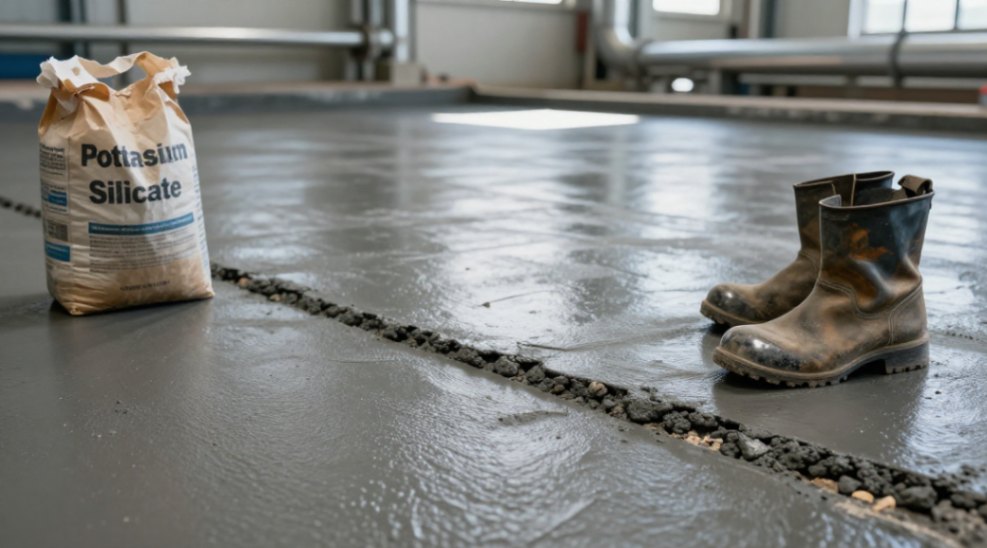
Forget the idea of a simple glue. Potassium silicate, often called waterglass, acts as a reactive precursor. In its liquid state, it’s an alkaline solution of silica dissolved in potassium hydroxide. The magic begins when you introduce a hardener, typically a powdered silicate like sodium fluorosilicate or aluminum phosphate. This initiates an acid-base reaction that gels the binder. Over hours and days, this gel undergoes polycondensation. Silanol (Si-OH) groups link together, forming a continuous, three-dimensional silicon-oxygen (Si-O-Si) network. This network is a ceramic in all but its formation temperature. It embeds the acid-resistant aggregates-usually quartz, andesite, or ceramic shards-into a monolithic, mineral solid. The resulting composite is impervious to most inorganic acids because the matrix itself is an acid. You cannot attack it with the very substance of which it is made. This distinguishes it from Portland cement, which is highly alkaline and vulnerable, and from organic resins, which can soften, hydrolyze, or burn.
Step-by-Step Guide: From Powder to Impervious Surface
Success is sequential. Deviating from this order guarantees a weak, non-resistant installation.
Stage One: Substrate Preparation – The Non-Negotiable Foundation
You are not applying a coating; you are building a new, integral ceramic layer. The concrete substrate must be sound, clean, and profiled. Mechanical scarification with a shot blaster or scarifier is mandatory to achieve a CSP 3 (coarse) profile, removing laitance and opening pores. All dust must be removed with industrial vacuuming. The surface must be saturated-surface-dry (SSD). Standing water will dilute the binder; a dry, porous surface will steal water from the mix, starving the chemical reaction. Check for levelness and structural cracks, which must be repaired with a compatible epoxy mortar beforehand. This stage consumes 50% of the labor but determines 100% of the outcome.
Stage Two: Material Handling and Proportioning – Precision is Paramount
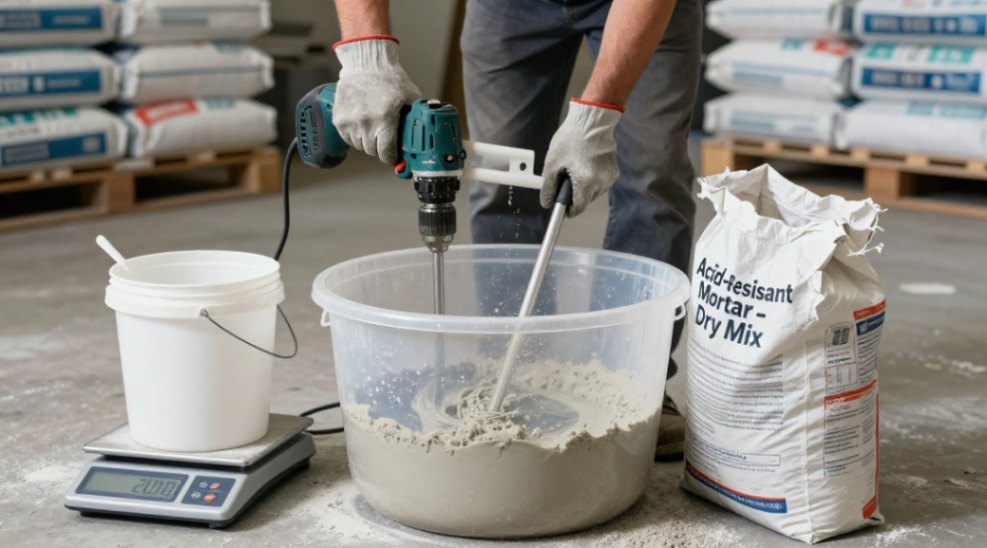
Pre-bagged, factory-blended dry mortars are standard and recommended. These contain the precise ratio of graded aggregates and the powdered hardener. The only component you add on-site is the liquid potassium silicate binder. Follow the manufacturer’s mix ratio to the letter, always by weight, not volume. A typical ratio is 100 parts dry powder to 18-22 parts liquid binder by weight. Pour the correct mass of silicate liquid into a clean mixing tub. Gradually add the full bag of powder while mixing with a low-speed, high-torque paddle mixer (300-400 rpm). Mix for 3-4 minutes until a homogeneous, lump-free, buttery consistency is achieved. The pot life is typically 30-45 minutes at 20°C (68°F). Mix only as much as you can place within that window.
Stage Three: Application and Curing – The Chemical Transformation
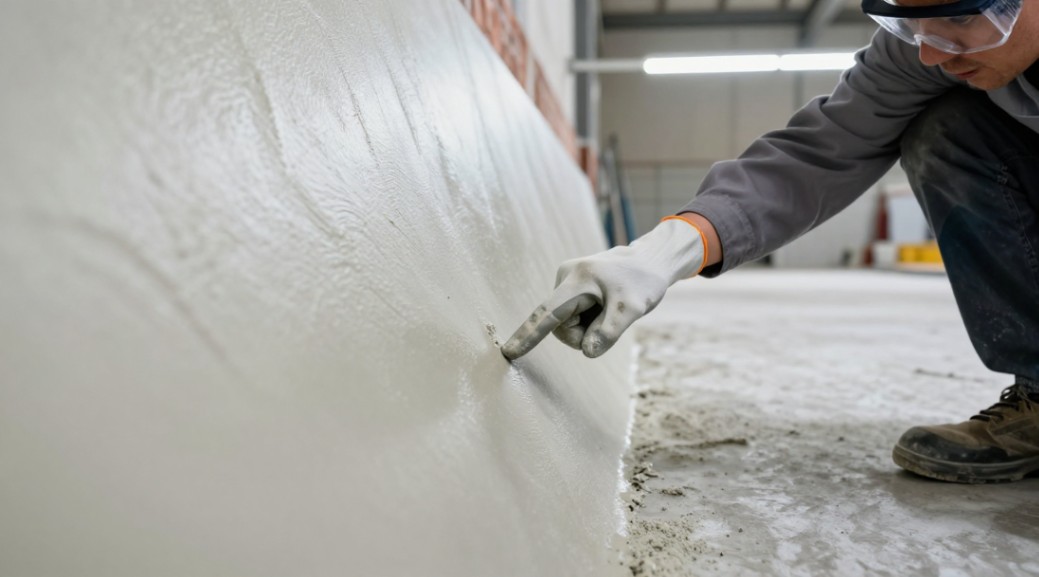
Apply the mortar using a steel trowel. Work it firmly into the substrate to eliminate voids. For floors, apply in a single layer to the specified thickness, usually between 15 mm and 25 mm. Strike it off with a straightedge, then finish with a steel trowel as it begins to stiffen. The initial set, where the material can bear light foot traffic, occurs in 4-8 hours. The chemical cure, however, takes days. You must manage the evaporation. Too fast, and the gel cracks; too slow, and strength development stalls. Cover the installed mortar with polyethylene sheeting for 24 hours. Then, remove the sheeting and allow it to air-cure for a minimum of 72 hours before light service. Full chemical resistance develops after 7-10 days. During this period, a controlled environment of 15-25°C (59-77°F) is ideal.
Critical Process Summary
| Stage | Key Action | Critical Parameter | Acceptable Range |
|---|---|---|---|
| Preparation | Surface Profiling | Profile Depth | CSP 3 (Coarse) |
| Proportioning | Mixing Ratio | Powder : Liquid (by weight) | 100 : 18 – 22 |
| Mixing | Mixing Time & Speed | Duration / RPM | 3-4 min / 300-400 rpm |
| Application | Working Time | Pot Life at 20°C | 30-45 minutes |
| Curing (Initial) | Moisture Retention | Covered Duration | 24 hours minimum |
| Curing (Final) | Air Cure Before Service | Time to Light Service | 72 hours minimum |
The Profile of Performance and Where It Belongs
This material is not a universal panacea. Its strength is its specific profile. Potassium silicate mortars exhibit outstanding resistance to all concentrations of inorganic acids-sulfuric, hydrochloric, nitric, phosphoric-and acidic salts. They withstand continuous temperatures up to 800°C (1472°F) without softening, making them ideal for chimney linings and furnace foundations. Their zero organic content makes them non-combustible and free of toxic smoke. The ceramic nature grants excellent compressive strength and abrasion resistance. These properties define its core application areas: monolithic floor toppings and trenches in battery recycling plants, metal pickling lines, and chemical processing areas; linings for secondary containment bunds and chemical storage tanks; brickwork bedding and jointing in acid towers; and linings for wastewater neutralization pits. Its weakness is hydrofluoric acid and strong alkaline solutions (pH > 12), which attack the silica network. In those environments, an organic resin or carbon brick system is the correct choice.
Ensuring Decades of Service: Safety, Inspection, and Maintenance
Handling requires respect. Wear alkali-resistant gloves, goggles, and protective clothing. Liquid potassium silicate is alkaline and can irritate skin and eyes. Ensure good ventilation in confined spaces. Once installed and cured, maintenance is minimal but critical. Perform a visual inspection quarterly for any cracks, chips, or signs of mechanical damage. Chemical attack is usually evident as a loss of gloss or a slight surface powdering in localized areas. Do not use alkaline cleaners for wash-down. For repair, the area must be cut back to sound material, the edges feathered, and the same mix reapplied following the original curing protocol. The system’s longevity is proven. I have inspected floors still in perfect service after thirty years of exposure to 10% sulfuric acid. That durability is not an accident. It is the direct result of rigorous adherence to the chemical process outlined here.
The Next Step for the Practitioner
This guide provides the foundational methodology. Your next action should be to obtain the technical data sheets for a specific, reputable manufacturer’s potassium silicate mortar system. Study them. Then, conduct a trial installation on a mock-up panel, precisely following these steps and the manufacturer’s instructions. Measure your mixing times, observe the curing behavior, and test the panel’s hardness after 7 days. Only through this hands-on verification will you internalize the nuances of working time, trowel feel, and curing response. This practical confidence is what separates a successful, lasting installation from a costly failure. The material is capable. The execution determines the outcome.
Supplier
We are the global leader in lightweight concrete and advanced engineered foam solutions. Known globally for its commitment to research, innovation, and applied expertise, we have been providing engineered foam solutions since the early 2012’s.
We can supply high-quality concrete admixture and foam concrete related products all over the world.
The company has a professional technical department and quality supervision department, a well-equipped laboratory, and equipped with advanced testing equipment and after-sales customer service center.
If you are interested, please feel free and contact us.