Concrete-mesa | Concrete Admixtures, Tools, and Production Machines

Foamed Concrete Density for Fill: The Contractor’s Secret Weapon (Not Magic)
Stop Wasting Time and Money on Improper Fill
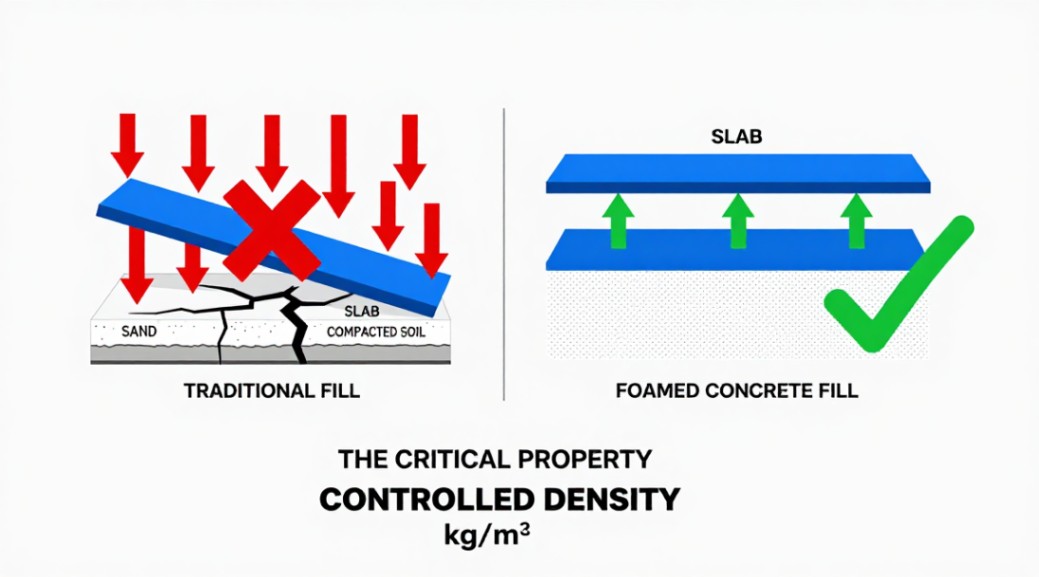
Are you tired of settlement issues destroying your carefully compacted backfill? Did another ‘flowable fill’ claim sink your budget and your slab? You’re not imagining the chaos. I’ve seen projects where traditional fill methods fail, not because of bad crews, but because of a stubborn refusal to adapt. The industry is drowning in outdated specs and generic advice. The truth is simpler. For foamed concrete density for fill applications, one property rules them all. Density. Not a magic formula, but a hard, controllable number.
Q&A: The Unfiltered Truth About Foamed Concrete Fill
What exactly is foamed concrete for fill, and why does everyone get the basics wrong?
Foamed concrete is a slurry of cement, water, and a pre-formed foam. That’s it. The foam introduces microscopic air bubbles. The common myth? That it’s just ‘lightweight concrete.’ That’s dangerously vague. For fill, it’s a controlled density material. The foam isn’t an additive; it’s the primary aggregate replacement. The composition is ruthlessly simple to allow for one outcome: precise density control, from 300 kg/m³ to 1600 kg/m³, without changing the fundamental mix design.
Why is density the ONLY property that matters for fill?
Forget compressive strength for a second. For structural pours, yes, strength is king. For fill, density is the dictator. It directly governs everything you care about: dead load, bearing capacity, and flowability. Want a number? A foamed concrete density for fill applications in the 400-800 kg/m³ range typically yields 0.3 to 1.0 N/mm² strength. That’s more than enough to support overburden and resist lateral earth pressures, while being 75% lighter than compacted soil. Engineers specify strength. Smart contractors control density to hit that strength target. Control the density, and you control the performance.
Low-density fill vs. structural fill: What’s the real difference?
The industry loves these terms. They’re misleading. It’s a continuous spectrum.
| Target Application | Typical Wet Density Range | Key Driver & Misconception |
|---|---|---|
| Utility Trench Backfill, Voids | 400 – 600 kg/m³ | Driver: Minimize load on pipes, superior flow. Misconception: It’s ‘weak.’ It’s designed for zero lateral load, not structural support. |
| Slab Subgrade, Foundation Replacement | 800 – 1200 kg/m³ | Driver: Balance lightweight properties with needed bearing capacity. Misconception: You need 2000+ kg/m³. You don’t. This range prevents differential settlement cold. |
| Structural Fill (e.g., behind abutments) | 1200 – 1600 kg/m³ | Driver: High strength-to-weight for active zones. Misconception: It’s just lightweight concrete. The controlled flow and self-levelling are the real value, eliminating compaction voids. |
What are the brutal advantages over compacted soil?
Lightweight. This is the headline. A 500 kg/m³ fill imposes 1/4 the load of soil. This solves underground utility and weak subgrade problems instantly. Flowability. It’s self-levelling and fills every irregularity and void. No more hand-compacting behind complex foundations. I’ve seen crews cut project timelines by 60% on deep trench backfills. Predictability. There is zero settlement. None. Once it cures, it’s done. The number of callbacks for sinking pavements drops to zero.
What’s the real process on site? No fluff.
1. Site Prep: Excavate to required line. Remove water. No special compaction needed. That’s the point.
2. Placement: Pump directly from the truck or mixer. Use a hose and let it flow. Placement rates can exceed 40 cubic meters per hour.
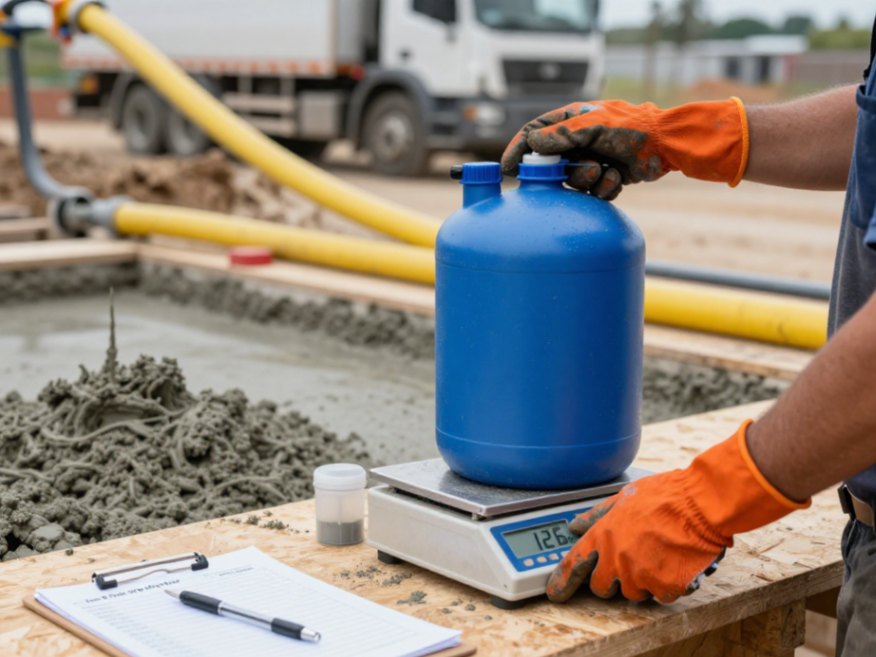
3. The Critical Step – On-Site QC: Every truck. Every pour. You must take a wet density check. Use a 1-liter or 5-litre pressurized container (like a Super Air Meter pot). Weigh it on a calibrated scale accurate to 0.1 kg. Calculate: Density (kg/m³) = (Mass of Full Pot – Tare Mass) / Pot Volume (in m³). If it’s outside the spec range (e.g., ± 50 kg/m³ of target), reject the batch. This simple 5-minute test prevents 95% of failures.
Does it last, or is this a temporary fix?
This is the most common question on contractor forums. The answer is permanent. The cementitious matrix encapsulates the air bubbles. It doesn’t degrade, biodegrade, or settle. It has minimal permeability, so it resists freeze-thaw cycles better than saturated soil. Long-term stability isn’t a hope; it’s a material property. I have core samples from 20-year-old installations showing consistent density and no degradation.
Let’s talk money. Is foamed concrete fill more expensive?
Yes, on a pure material cost per cubic yard basis. No, on a total installed cost basis. This is the calculation most estimators botch. Factor in: zero compaction equipment (labor, fuel, rental), dramatically faster placement, no import/export of unsuitable soil, zero testing for compaction (Proctor, nuclear density gauge), and the eliminated risk of post-construction settlement repairs. The project closes faster. The warranty risk plummets. When you run the real numbers, the premium often disappears, and it can even save money.
How do I specify this correctly on my next project?
Demand specificity. Vague specs like ‘lightweight fill’ cause disasters. Your specification must state: ‘Controlled Density Fill (CDF) with a target wet density of XXX kg/m³ (± 50 kg/m³) and a minimum 7-day compressive strength of Y.Y N/mm².’ Link the strength to the density. Require on-site wet density testing for every 50 m³ placed. This forces the supplier to control their process. It gives you, the contractor, a clear, measurable pass/fail criterion.
What about the environment? Is this just greenwashing?
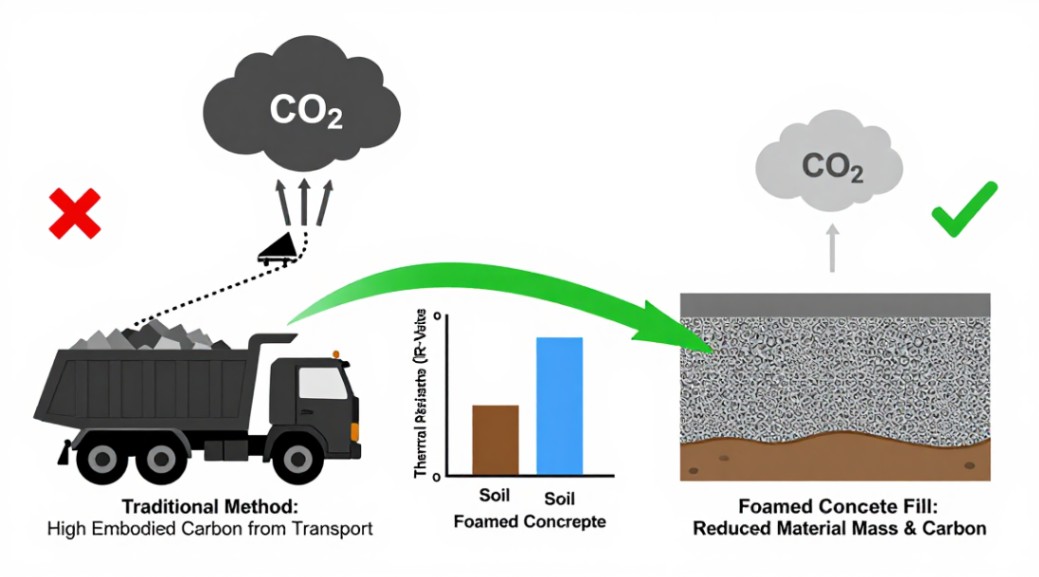
No. The environmental benefit is concrete (pun intended). By reducing the need to import thousands of tons of quarried aggregate, you slash embodied carbon from transportation. The thermal resistance (R-value) of low-density foamed concrete is significantly higher than soil. While not a dedicated insulation layer, it contributes to a more thermally stable subgrade. The real win is material reduction-achieving the same structural function with less mass. That’s fundamental efficiency.
Your Next Step
The data is clear. The method is proven. The barrier is habit. Stop fighting with unpredictable soil. On your next project with complex backfill, weak soils, or tight access, specify by density. Require the on-site test. The performance jump isn’t incremental. It’s absolute. To validate this for your specific soil conditions, the next step is a simple bearing capacity calculation comparing your traditional fill design load to the reduced load of a 600 kg/m³ foamed concrete fill. The difference will shock you. Then, talk to a specialist who understands that for foamed concrete density for fill applications, precision beats tradition every time.
Supplier
We are the global leader in lightweight concrete and advanced engineered foam solutions. Known globally for its commitment to research, innovation, and applied expertise, we have been providing engineered foam solutions since the early 2012’s.
We can supply high-quality concrete admixture and foam concrete related products all over the world.
The company has a professional technical department and quality supervision department, a well-equipped laboratory, and equipped with advanced testing equipment and after-sales customer service center.
If you are interested, please feel free and contact us.