Concrete4U | Concrete Admixtures, Tools, and Production Machines

Stop Chasing Bubbles: The 5-Step Fix for Mortar Defoamer That Actually Works
Your Perfect Mortar Surface Has a Hidden Enemy
Have you ever finished a tile adhesive job only to find a moon-scape of pinholes? Do your self-levelling compounds look like Swiss cheese after curing? That air is not just cosmetic. It weakens the bond. It creates pathways for water. It ruins the density you paid for.
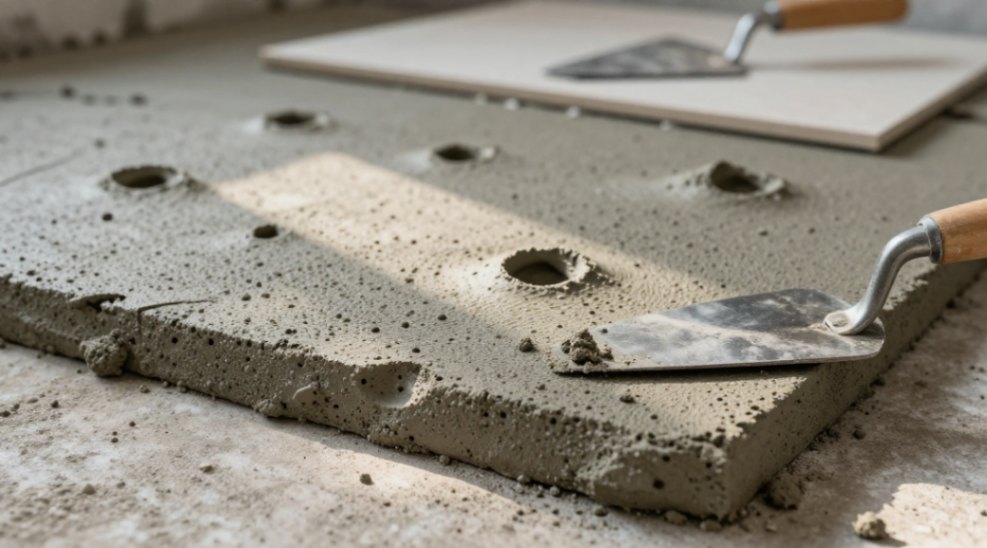
You have tried adding more defoamer. That just made the mix oily and weak. You have tried switching brands. Same bubbles, different bottle. The problem is not the chemical. It is how you think about air. You do not need to kill every bubble. You need to control the high efficiency defoamer for mortar applications to collapse the right bubbles at the right time. This is the gap between amateur mixing and professional results.
How Foam Forms: The Science You Cannot Ignore
Air entrainment in mortar is not random. It is a predictable outcome of three forces: surfactants, mechanical energy, and rheology modifiers. Cellulose ethers, re-dispersible powders, and plasticizers are surface-active. They stabilize air. When your mixer runs at high RPM, it folds air in. The additives lock those bubbles in place.
Foam in cement systems is different from gypsum. Cement systems have high ionic strength. That destabilizes some foam, but the high shear mixing re-entrains it. Gypsum systems are more sensitive to pH shifts. A liquid defoamer that works in cement can fail in gypsum. You need a product designed for high efficiency defoamer for mortar applications that handles both ionic and shear conditions.
Step 1: Pick the Right Weapon – Powder vs. Liquid
This is where most formulators go wrong. They choose based on handling, not performance.
| Type | Best For | Dosage Range (by weight of dry mix) | Key Warning |
|---|---|---|---|
| Liquid (Polyether, Silicone, Mineral Oil) | Site mixing, wet pre-mixes, liquid admixtures | 0.1-0.3% | Phase separation in storage if emulsion breaks. |
| Powder (Free-flowing, silica-carrier based) | Dry-mix mortars, factory blends, long shelf-life | 0.2-0.5% | Over-defoaming risk if particle size is too fine. |
For dry-mix tile adhesives, always start with a powder defoamer. It integrates into the blend without extra liquid. For self-leveling compounds applied on site, a liquid polyether defoamer works faster. It hits the air right at the mixing paddle. The high efficiency defoamer for mortar applications you choose must survive the pH swing from fresh mix (pH 11-12.5 in cement) to cured state.
Step 2: Dosage Precision – The 0.5% Trap
Industry standard says 0.1-0.5% by weight of dry binder. Here is the hard truth: 0.5% is almost always too much. Over-defoaming makes the mortar hydrophobic. Air tests show lower entrainment, but the surface finish gets oily. Compressive strength drops by 10-15% because the defoamer interferes with hydration.
Start at 0.15% for liquid, 0.2% for powder. Mix for 2 minutes at 700 RPM (lab scale). Check the wet density. Target 2.10 g/cm³ for standard cement mortar. If density is below that, raise dosage by 0.05% increments. Never exceed 0.35% unless your raw materials are extremely high in entrained air from the factory. Real high efficiency defoamer for mortar applications works at low dose.
Step 3: Mixing Protocol – Your Mixer Is the Problem
You cannot test a defoamer with a slow Hobart mixer on low speed. That creates no foam, so the defoamer looks great. Then you scale up to a paddle mixer on site, and it fails. Standardize your lab test.
- Dry blend the powder defoamer with the cement and aggregates for 30 seconds at low speed.
- Add water and mix at 1500 RPM for 60 seconds. Yes, high shear. That simulates real mixing.
- Scrape down the bowl at 30 seconds to ensure homogeneity.
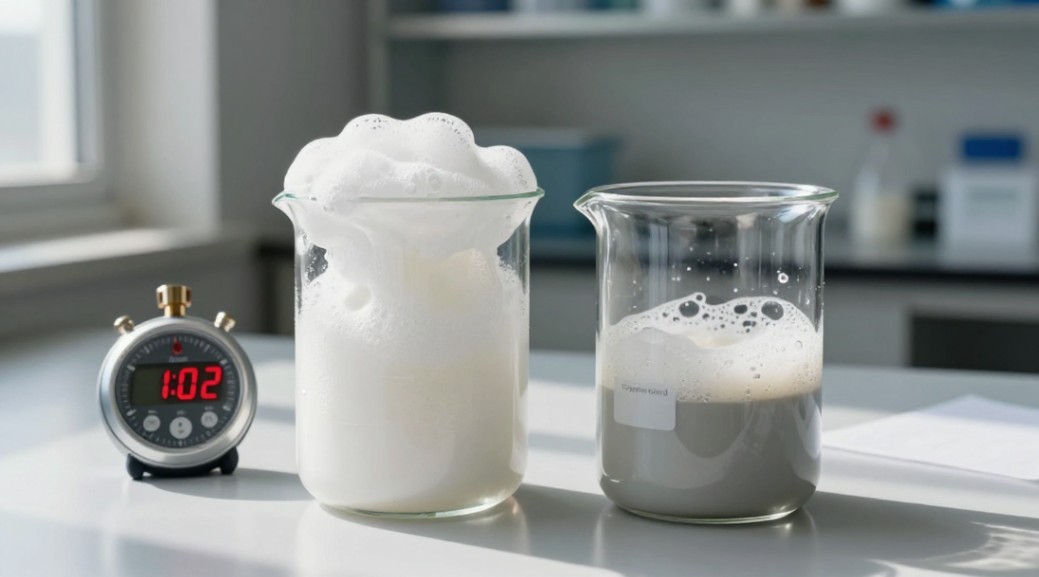
- Check foam height immediately after mixing. Pour into a graduated cylinder. Read foam volume at 1 minute and 5 minutes.
A high efficiency defoamer for mortar applications should collapse foam volume by at least 60% within 60 seconds. If the foam persists past 2 minutes, the defoamer is failing the persistence test. Switch from silicone to a polyether blend.
Step 4: Compatibility Roulette – Cellulose Ethers and Retarders
Here is the dirty secret: most defoamers kill the performance of your cellulose ether. The defoamer molecules compete for interface space, reducing the air that helps workability. You must test the combination.
Prepare three mortars with identical formulations. One with no defoamer (control), one with your test defoamer, one with a reference. Measure flow (EN 13395) and water retention after 30 minutes. If the defoamer reduces flow by more than 15%, it is incompatible. You need a high efficiency defoamer for mortar applications that has a low plateau surface tension – around 25 mN/m – so it does not disrupt the cellulose ether network.
For re-dispersible powders (VAE), the risk is phase separation. The defoamer can destabilize the polymer dispersion. Test by mixing the defoamer with the re-dispersible powder slurry at 1:100 ratio. If the slurry becomes cloudy or viscous within 10 minutes, reject that defoamer.
Step 5: Test Under Real Conditions – The 7-Day Hard Truth
Lab tests at room temperature lie. Mortar heats up during mixing. Storage temperature in a warehouse can hit 50°C. You need stability.
- Storage test: Store the defoamer at 5°C, 25°C, and 50°C for 28 days. Cheque viscosity and appearance. If phase separation occurs, the high efficiency defoamer for mortar applications fails.
- pH tolerance: Mix defoamer with a saturated lime solution (pH 12.5). Stir for 1 hour. If the defoamer turns into a gel or milky layer, it is not stable in cement.
- Re-dispersion test: For powder defoamers, ensure the carrier dissolves fully in water. Any gritty residue indicates poor formulation.
Why Cost Per Dose Matters More Than Cost Per Kilo
I see procurement teams buy cheap mineral oil defoamers at $2/kg. They dose at 0.5%. A high efficiency defoamer for mortar applications might cost $8/kg, but you dose at 0.15%. Let us do the math.
For 1000 kg of mortar: Cheap defoamer = 5 kg x $2 = $10. High efficiency = 1.5 kg x $8 = $12. The price gap is $2 per ton. But the high efficiency version gives you better surface quality, fewer rejects, and no strength loss. That $2 saves you hundreds in rework. Stop looking at the per-kilo price. Look at the performance per gram of active material.
Your Action Plan for Zero Pinholes
You now have the protocol. Execute it.
- Identify your mortar type: dry-mix or site-mix. Choose powder or liquid accordingly.
- Start dosage at 0.15% (liquid) or 0.2% (powder). Measure wet density.
- Mix at high shear (1500 RPM) for 60 seconds. Check foam collapse rate.
- Test compatibility with your cellulose ether and re-dispersible powder using the simple slurry test.
- Validate stability at 50°C for 28 days. Ditch any defoamer that separates.
Do not settle for a defoamer that works on paper. Run these tests. You will find that a high efficiency defoamer for mortar applications is not a mystery. It is a measurable, doseable tool. Get the right one, and your pinhole problems disappear. Your surfaces will be smooth. Your bonds will be strong. Your customers will stop complaining.
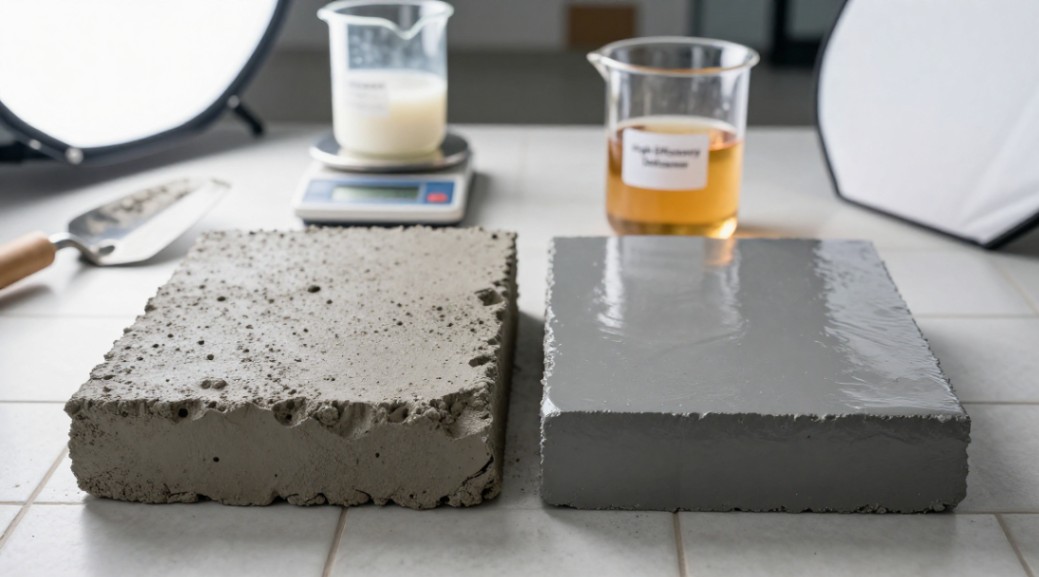
Start with a sample batch at 0.2% of a powder polyether-based defoamer. Run the 5 steps. You will see the difference in one mix test. That is your next move.
Supplier
We are the global leader in lightweight concrete and advanced engineered foam solutions. Known globally for its commitment to research, innovation, and applied expertise, we have been providing engineered foam solutions since the early 2012’s.
We can supply high-quality concrete admixture and foam concrete related products all over the world.
The company has a professional technical department and quality supervision department, a well-equipped laboratory, and equipped with advanced testing equipment and after-sales customer service center.
If you are interested, please feel free and contact us.