Concrete-mesa | Concrete Admixtures, Tools, and Production Machines

Your Foamed Concrete is Failing? Stop Making These 5 Foaming Agent Mistakes
The Hidden Enemy in Your Mixer
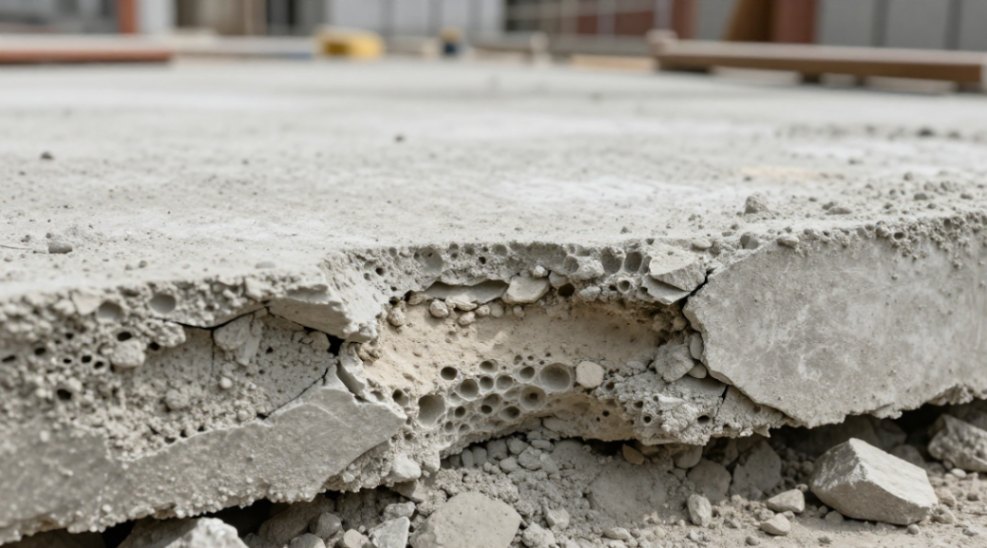
You followed the spec. You hit the target density. The pour looked perfect. Then, a week later, the surface crumbles like stale bread. Or worse, the entire slab settles unevenly. You’ve been burned by a failed batch of foamed concrete. The culprit isn’t magic; it’s a fundamental misunderstanding of the foaming agent for foamed concrete mixture. This isn’t just an additive; it’s the architect of your entire material structure. Treat it wrong, and failure is guaranteed.
1. The Synthetic vs. Protein Trap: It’s Not Just Price
The industry sells you a simple choice: cheap synthetic or expensive protein-based. This is a dangerous oversimplification. Your choice dictates the soul of your concrete.
Synthetic agents (like SLS-based) create bubbles through sheer chemical force. They’re cheap and easy. But those bubbles are like soap suds-thin-walled and unstable. They collapse under the weight of cement paste or merge into larger, weaker voids. You get unpredictable density and severe strength loss.
Protein-based agents are a different beast. Hydrolyzed proteins form complex, viscoelastic membranes around each air bubble. Think of a sturdy balloon versus a soap film. The bubbles resist coalescence and drainage. The result is a stable, uniform pore structure. The cost is higher, but the structural certainty is non-negotiable for anything beyond backfill.
The Mistake: Using a synthetic agent for a structural or insulating application to save pennies. The risk of failure costs dollars.
2. The Dosage Delusion: More is Not Better
Pouring in extra foaming agent to “be safe” is a recipe for disaster. Foam is not filler. It is a precisely engineered void.
Excess foam destabilizes the entire matrix. The cement paste cannot coat the overwhelming number of bubbles. Water films thicken. The mix becomes a wet, segregating slurry that bleeds water and collapses. Your density plummets, but so does every mechanical property. Strength and durability evaporate.
Dosing is a scientific calculation based on target wet density, agent concentration, and water quality. It requires a simple test every single time: the foam stability test. Generate your foam, fill a 1-liter container, and let it sit for 30 minutes. Volume loss over 5%? Your agent or your water is faulty. Proceed, and you gamble with the entire batch.
3. Murdering Your Foam in the Mixing Stage
You think the foam generator’s job is done once the foam is made? Wrong. How you introduce foam to mortar is critical. Dump it all in at once and mix aggressively? You’ve just shredded millions of delicate bubbles with shear forces.
The correct methodology is a gentle, controlled marriage.
- Prepare a stable base mortar first. Ensure it has the correct workability and no lumps.
- Start the mixer at a slow speed.
- Introduce the pre-generated foam in a steady, thin stream, typically over 60-90 seconds. Let the paddles fold it in.
- Mix only until homogeneous. Overmixing is destruction.
This process ensures a uniform distribution of intact air voids, which is the entire point of using a foaming agent for foamed concrete mixture.

4. Ignoring the Water: The Silent Foam Killer
Tap water is not neutral. Chlorines, fluorides, and high mineral content (hard water) can attack the surfactants in your foaming agent. They disrupt the bubble membrane formation. Your foam looks good in the generator but dies a quick death in the mix.
The fix is simple and non-negotiable: Use potable, neutral pH water for diluting the foaming agent concentrate. If in doubt, test your foam stability with the job-site water before committing to a full batch. This one step prevents more failures than any other.
5. Sacrificing Everything for Density
The obsession with achieving ultra-low density (below 600 kg/m³) often leads to catastrophic choices. To get there, you over-foam. The concrete becomes a fragile honeycomb with minimal cementitious binder connecting the solid particles.
Understand the brutal trade-off: every kilogram of density you drop impacts compressive strength disproportionately. A 1200 kg/m³ mix has useful strength. A 400 kg/m³ mix is strictly for void fill. You cannot have featherweight density and rock-like strength. Choose your priority based on the application: insulation, fill, or semi-structural element. Don’t let a number on a spec sheet blind you to physics.
From Pitfalls to Practice: A Framework for Success
Avoiding these mistakes requires a disciplined system. Here is your action plan.
Selection: For any application where performance matters (insulating roof screeds, floor toppings, lightweight blocks), use a high-quality protein-based agent. Reserve synthetics for simple fill.
Testing: Conduct a daily foam stability test with your site water and equipment. Record results.
Process Control: Follow the gentle mixing protocol religiously. Train every operative on its importance.
| Step | Action | Critical Check |
|---|---|---|
| 1. Agent Prep | Dilute concentrate with potable water per manufacturer’s ratio (e.g., 1:30 to 1:40). | Water quality is neutral, clean. |
| 2. Foam Generation | Use a dedicated foam generator at correct air/ solution pressure. | Foam is dry, stiff, with bubble size < 1mm. |
| 3. Mortar Base | Mix cement, sand, water to a cohesive, lump-free slurry. | Correct flow, no segregation. |
| 4. Incorporation | With slow mixer rotation, add foam in thin stream over 60-90 sec. | No aggressive, high-shear mixing. |
| 5. Verification | Check wet density of mixed foamed concrete using a 1-liter container on a scale. | Match target density ± 25 kg/m³. |
The Logical Path Forward
Stop treating the foaming agent as a commodity. It is the key variable. The logic is straightforward: stable, uniform air voids require a high-quality agent, precise dosing, and a respectful mixing process. Ignore any part of this chain, and the material fails. It’s not mysterious. It’s cause and effect.
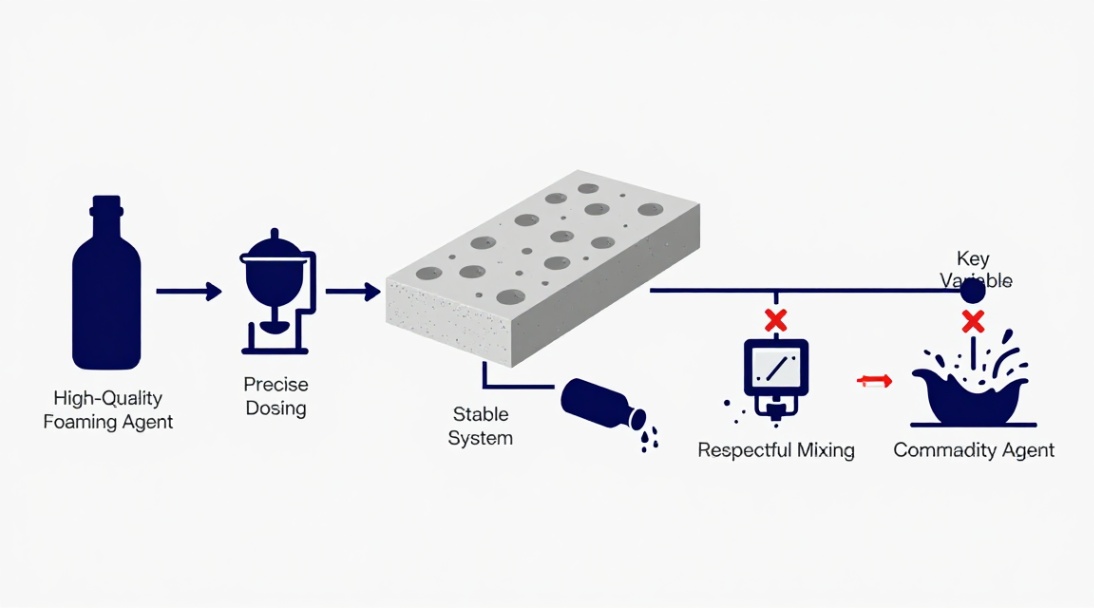
Your next step is validation. If your current process is plagued with inconsistency, scrutinize your agent and your method against the mistakes outlined here. For a reliable system, you need components engineered to work together. This includes using a foaming agent for foamed concrete mixture with proven stability, like advanced protein hydrolysates, and pairing it with disciplined site practice. Test a small batch using the strict protocol above. Compare the stability and finished properties. The results will dictate your path to consistent, high-performance foamed concrete.
Supplier
We are the global leader in lightweight concrete and advanced engineered foam solutions. Known globally for its commitment to research, innovation, and applied expertise, we have been providing engineered foam solutions since the early 2012’s.
We can supply high-quality concrete admixture and foam concrete related products all over the world.
The company has a professional technical department and quality supervision department, a well-equipped laboratory, and equipped with advanced testing equipment and after-sales customer service center.
If you are interested, please feel free and contact us.