Concrete-mesa | Concrete Admixtures, Tools, and Production Machines

Nano-Silica for UHPC: The Data-Backed Modifier Transforming Strength & Durability
A Counterintuitive Data Point
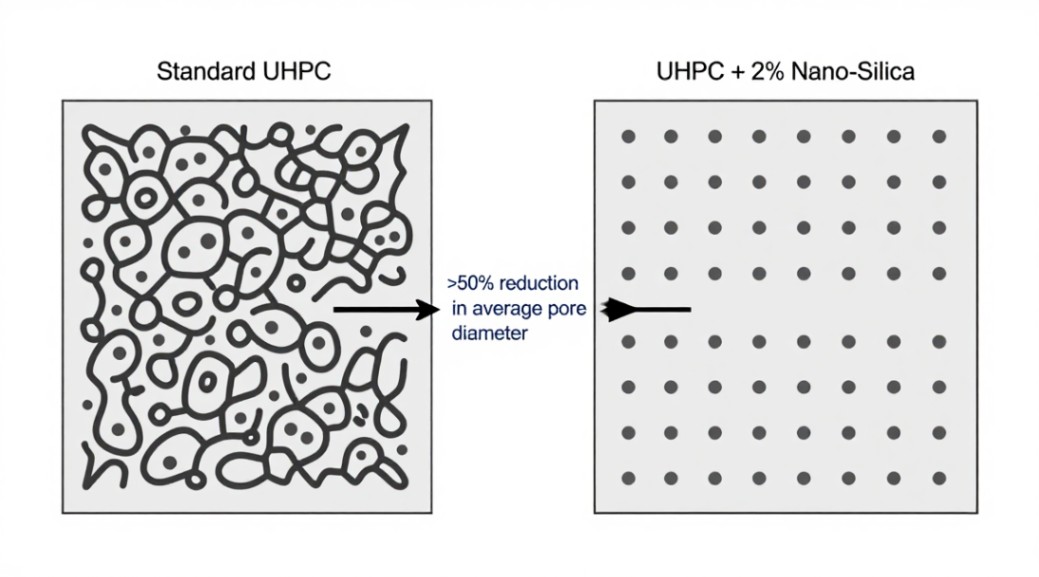
Research shows that adding a modest 2% nano-silica by weight of cement can reduce the average capillary pore diameter in UHPC by over 50%. This isn’t about adding more material; it’s about fundamentally restructuring the concrete at the nanoscale. The implications for durability are staggering.
Understanding the Nano-Silica Modifier
What exactly is a nano-silica modifier for UHPC?
A nano-silica modifier is an ultrafine, amorphous silicon dioxide powder with particles typically between 5-50 nanometers. In UHPC, it acts as a multifunctional admixture. Its primary roles are as a highly reactive pozzolan and an ultra-efficient physical filler. Unlike conventional silica fume, its particle size is two orders of magnitude smaller, granting it unique properties.
How does nano-silica make UHPC stronger and more durable?
The mechanisms are synergistic. First, the pozzolanic reaction consumes free calcium hydroxide, forming additional calcium silicate hydrate (C-S-H) gel. This is the glue that holds concrete together. Second, the filler effect physically plugs nano-sized gaps between cement grains and other particles, dramatically increasing packing density. This dual action refines the microstructure, transforming it from a porous network into a near-solid monolithic mass.
Key Performance Impacts
Does it just improve compressive strength?
No. While compressive strength increases of 15-25% are common, the benefits are broader. Tensile and flexural strength see significant gains due to the refined bond between the paste and micro-reinforcement (like steel fibers). More critically, it accelerates early-age strength development, which is crucial for precast operations and rapid repair.
What are the main durability benefits?
- Chloride Resistance: The denser matrix drastically slows chloride ion ingress, protecting embedded steel.
- Sulfate Attack Mitigation: Reduced permeability limits the movement of sulfate ions.
- ASR Mitigation: Nano-silica consumes alkalis and reduces permeability, helping to suppress destructive alkali-silica reactions.
- General Durability: The reduction in capillary pores directly lowers water permeability and gas diffusion.
Practical Application and Challenges
What is the optimal dosage range?
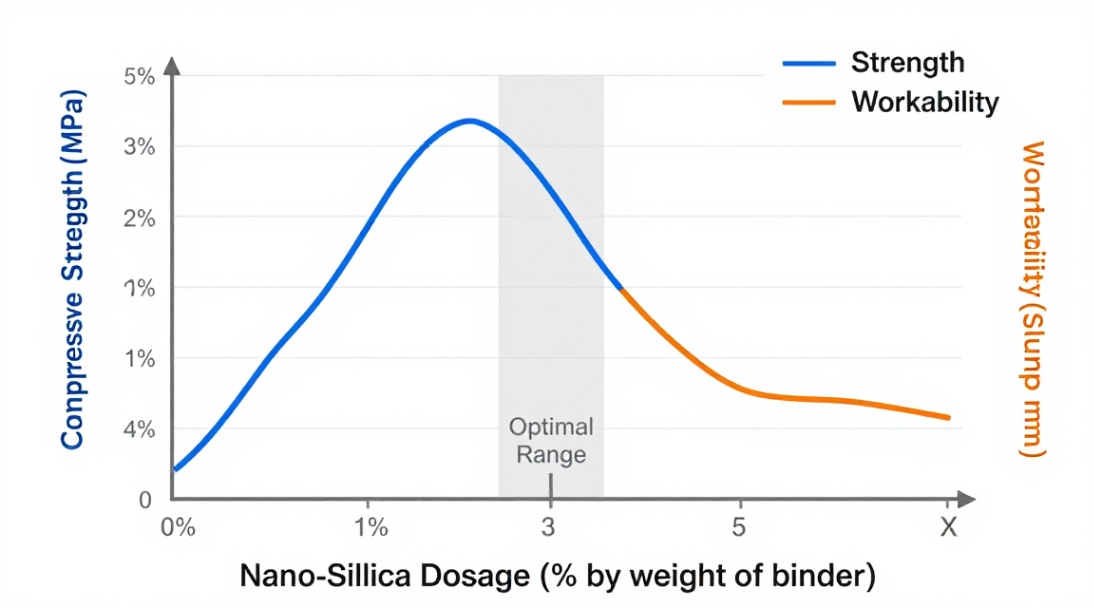
The sweet spot typically lies between 1-3% by weight of binder. Exceeding 3-4% often leads to diminishing returns and severe workability challenges. The enormous surface area of nano-silica rapidly absorbs water and admixtures, demanding careful mix design adjustment.
How does it interact with superplasticizers?
This interaction is critical. Nano-silica’s high surface area can absorb superplasticizer molecules, reducing their effectiveness for fluidizing the paste. Successful formulations often require increased dosages of advanced polycarboxylate-based superplasticizers and precise sequencing during batching to ensure proper dispersion and maintain flow.
How does it compare to silica fume?
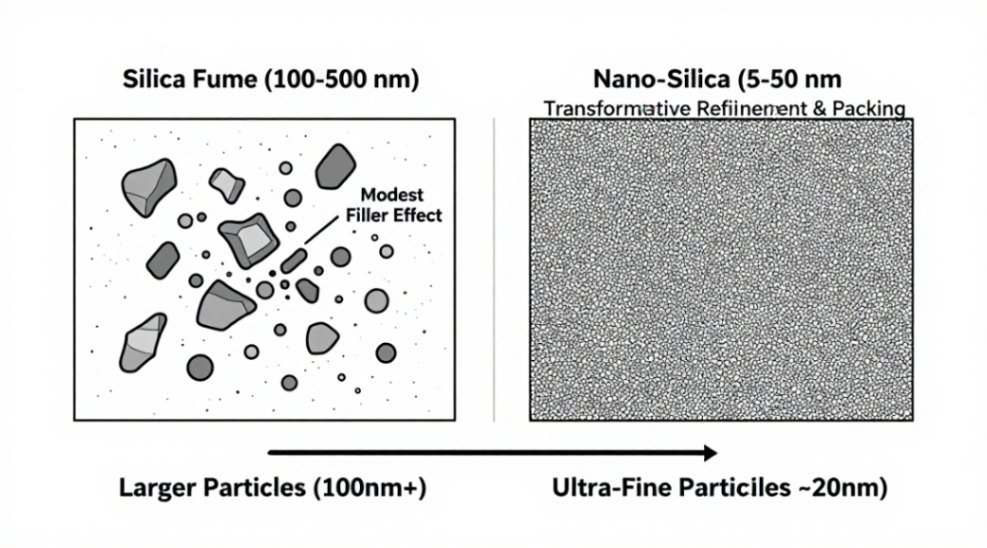
Nano-silica is not a direct replacement; it’s a performance upgrade. Silica fume (100-500 nm) is effective. Nano-silica (5-50 nm) is transformative. It offers faster reactivity, greater filler efficiency, and superior microstructural refinement. However, it presents greater handling and dispersion challenges and comes at a higher cost. The choice depends on the performance ceiling required for the project.
The Future and Sustainable Trends
The next frontier is sustainable production. Researchers are actively developing processes to synthesize nano-silica from agricultural waste (like rice husk ash) and industrial by-products. This aligns with the global push for greener construction materials. Furthermore, surface-modified nano-silica, engineered for better dispersion and compatibility, is emerging to solve current workability issues. For engineers specifying the next generation of resilient infrastructure-from seismic-resistant bridges to long-life marine structures-understanding and correctly applying nano-silica modifiers is now a requisite skill. Selecting a supplier that provides consistent, well-dispersed colloidal nano-silica or easy-to-handle powder blends can be the decisive factor between a good mix and a revolutionary one.
Supplier
We are the global leader in lightweight concrete and advanced engineered foam solutions. Known globally for its commitment to research, innovation, and applied expertise, we have been providing engineered foam solutions since the early 2012’s.
We can supply high-quality concrete admixture and foam concrete related products all over the world.
The company has a professional technical department and quality supervision department, a well-equipped laboratory, and equipped with advanced testing equipment and after-sales customer service center.
If you are interested, please feel free and contact us.