Concrete4U | Concrete Admixtures, Tools, and Production Machines

The AAC Block Specs They Don’t Want You to Ignore: A Contractor’s Breakdown
The One Spec That Kills 80% of AAC Projects
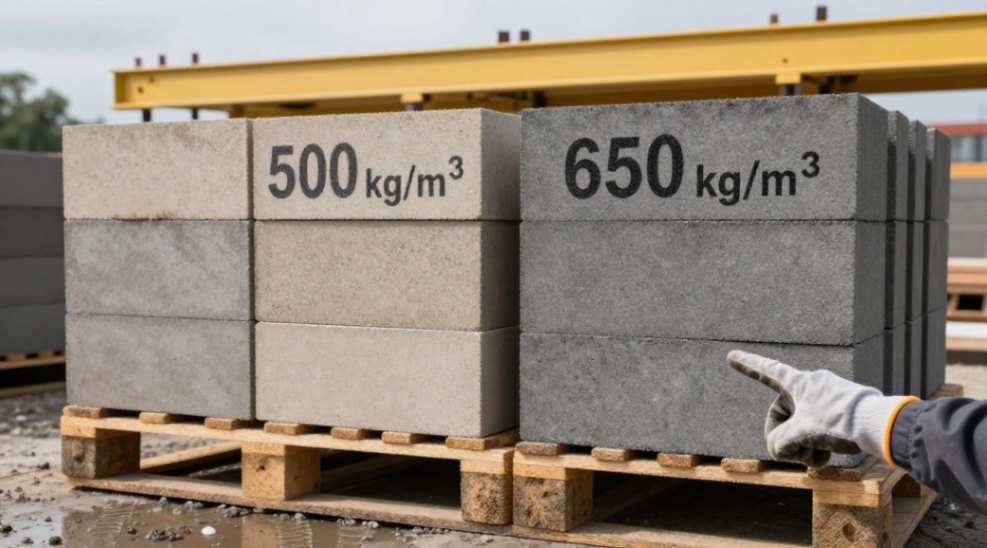
80% of specification errors start with the dry density classification. Teams grab the cheapest block without checking if it should be load-bearing or non-load-bearing. That mistake is structural suicide. Here is the cold truth: if you need a wall that holds up a roof, a 500 kg/m³ block is a toy. You need 650 kg/m³ or higher. Learn to read density before you read the price tag.
1. Standard Dimensions: The Secret to Zero Waste
aerated autoclaved concrete block specifications start with size. Standard length is 600 mm. Standard height is 200 mm or 250 mm. Thickness ranges from 75 mm to 300 mm. Why does this matter? Because a non-standard dimension kills your modular coordination. You end up cutting every third block. That creates dust, waste, and slow labor. Stick to blocks that match your door and window module. Your profit margin will thank you.
Dimensional Tolerances: The Hidden Cost
A tolerance of ±1.5 mm in length is acceptable. ±3 mm is sloppy. If your supplier delivers blocks with fat tolerances, your thin-bed mortar joint fails. You cannot compensate with thick mortar. AAC requires precision. Reject any pallet where blocks vary more than 2 mm. That rule alone cuts your plaster thickness in half.
2. Dry Density Classification: Light is Not Always Right
Here is the uncomfortable truth: lightweight is not synonymous with structural strength. Use aerated autoclaved concrete block specifications to separate load-bearing from infill work.
- 400-500 kg/m³: Thermal insulation only. Zero structural value. Do not hang a kitchen cabinet on this.
- 500-650 kg/m³: Non-load-bearing partitions. Acceptable for internal walls. Do not use it for a 3-story shear wall.
- 650-850 kg/m³: Load-bearing. This is your structural block. You need this for walls carrying floor slabs or roof trusses.
Match the density to the building height. A 600 kg/m³ block can carry a two-story house. Anything taller demands 700 kg/m³ minimum. Do not negotiate with gravity.
3. Compressive Strength: Why 3 MPa is the Floor, Not the Ceiling
Most specs list 3 to 5 MPa minimum. That 3 MPa block works for a single-story garden wall. It does not work for a residential apartment. Here is the logic: a typical wall in a 3-story building experiences compressive stress around 0.5 to 1 MPa. You need a safety factor of at least 3. That pushes you to 4 MPa at a minimum. Go to 5 MPa for long-term creep resistance. If your supplier pitches you 3.5 MPa as “standard,” ask for the test certificate. And read the date on it. Old data is dangerous.
4. Thermal Conductivity: The 0.12 W/mK Myth
Manufacturers love printing a k-value of 0.12 W/mK. That number is measured in a controlled lab on a bone-dry block. Your wall will not be bone-dry. Real-world moisture content pushes that k-value to 0.18 W/mK or higher. Design your insulation calculation using a k-value of 0.15 W/mK for dry climates and 0.18 W/mK for humid zones. Anything else is wishful thinking. Plan for reality, not the brochure.
5. Fire Resistance: Thickness is Your Only Friend
Fire ratings of 1 to 4 hours sound great. But they depend entirely on block thickness. A 100 mm block gives you about 1 hour of fire resistance. A 200 mm block pushes that to 4 hours. There is no magic chemistry here. It is simple mass. If your building code demands a 2-hour fire separation, do not use a 100 mm block. Go to 150 mm. And note that the mortar joint fails before the block does. Use a proper fire-rated thin-bed mortar. The joint is the weak link.
6. Sound Insulation: The 40 dB Trap
A standard 100 mm AAC block delivers a weighted sound reduction index (Rw) of about 40 dB. That is fine for a bedroom wall. It is not fine for a wall between a mechanical room and a library. You need 45 dB or higher. How do you get there? Either increase block thickness to 200 mm, or add a separated leaf of gypsum board with an air gap. Do not trust a 40 dB rating for high-noise scenarios. Double-check your acoustic requirements first.
7. Water Absorption: The 20% Limit is a Red Flag
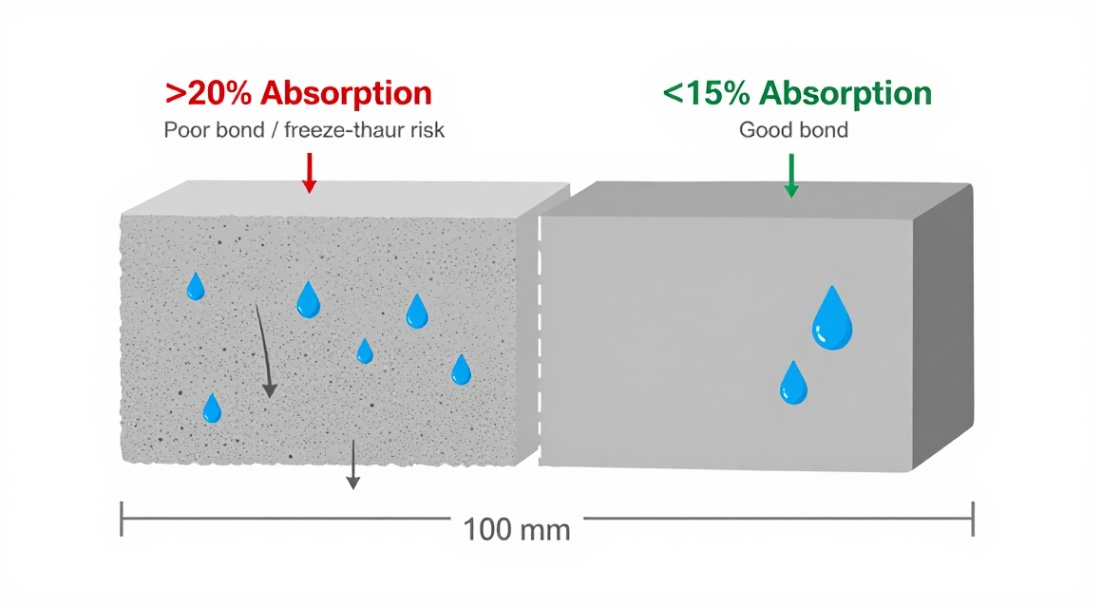
Most standards set a maximum water absorption of 20% by weight after 24 hours of immersion. 20% is high. A good block absorbs less than 15%. Why does this matter? High absorption means the block sucks water out of your mortar, causing a poor bond. It also means freeze-thaw damage in exterior applications. Insist on a water absorption of 15% or lower for exterior walls. If the block passes 20%, seal it immediately after installation. No exceptions.
8. Drying Shrinkage: The 0.6 mm/m Limit is Non-Negotiable
Drying shrinkage is the silent crack killer. The maximum allowable drying shrinkage is typically 0.6 mm per meter. If your supplier’s block shrinks more than that, your wall will crack at the joints within 6 months. A block that shrinks 0.4 mm/m is premium. A block at 0.6 mm/m is borderline. Reject anything above 0.6 mm/m. Your plaster will not cover up structural movement. The crack will show.
9. Material Composition: Follow the Aluminum Trail
AAC is made from cement, lime, sand or fly ash, water, and a tiny amount of aluminum powder. The aluminum reacts with the lime to create hydrogen gas bubbles. That is what makes the block lightweight. Here is the spec to watch: the fly ash must be Class F (low calcium). Class C fly ash contains too much free lime and causes efflorescence. If the supplier uses Class C ash, your walls will turn white within a year. It is ugly and unprofessional. Ask for the ash source. Get it in writing.
10. Compliance: Three Standards, One Logic
You will encounter ASTM C1693, IS 2185 Part 3, and EN 771-4. All three set similar rules for density, strength, and shrinkage. Do not get lost in the alphabet. The logic is universal: pick a standard that your local building inspector accepts. If you are in North America, use ASTM C1693. If you are in Europe, use EN 771-4. Mixing standards is asking for a project delay. Pick one and stick to it.
Surface Finish and Joint Thickness: The Thin-Bed Mandate
You cannot use a standard cement mortar on AAC. The blocks are too absorbent. Standard mortar dries too fast and loses bond strength. You must use a thin-bed mortar at a joint thickness of 2-3 mm. This is not a suggestion. It is a requirement. If you see a contractor using a 10 mm cement mortar joint, stop the work. The wall will delaminate under load. Thin-bed mortar is the only way to maintain the block’s thermal and acoustic performance.
Delivery Moisture Content: The Wet Block Problem
A fresh block leaves the autoclave at around 30-40% moisture content. You should never install a block with a moisture content above 25%. Why? Because as the block dries, it shrinks. If you install a wet block and it dries in the wall, it will shrink and crack. Specify delivery at no more than 20% moisture content by weight. Stack the blocks on site for 7 days to equalize moisture before installation. That simple delay saves you a year of crack repairs.
Autoclave pressure and temperature specs rarely matter to the buyer. They matter to the producer. If you want to sound like an expert, ask your supplier: “What is your autoclave curing cycle?” The correct answer is 12 hours at 10-12 bar pressure and 180-190°C. A shorter cycle means the blocks are under-cured. Under-cured blocks have lower strength and higher shrinkage. If they cannot answer that question, find another supplier.
The Final Spec Checklist
Stop comparing prices. Compare these seven specs: density class, compressive strength, k-value, water absorption, drying shrinkage, moisture content at delivery, and compliance standard. If any spec is missing, demand it. A supplier that hides a spec is hiding a defect. Use this checklist to filter out 80% of suppliers before you even call them. The remaining 20% are the ones who can deliver a wall that stands for 50 years without a crack.
If you want to skip the research phase and work with a supplier who publishes full aerated autoclaved concrete block specifications upfront, we have pre-vetted options ready. We sell only blocks that meet or exceed the ISO 9001 production standard. Contact us for a quote on load-bearing or non-load-bearing AAC blocks with full technical data sheets and a guarantee against shrinkage cracks. It is the only way to build without regrets.
Supplier
We are the global leader in lightweight concrete and advanced engineered foam solutions. Known globally for its commitment to research, innovation, and applied expertise, we have been providing engineered foam solutions since the early 2012’s.
We can supply high-quality concrete admixture and foam concrete related products all over the world.
The company has a professional technical department and quality supervision department, a well-equipped laboratory, and equipped with advanced testing equipment and after-sales customer service center.
If you are interested, please feel free and contact us.