Concrete-mesa | Concrete Admixtures, Tools, and Production Machines

Stop Guessing Density: A 20-Year Veteran’s Guide to Cellular Lightweight Concrete Density Range
The $50,000 Lesson: Why Density Range Dictates Success or Failure
I watched a project manager lose a $50,000 contract last year. He promised a lightweight fill. He delivered a mix that was too heavy for the roof deck. The structural engineer rejected it. The client was furious. The problem? He didn’t understand the cellular lightweight concrete density range.
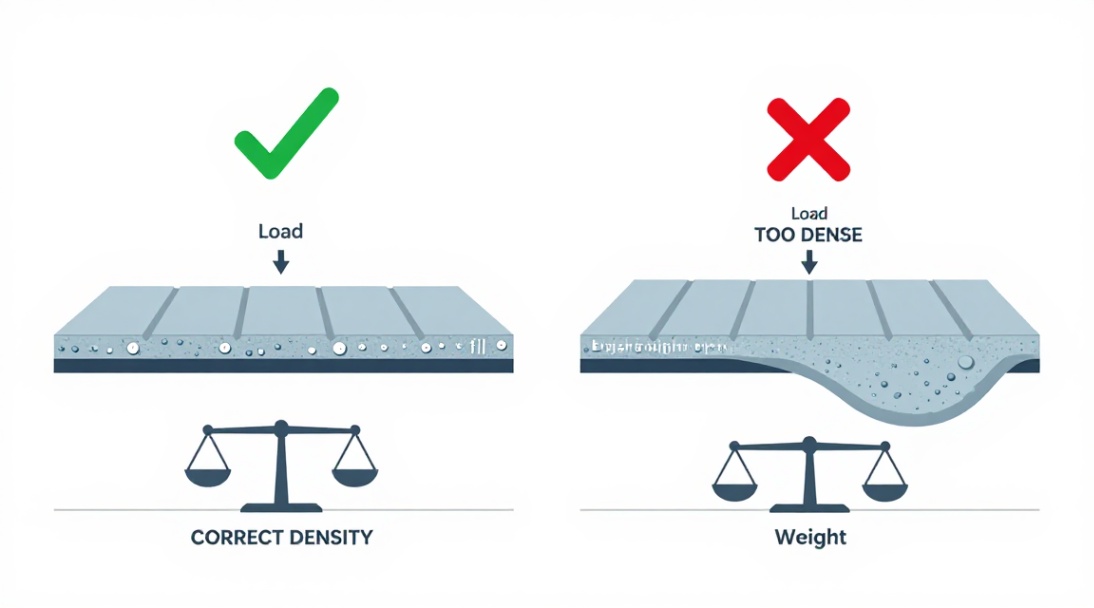
This isn’t a theoretical exercise. I’ve seen it happen dozens of times. You pick a random foam volume. You pour it. You test it. It fails. Then you scramble. You waste materials. You lose money.
Here is the hard truth: Density is the single most critical control parameter. It dictates your compressive strength. It governs your thermal performance. It defines your application. Master the range, or your project fails.
This guide gives you the hard data and logic to select, test, and verify your target density. No fluff. No theory. Just 20 years of field experience.
1. What is the Exact Cellular Lightweight Concrete Density Range?
You hear people say “lightweight concrete.” That term is too vague. Normal concrete sits around 2,400 kg/m³. Cellular lightweight concrete targets a completely different spectrum. The usable, proven cellular lightweight concrete density range is from 300 kg/m³ to 1,800 kg/m³.
Below 300 kg/m³, the mix has too much air. It becomes unstable. The bubbles coalesce. You get a spongy, weak material. Above 1,800 kg/m³, you are moving into structural lightweight aggregate territory. You lose the key advantages of cellular concrete: extreme lightness and insulating capacity.
2. Why Does My Density Vary So Much Between Batches?
Three factors control your density. You must control all three. Ignore one, and your results drift.
- Foam Volume: This is the primary lever. More foam = lower density. Less foam = higher density. A change of just 5% in foam volume can shift your density by 50 kg/m³.
- Cement Content: The paste is the heavy part. Lower cement content reduces density, but it also reduces strength. You must balance these.
- Water-Cement Ratio: Excess water creates bleed channels. It destabilizes the foam. It increases density as the water evaporates. Keep your w/c ratio below 0.55 for stable foam structures.
The mistake I see most often: operators add water to improve flow. This destroys the foam. Density spikes. The mix turns into heavy, uneven concrete. Stop doing it.
3. How Do You Classify Densities for Practical Use?
Stop thinking about density as one number. Think of it as a tier system. Each tier has a specific job. I classify them into three categories.
| Density Tier | Range (kg/m³) | Primary Application | Typical Compressive Strength (MPa) |
|---|---|---|---|
| Low | 300 – 600 | Thermal insulation, void filling, roof screeds | 0.5 – 2.0 |
| Medium | 600 – 1,200 | Floor levelling, precast blocks, partition walls | 1.5 – 6.0 |
| High | 1,200 – 1,800 | Structural fill, road sub-base, retaining wall backfill | 5.0 – 15.0 |
Low-density material is for insulation. It feels like a stiff foam. Medium-density is your workhorse. High-density acts more like a weak rock. Choose your tier first. Then dial in the exact number.
4. How Does Density Control Compressive Strength and Insulation?
This is a direct relationship. It is not optional. As density increases, compressive strength increases. As density decreases, thermal conductivity decreases (better insulation). You cannot have both maximum strength and maximum insulation. Physics forces a trade-off.
For a floor screed requiring 4 MPa strength, you rarely go below 1,000 kg/m³. For a roof deck needing an R-value of 1.5 per inch, you must stay below 500 kg/m³. Test your specific mix. Do not rely on generic tables from a supplier. Your local materials will behave differently.
5. What Role Does the Foaming Agent Play?
Your foaming agent type and dosage define the bubble quality. A synthetic agent creates smaller, more uniform bubbles. A protein-based agent creates larger, less stable bubbles. For precise density control, I always use synthetic agents.
Dosage is critical. Too little foaming agent yields a dense, over-collapsed mix. Too much yields a watery foam that collapses in the mixer. The correct dosage creates a stiff, shaving-cream-like foam. You must calibrate this for every batch of cement you receive. Cement chemistry changes. Your foam dosage must adapt.
6. How Do I Measure and Verify Density in the Field?
You must measure twice: once in the fresh state, once in the hardened state. They will differ. Fresh density is an early warning system. Hardened density is the final proof.
- Fresh Density Test: Use a standard container of known volume (e.g., 1 liter). Fill it. Weigh it. Calculate density = mass / volume. Run this test every 30 minutes during your pour. If it drifts outside your target by more than 2%, stop and adjust the foam feed rate immediately.
- Hardened Density Test: Cut a sample after 28 days. Dry it in an oven until constant mass. Weigh it. Measure its volume by water displacement or calipers. This gives you the true dry density. This is your contractual deliverable.
7. How Does Cellular Concrete Compare to Other Materials?
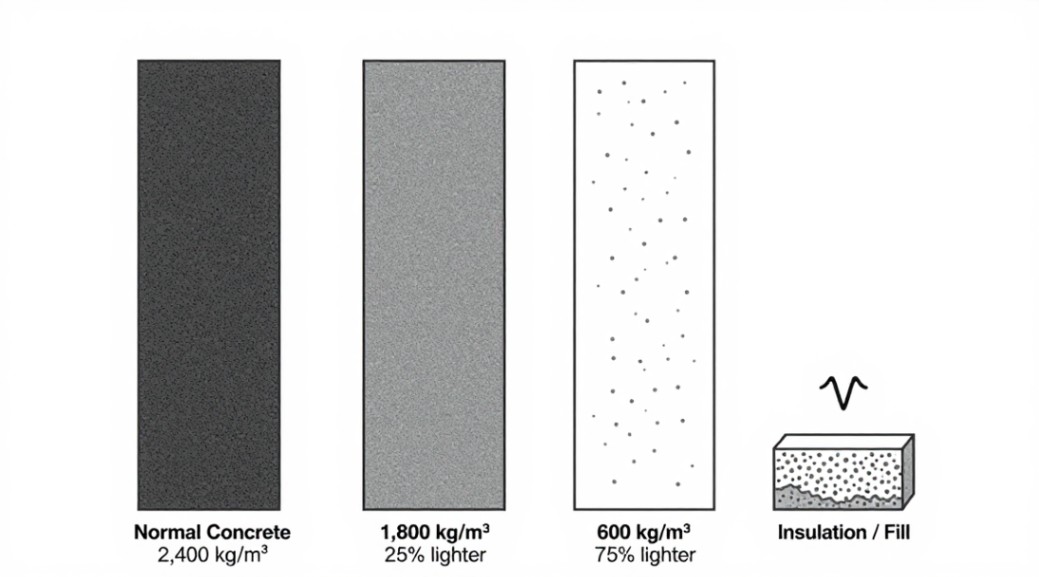
Compare it to normal concrete. Normal concrete at 2,400 kg/m³ is structural. Cellular concrete at 1,800 kg/m³ is 25% lighter. At 600 kg/m³, it is 75% lighter. You cannot use cellular concrete for a high-rise column. You can use it to fill an abandoned tunnel, insulate a power plant roof, or level a warehouse floor.
Compare it to lightweight aggregate concrete. Lightweight aggregate concrete uses porous rocks. It still has a minimum density around 1,400 kg/m³. Cellular concrete goes much lower. It is a true low-density solution.
8. What About Fire Resistance and Sound Absorption?
Density directly impacts both.
Fire Resistance: Lower density means more air. Air is an insulator. But it also means less mass to absorb heat. At 300 kg/m³, the material can char and spall faster under direct flame. At 1,200 kg/m³, the thermal mass is high enough to provide 2-4 hour fire ratings. Standard recommendations cite a minimum density of 600 kg/m³ for rated fire separations in many building codes.
Sound Absorption: Low density material is good at absorbing sound in mid-to-high frequencies. High density material blocks sound transmission better. For a sound-rated partition wall, target 1,000 kg/m³ or higher. For an acoustic absorber panel, go down to 400-500 kg/m³.
9. What Are the Industry Standards for Density Ranges?
ACI 523.1-06 guides cellular concrete for building construction. ASTM C495 measures compressive strength. ASTM C796 measures foam stability. No single standard dictates your exact density. You must specify it in your contract documents.
I recommend this rule: specify a tolerance of ± 50 kg/m³ for your target density. Tighter tolerances increase cost. Looser tolerances increase risk. For most floors and fills, ± 50 kg/m³ is achievable and safe.
10. Real Case: Floor Screed Density Selection
I consulted on a project last year. A warehouse needed a 100 mm floor screed for a new freezer. They wanted insulation. They also needed 2.5 MPa to hold forklift traffic. We tested.
At 500 kg/m³, the strength was 1.2 MPa. Too weak. At 1,200 kg/m³, the strength was 5.0 MPa. But the thermal performance was poor. The compromise was a 1,000 kg/m³ mix. It delivered 3.0 MPa strength and acceptable insulation. Density targeting is a balancing act. You must test, not guess.
11. Key Limitations You Must Accept
High density cellular concrete (1,200-1,800 kg/m³) cannot replace traditional concrete for structural beams or columns. It has lower modulus of elasticity. It creeps more. It is more brittle.
Low density cellular concrete (300-500 kg/m³) has negligible structural capacity. Do not walk on a 400 kg/m³ screed for 48 hours. It will crush. Protect it.
You must also account for shrinkage. Higher cement content and lower density both increase drying shrinkage. Design your joints accordingly.
12. Your Next Move: Stop Wasting Time on Bad Mixes
You now have the knowledge to specify your cellular lightweight concrete density range with confidence. Low density for insulation. Medium density for floors. High density for fill.
But knowledge without the right tools is useless. You need a foaming agent you can trust. You need a foam generator that delivers consistent bubbles. You need a mixing process that is repeatable.
I recommend our Ultra-Pro Foam Generator and Synthetic Foam Concentrate kit. It is calibrated for precise density control from 300 kg/m³ to 1,800 kg/m³. You get a stable foam 95% of the time on the first try. No guesswork. No rejected loads.
Stop losing money on density failures. Click here to order the kit now and get a free density calibration chart for your specific cement type. That is a $500 value, free with your purchase. Do not wait. The next failed pour is on you.
Supplier
We are the global leader in lightweight concrete and advanced engineered foam solutions. Known globally for its commitment to research, innovation, and applied expertise, we have been providing engineered foam solutions since the early 2012’s.
We can supply high-quality concrete admixture and foam concrete related products all over the world.
The company has a professional technical department and quality supervision department, a well-equipped laboratory, and equipped with advanced testing equipment and after-sales customer service center.
If you are interested, please feel free and contact us.