Concrete4U | Concrete Admixtures, Tools, and Production Machines

EIFS Failure Warning: Why Your RDP is the Most Critical Component
The RDP is Not an Optional Detail; It is the Deciding Factor Between a 30-Year Wall and a Liability
The single most common and costly error in exterior insulation and finish systems (EIFS) is treating the RDP for exterior insulation and finish systems as a secondary component. It is not. The RDP is the primary air and water-resistive barrier, the system’s defense against bulk water intrusion and vapor drive. Ignoring its proper specification and installation guarantees moisture-related failures, including structural rot, mold, and finish delamination. This analysis outlines the non-negotiable practices for system longevity.
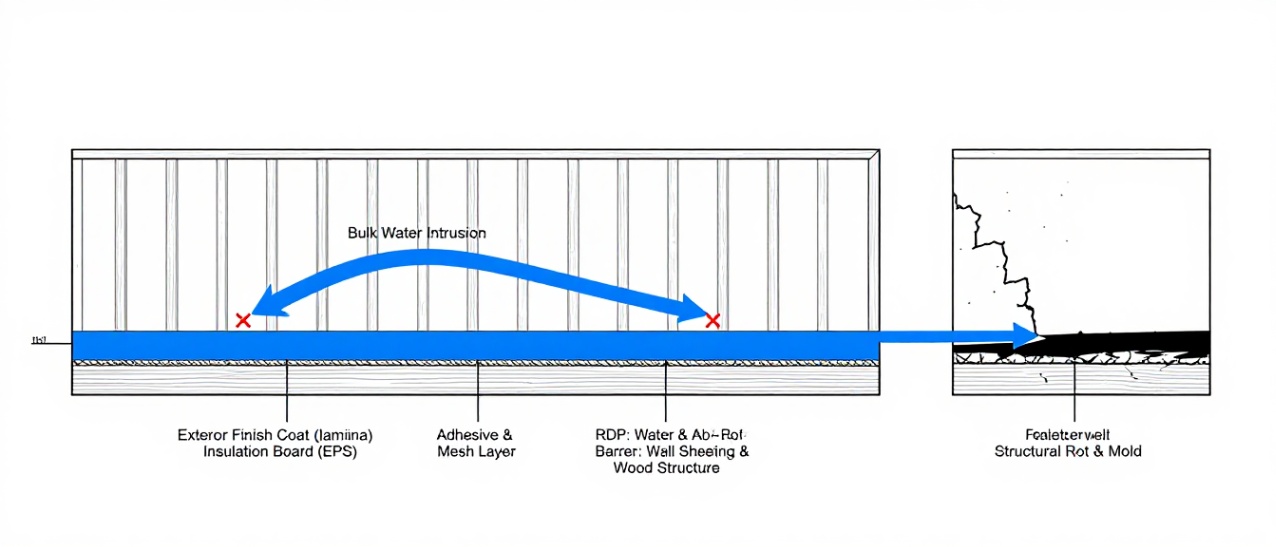
Barrier EIFS vs. EIFS with Drainage (RDP): A System-Defining Choice
Historically, barrier systems relied solely on the synthetic stucco lamina as the water barrier. This design is fundamentally flawed for most climate zones, as it traps incidental moisture. Modern best practice mandates an EIFS with drainage design, where the RDP creates a ventilated drainage cavity. The distinction is not minor; it defines the wall’s physics. The core function of the RDP is to manage moisture through three mechanisms: resisting bulk water entry, providing a drainage path for any incidental water, and allowing the wall assembly to dry.
Critical System Components and the RDP’s Role
An exterior insulation and finish system is a multi-layered assembly. From the substrate outward:
- Substrate: Sheathing (OSB, plywood, gypsum). Must be clean, dry, and structurally sound.
- Primary Air/Water Barrier (RDP): A fluid-applied membrane or engineered sheet membrane directly adhered to the substrate. This is the system’s critical line of defence.
- Drainage Cavity: Created by ribbed mesh, dimpled mat, or adhesive applied in specific patterns. Provides a continuous air space for drainage and ventilation.
- Insulation Board: Typically EPS, XPS, or mineral wool, mechanically fastened and/or adhered.
- Reinforcement & Base Coat: Fiberglass mesh embedded in a polymer-based cementitious coating.
- Finish Coat: Acrylic or silicone-based textured finish providing colour and final weather resistance.
Common Catastrophic Errors and the Correct Methodology
Failure is almost always a result of flawed execution at the RDP layer. The following table contrasts dangerous shortcuts with the non-negotiable correct procedures.
| Error (What NOT to Do) | Correct Procedure & Rationale | Operational Specification |
|---|---|---|
| Applying RDP to a dirty, damp, or poorly prepared substrate. | Substrate preparation is 50% of the job. Adhesion failure here compromises the entire system. | Clean substrate of all dust, oils, and laitance. Verify moisture content is below 15% for wood, 4% for concrete. Prime if required by manufacturer. Surface must be smooth, with protrusions >3 mm (1/8″) ground flat. |
| Using a generic “building wrap” or incompatible fluid as the RDP. | The RDP must be a tested, integrated component of the EIFS assembly. Incompatible materials can react or de-bond. | Select a manufacturer-approved fluid-applied (e.g., acrylic, silicone) or sheet membrane specifically rated as an air/water barrier for EIFS. Verify compatibility with all adjacent materials (adhesives, sealants). |
| Failing to integrate the RDP at penetrations and transitions. | 99% of leaks occur at joints, not field areas. The RDP must be continuous. | Extend the RDP a minimum of 100 mm (4″) onto the flange of windows and doors. Use compatible flashing tapes and sealants. For pipe penetrations, use pre-formed boots or sealant dams. Overlap all sheet membrane seams by at least 50 mm (2″) and seal. |
| Creating a “zero-drainage” scenario by fully trowel-adhering insulation. | This negates the drainage function, reverting the system to a flawed barrier type. | Create a continuous drainage plane. Apply adhesive in vertical ribbons (minimum 25 mm wide) or perimeter dabs, leaving open channels. Alternatively, use a mechanically attached drainage mat. Maintain a consistent cavity depth of 3-5 mm. |
| Ignoring code requirements and industry standards. | This exposes the designer and installer to liability. Compliance is a baseline. | The assembly must meet IECC/IRC air barrier requirements, Chapter 14 water-resistive barrier mandates, and specific ASTM standards (e.g., E2568 for water penetration, E2357 for air barrier systems). Documentation is essential. |
The Proven Path to Long-Term Performance
A correctly executed RDP for exterior insulation and finish systems delivers quantifiable benefits beyond leak prevention. It is the cornerstone of energy efficiency by eliminating air infiltration, which can account for 30-40% of heating and cooling loads. It protects the structural integrity of the building by keeping sheathing dry. This directly contributes to sustainability by extending the building’s service life and reducing operational energy consumption. The initial investment in a proper RDP installation is repaid many times over in avoided repair costs and energy savings.
Your Next Critical Action
The margin for error is small. Do not proceed with EIFS cladding based on assumption or outdated practice. First, review the project’s climate zone and building code requirements to mandate an EIFS with drainage design. Second, select a single, proprietary EIFS system from a major manufacturer where all components-substrate primer, RDP, adhesive, insulation, and finishes-are tested and warranted to work together. Third, engage or become a trained, certified installer. The system is only as good as the craftsman applying it. Finally, implement rigorous quality control, with particular focus on the RDP installation and integration details, using third-party inspection if necessary. This disciplined approach is the only reliable method to ensure the durability promised by modern exterior insulation and finish systems.
Supplier
We are the global leader in lightweight concrete and advanced engineered foam solutions. Known globally for its commitment to research, innovation, and applied expertise, we have been providing engineered foam solutions since the early 2012’s.
We can supply high-quality concrete admixture and foam concrete related products all over the world.
The company has a professional technical department and quality supervision department, a well-equipped laboratory, and equipped with advanced testing equipment and after-sales customer service center.
If you are interested, please feel free and contact us.