Concrete4U | Concrete Admixtures, Tools, and Production Machines

How to Apply Hydroxyethyl Cellulose (HEC) for Effective Drilling Fluid Control: A Step-by-Step Guide
The Core Principle: Why Rheology is Everything
Despite its seemingly simple chemical structure, hydroxyethyl cellulose in drilling fluid applications solves a complex physical contradiction. A common industry statistic is revealing: a properly viscosified fluid can reduce non-productive time from wellbore instability by up to 20-30%, but only if the additive’s behavior under both static and dynamic conditions is predictable. Hydroxyethyl cellulose (HEC) provides this predictability through a unique non-ionic, shear-thinning mechanism. This article details a logical, step-by-step methodology for its application.
Foundations: What is Hydroxyethyl Cellulose?
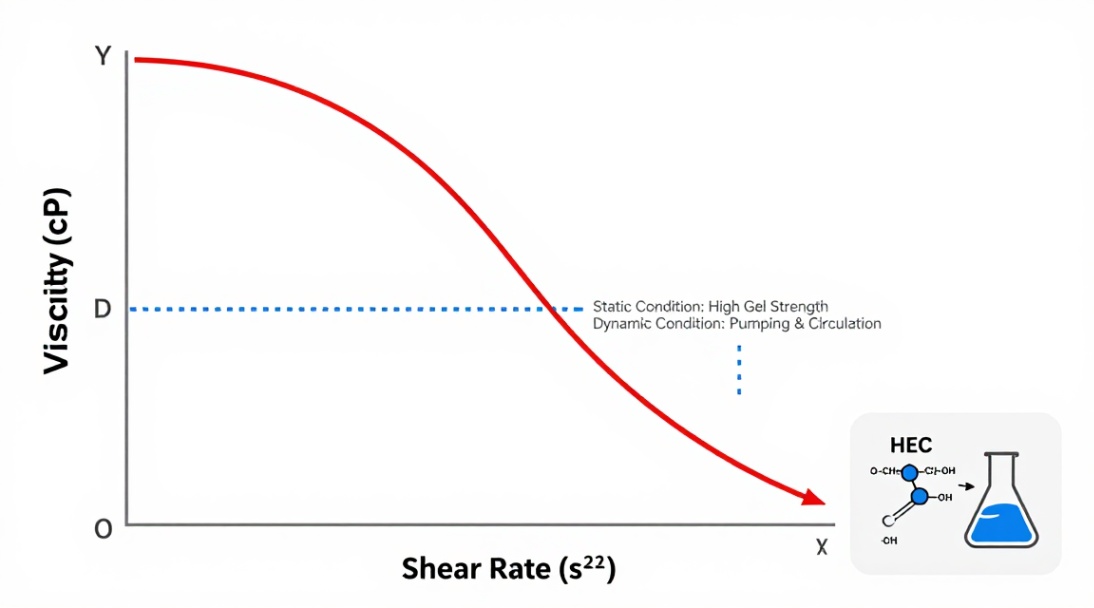
Hydroxyethyl cellulose (HEC) is a water-soluble polymer derived from cellulose. Its chemical structure involves the substitution of hydroxyl groups with hydroxyethyl ether groups. This modification grants key performance characteristics: non-ionic nature, high water-binding capacity, and resistance to salts and divalent cations. In a drilling fluid system, HEC functions primarily as a viscosifier and rheology modifier. It builds viscosity through the entanglement and hydration of its long polymer chains, creating a robust yet fragile three-dimensional network in the aqueous phase.
Mechanism: How HEC Modifies Fluid Behavior
The efficacy of HEC stems from its interaction with water and its response to shear forces. Upon hydration, the polymer chains extend and entangle, dramatically increasing the fluid’s viscosity at low shear rates. This high gel strength is critical for suspending drill cuttings when circulation stops. Under the high shear of the drill bit, the aligned polymer chains slide past each other, causing a reversible viscosity decrease. This shear-thinning behavior minimizes pump pressure losses while maintaining carrying capacity in the annulus. Simultaneously, HEC’s hydrated polymers bridge pore throats in the formation, aiding in filter cake formation and fluid-loss control.
Step-by-Step Application Guide for Field Engineers
1. Pre-Application Assessment and System Design
Before introducing HEC, conduct a thorough audit. Analyze your base fluid salinity, anticipated bottom-hole temperature, and the primary lithology to be drilled. Determine the primary objective: is it shale stabilization, enhanced hole cleaning, or fluid-loss control? This dictates your starting concentration and compatibility checks with existing additives like clay inhibitors or lubricants. Plan for adequate mixing time and shear.
2. Dry Addition and Mixing Protocol
Never add HEC powder directly to a stagnant pit. This causes “fish-eyes” – undissolved gel lumps that waste material and create processing headaches. Follow this sequence instead.
- Maintain active, high-shear mixing in your designated hopper or mixing pit. Agitation is non-negotiable.
- Using a sacking hopper or a controlled dust-free feeder, introduce the HEC powder at a steady, moderate rate. A practical rate is 0.5 to 1.0 pound per barrel (ppb) per minute.
- Continue high-shear mixing for a minimum of 30 minutes after the final addition. Complete hydration is essential for performance.
- Allow the fluid to circulate for at least one full cycle. Measure rheological properties (plastic viscosity, yield point, gel strengths) and fluid loss.
3. Dosage Adjustment and Performance Optimization
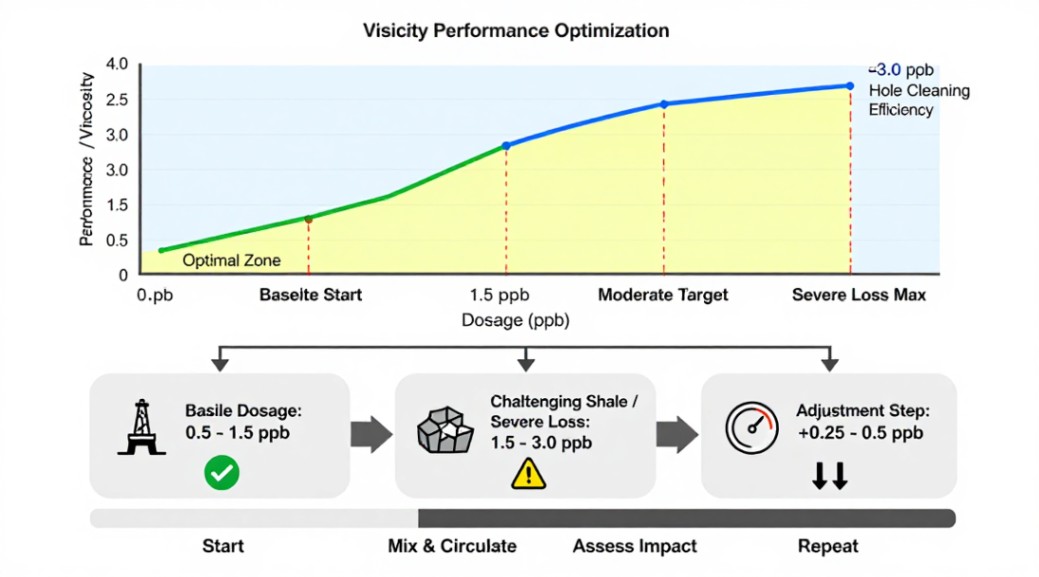
Start with a baseline dosage of 0.5 to 1.5 ppb for moderate viscosity and fluid-loss control. For challenging shale sections or severe fluid loss, target 1.5 to 3.0 ppb. Make incremental adjustments of 0.25 to 0.5 ppb, allowing full circulation between each addition to assess the impact. The target is the minimum effective viscosity to achieve hole cleaning and wellbore stability. Excessive viscosity increases unnecessary hydraulic friction and swab/surge pressures.
Comparative Analysis: HEC vs. Common Alternatives
Choosing the right viscosifier requires a clear understanding of trade-offs. The table below summarizes key operational differences.
| Property / Consideration | Hydroxyethyl Cellulose (HEC) | Xanthan Gum (Biopolymer) | Polyanionic Cellulose (PAC) |
|---|---|---|---|
| Ionic Nature | Non-ionic | Anionic | Anionic |
| Salt Tolerance | Excellent in monovalent & divalent brines | Good in NaCl, poor in divalent salts | Good in NaCl, precipitates in high Ca/Mg |
| Shear-Thinning | Pronounced, reversible | Extremely pronounced, pseudo-plastic | Moderate |
| Fluid-Loss Control | Good, builds compressible filter cake | Fair, primary role is viscosity | Excellent, primary role is fluid-loss control |
| Thermal Stability | Up to 150°C (302°F) in non-oxidizing environments | Degrades above ~120°C (248°F) | Stable to ~150°C (302°F) |
| Primary Application Driver | Salt-saturated fluids, shale inhibition, KCL/polymer muds | High low-shear-rate viscosity for hole cleaning | API fluid loss control in freshwater/low-salt muds |
Critical Considerations and Limitations
Successful application requires respecting HEC’s boundaries. Its thermal stability is generally limited to 150°C (302°F) in the absence of oxygen and high pH; above this, polymer degradation accelerates. In highly oxidizing environments, degradation occurs faster. HEC is also susceptible to bacterial and enzymatic breakdown. Use a compatible biocide in long-term operations. Its non-ionic nature ensures compatibility with most additives, but always conduct a jar test before large-scale blending, particularly with high concentrations of cationic materials or strong oxidizers.
Strategic Application Scenarios
Shale Stabilization in Saltwater Systems
For drilling water-sensitive shales with a KCl or NaCl brine, HEC is often the superior choice. Its non-ionic structure does not interfere with cationic inhibitors. It viscosifies the brine, reduces filtrate invasion into the shale, and its shear-thinning profile minimizes equivalent circulating density (ECD) spikes. A typical system uses 1.0-2.0 ppb HEC with 3-5% KCl.
Wellbore Cleaning in Deviated and Horizontal Sections
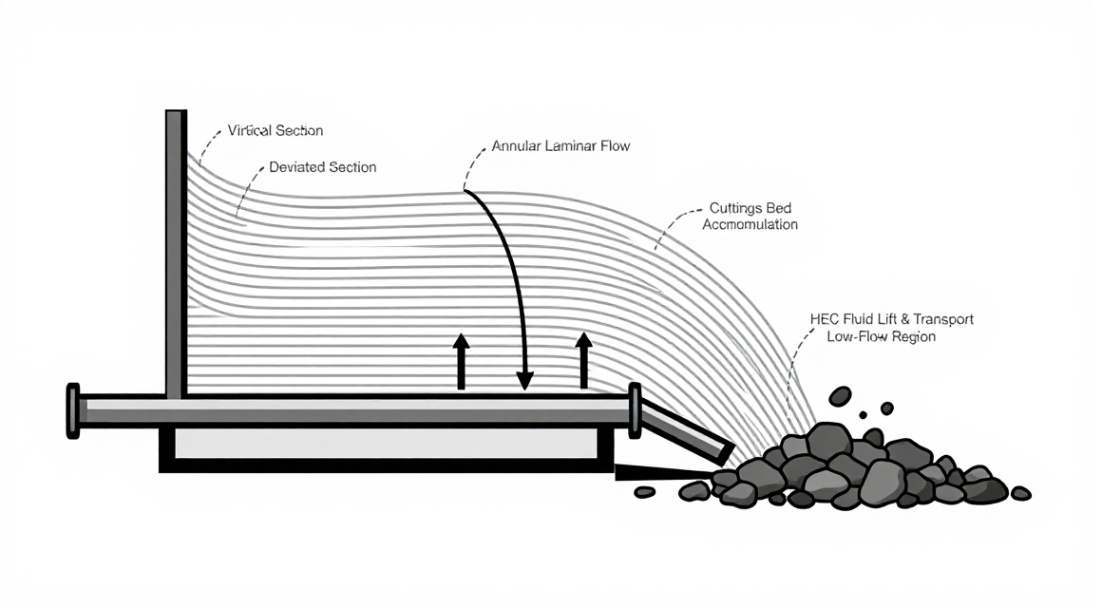
In high-angle holes, laminar flow regimes can lead to cutting beds. HEC’s ability to maintain a high yield point and gel strengths helps transport cuttings in low-flow regions of the annulus. Combine it with a suitable lubricant to reduce torque and drag.
Operational Summary and Outlook
Mastering hydroxyethyl cellulose in drilling fluid applications is a matter of disciplined process control. The steps are precise: assess, mix under shear, dose incrementally, and monitor. Its value lies in a specific niche: providing reliable, salt-tolerant rheology where other polymers fail. Future developments focus on enhancing its thermal stability through synthetic blends and modifying its structure for even more robust fluid-loss control in extreme conditions. The logical path forward is to integrate these process steps into your standard operating procedures for water-based fluids in challenging environments. Test it in a pilot volume. Measure the results. The data will confirm its utility.
Supplier
We are the global leader in lightweight concrete and advanced engineered foam solutions. Known globally for its commitment to research, innovation, and applied expertise, we have been providing engineered foam solutions since the early 2012’s.
We can supply high-quality concrete admixture and foam concrete related products all over the world.
The company has a professional technical department and quality supervision department, a well-equipped laboratory, and equipped with advanced testing equipment and after-sales customer service center.
If you are interested, please feel free and contact us.