Concrete4U | Concrete Admixtures, Tools, and Production Machines

Stop Silicone Stains: The Right Non-Silicone Defoamer Solves Self-Leveling Disasters
Why Non-Silicone Defoamers? The Single Biggest Mistake You Can Make
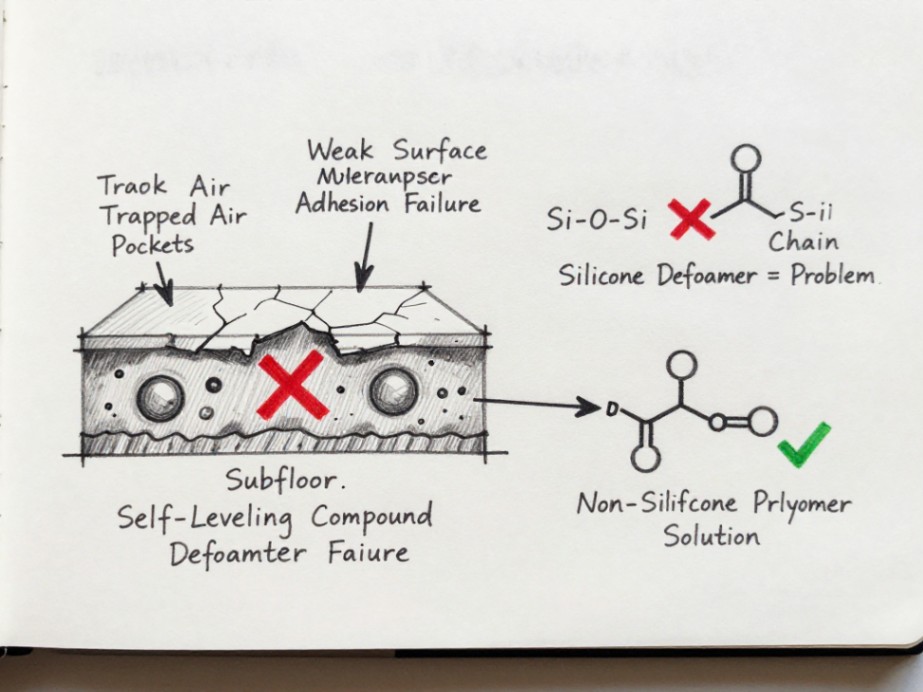
Using a silicone-based defoamer in your self-leveling compound is a near-guarantee of finishing and adhesion failure. This is the core, non-negotiable warning. The industry’s reliance on cheap, generic silicone defoamers for self-leveling compounds has created a legacy of weak surfaces, fisheyes, and costly callbacks. Let’s break down exactly why and what to do instead.
Critical Q&A: Your Non-Silicone Defoamer for Self-Levelling Compounds Questions, Answered
What’s wrong with silicone defoamers here?
Silicone defoamers are fugitive. They burst air bubbles quickly, but the silicone oil then migrates. It migrates to the surface, creating hydrophobic spots called fisheyes that ruin finish coats. Worse, it migrates to the substrate interface, destroying the mechanical bond. Your expensive epoxy or flooring adhesive fails. A non-silicone defoamer for self-levelling compounds stays put, works chemically without leaving a damaging residue.
What’s inside a non-silicone defoamer?
Think chemistry of displacement, not just popping. Common actives are mineral oils, polyglycols, and fatty alcohols. Their job is to spread rapidly at the air-bubble interface, destabilize the foam film, and allow air to escape. The key is their selective incompatibility with the cement slurry-they work at the right moment, then emulsify or disperse without migrating like silicone.
Does surface finish really improve?
Absolutely. This is the primary practical advantage. A properly selected non-silicone defoamer yields a dense, pinhole-free surface. You get a perfectly flat, closed trowel finish. No repellent spots. This directly enables successful application of thin mil coatings, vinyl adhesives, and polished concrete treatments. The surface is chemically receptive.
What about high-alkaline cement environments?
Alkali attack is a real killer. Many defoamers, even non-silicone ones, can hydrolyze or saponify in pH 12+ environments. You must select a defoamer specifically engineered for cementitious alkalinity. The chemical backbone must be stable. If it breaks down, defoaming power vanishes mid-cure, leaving you with a porous, weak slab.
How do I balance fast air release with stability?
This is formulation art. You need a blend. Fast-acting components (like certain polyglycols) knock down entrained air during mixing and pouring. Slower, hydrophobic particles (finely dispersed waxes) remain active during pumping and placement to handle secondary air entrainment. A single-component defoamer often fails at one of these stages.
Will it mess with my superplasticizer?
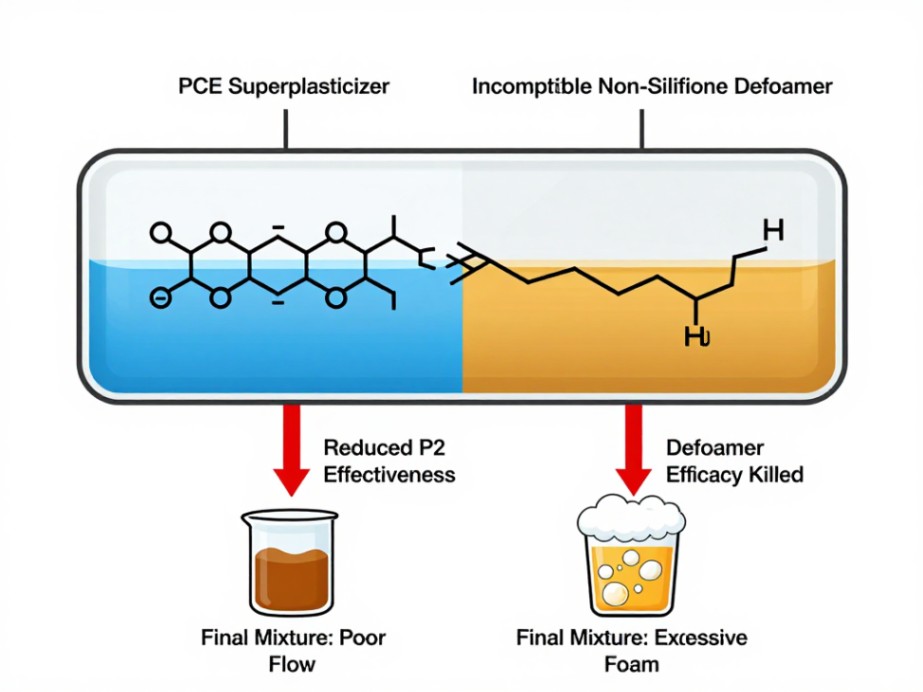
It can. This is a critical compatibility test you must run. Polycarboxylate ether (PCE) superplasticizers and defoamers compete at the interface. An incompatible non-silicone defoamer can reduce PCE effectiveness, killing flow. Or, the PCE can over-disperse the defoamer, killing its efficacy. Lab-test them together in your exact mix design.
What’s the biggest dosing mistake?
Overdosing. Period. More is not better. Exceeding the optimal dose of a non-silicone defoamer for self-leveling compounds can lead to segregation, bleeding, and reduced strength. The defoamer acts as a lubricant. Too much lubricant breaks down the particle structure. Follow the manufacturer’s range, but always verify with density and flow tests.
How do I test defoamer performance properly?
Skip the cup shaking test. It’s meaningless. Use three concrete methods: Fresh density (ASTM C185) measures air content reduction. Flow diameter ensures you haven’t harmed rheology. Surface inspection of a cast panel after cure reveals pinholes and fisheyes. All three are non-negotiable.
Cement-based vs. gypsum-based – does it matter?
Completely. They are different chemical worlds. Cement is alkaline, gypsum is neutral to slightly acidic. A defoamer for cement often uses alkali-stable carriers. A defoamer for gypsum must avoid interfering with crystal formation and set times. Using the wrong one cripples performance. Know your base chemistry.
What’s next for defoamer technology?
The future is precision and sustainability. Expect more targeted, low-VOC, and bio-based carrier oils. The trend is towards multifunctional additives that combine defoaming, plasticizing, and shrinkage reduction with minimal impact on total formulation chemistry. The goal is a simpler, cleaner, and more predictable system.
The Final Verdict
The choice is clear. A non-silicone defoamer for self-leveling compounds is not a luxury; it’s a requirement for professional, reliable results. The risk of silicone contamination is too high. Your next step is to pressure-test your current formulation. Cast a panel, let it cure, and try to coat it. If you see fisheyes or suspect weak bonding, your defoamer is the likely culprit. Reformulate with a compatible non-silicone system. Your floors will thank you.
Supplier
We are the global leader in lightweight concrete and advanced engineered foam solutions. Known globally for its commitment to research, innovation, and applied expertise, we have been providing engineered foam solutions since the early 2012’s.
We can supply high-quality concrete admixture and foam concrete related products all over the world.
The company has a professional technical department and quality supervision department, a well-equipped laboratory, and equipped with advanced testing equipment and after-sales customer service center.
If you are interested, please feel free and contact us.