Concrete4U | Concrete Admixtures, Tools, and Production Machines

Why Micro Fibers Are the Go-To Solution for Concrete Shrinkage Control
The Definitive Role of Micro Fibers in Concrete
Micro fibers provide the most effective first line of defense against shrinkage cracking in concrete. We use them as a secondary reinforcement material to bridge micro-cracks the moment they form, something traditional rebar simply cannot do. While macro-fibers handle structural loads, micro-fibers specialize in durability. Their job is to hold the concrete matrix together during its most vulnerable phases: plastic and early-age drying shrinkage. This isn’t just a surface fix. It’s a fundamental improvement to the material’s integrity from within.
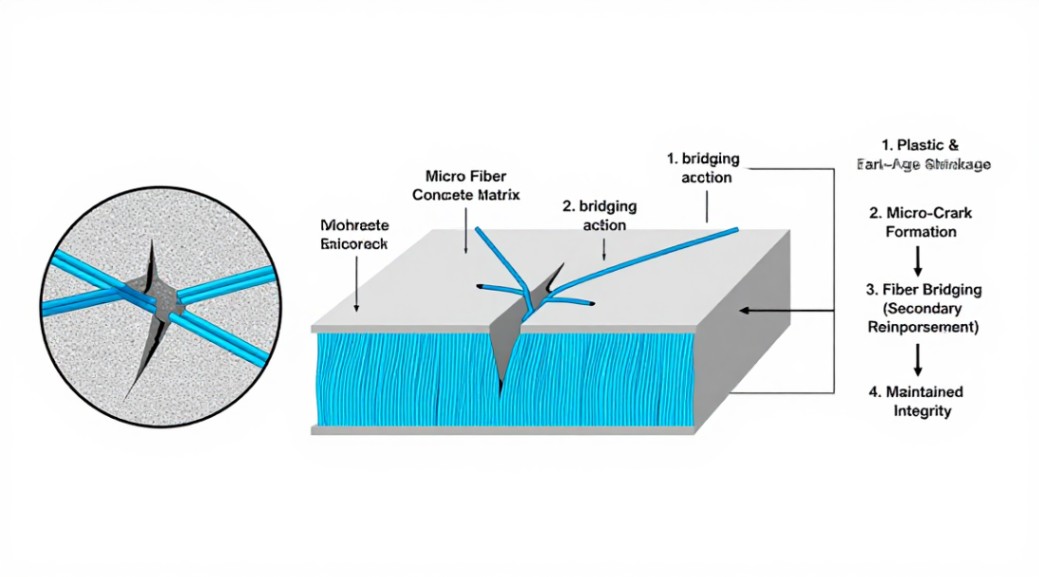
How Micro Fibers Work: The Crack-Stopping Mechanism
The mechanism is straightforward but powerful. As concrete loses moisture, it wants to shrink. Tensile stresses build up internally. Without reinforcement, these stresses exceed the concrete’s low tensile strength, causing cracks. Micro fibers, uniformly dispersed, create a three-dimensional network of tiny reinforcement throughout the mix.
Stopping Plastic Shrinkage
In the first few hours after placement, water bleeds to the surface and evaporates. This creates capillary pressures that pull the paste particles together, leading to plastic shrinkage cracks. Micro fibers inhibit this process. They provide just enough tensile capacity to resist these early stresses. Think of them as millions of tiny internal stitches, holding the fresh concrete together until it gains its own strength. This action during the critical curing period is non-negotiable for high-quality slabs and overlays.
Reducing Long-Term Drying Shrinkage
The benefit doesn’t stop there. As concrete dries over months and years, it continues to shrink. Micro fibers continue to work, distributing shrinkage stresses more evenly. They don’t eliminate shrinkage, but they control its damaging effects by reducing crack widths and distributing micro-cracking. The result is a tighter, more robust surface with significantly reduced permeability.
Synthetic vs. Steel Micro Fibers: A Practical Comparison
The choice between synthetic (polypropylene, nylon) and steel microfibers isn’t arbitrary. Each has a specific role based on project requirements.
Synthetic Micro Fibers (typically 0.1 to 0.3 mm diameter) are our primary tool for plastic shrinkage control. They are chemically inert, non-corrosive, and incredibly efficient at the dosages we use—usually between 0.6 and 1.8 kg per cubic meter. Their flexibility and high strand count per kilogram make them perfect for creating that dense, crack-bridging network. We specify them for almost all interior slabs, residential applications, and decorative concrete where corrosion is not a concern.
Steel Micro Fibers (typically 0.2 to 0.5 mm diameter) offer higher tensile stiffness. They are more effective at controlling both early-age and long-term shrinkage, and they provide some degree of post-crack residual strength. However, they are more expensive, heavier, and require careful handling to avoid balling during mixing. We turn to them for industrial floors, pavements, and overlays subjected to heavy wear, where their added toughness justifies the cost and mixing complexity.
Best Practices for Mixing, Dispersion, and Workability
Improper fiber handling ruins the system. The goal is uniform distribution. Every cubic inch of concrete needs its share of fibers.
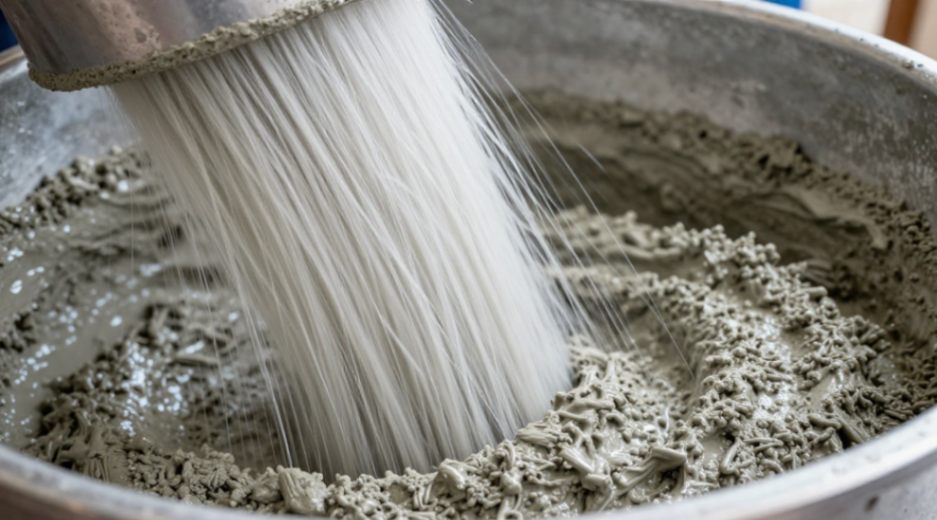
Our field-tested procedure is simple but must be followed precisely. First, add about 70-80% of the mixing water and all aggregates to the drum. Start the mixer. Then, add the cement and remaining water. Only after a homogeneous slurry forms—usually after 60 to 90 seconds of mixing—do we add the micro fibers. We feed them in steadily over 15-30 seconds to prevent clumping. Finally, we mix for a minimum of 3 to 5 additional minutes. The visual check is simple: no fiber balls should be visible in a discharged sample.
Micro fibers will reduce workability. It’s a trade-off. For every 0.9 kg of synthetic fiber per cubic meter, expect a slump reduction of roughly 25 to 50 mm. We plan for this. We either use mid-range water reducers or slightly increase the water-cement ratio (within strict limits) to maintain placeability. Never try to compensate by simply adding more water at the job site—this defeats the entire purpose of shrinkage reduction.
Performance Data, Standards, and Real-World Impact
This isn’t theoretical. The data from standardized tests like ASTM C157 (drying shrinkage) and ASTM C1581 (restrained shrinkage ring test) is compelling. In controlled studies, a properly dosed synthetic micro fiber mix can reduce plastic shrinkage cracking area by over 80% compared to plain concrete. In the ring test, fiber-reinforced specimens show a significant delay in first crack appearance and reduced crack widths.
The real-world case studies are everywhere. Consider a 100,000 sq. ft. warehouse slab pour we worked on. The contractor used polypropylene micro fibers at 0.9 kg/m³. The critical early pour, exposed to sun and wind, showed zero plastic shrinkage cracks. The adjacent control strip without fibers developed a network of fine cracks within the first day. The long-term cost-benefit is clear: the minor upfront material cost (often less than 2% of the total concrete cost) prevents expensive saw-cutting repairs, sealing, and future moisture-related damage. It extends the service life of the slab dramatically.
Integrating Micro Fibers into Your Reinforcement Strategy
Micro fibers complement primary reinforcement; they don’t replace it. They work synergistically with rebar or welded wire mesh (WWF). The rebar handles major structural loads and controls large crack widths. The micro fibers handle the shrinkage stresses that occur between the rebar grids, effectively suppressing the countless tiny cracks that rebar cannot constrain. For slabs-on-grade, this combination is unbeatable. The fibers also help mitigate plastic settlement cracking over the top mat of rebar.
Typical application scenarios where we see the highest return on investment include:
- Industrial and commercial floor slabs
- Toppings and overlays, especially thin-bonded applications
- Architectural and exposed aggregate concrete
- Shotcrete for slope stabilization and pools
- Any large, uninterrupted plane susceptible to early-age shrinkage
We recommend starting with a conservative dosage based on your aggregate size and mix design, then running a trial batch. Test for workability and, if possible, perform a simple plate or ring test to see the crack-inhibiting performance firsthand. The evidence in the mix will convince you far more than any spec sheet.
Supplier
We are the global leader in lightweight concrete and advanced engineered foam solutions. Known globally for its commitment to research, innovation, and applied expertise, we have been providing engineered foam solutions since the early 2012’s.
We can supply high-quality concrete admixture and foam concrete related products all over the world.
The company has a professional technical department and quality supervision department, a well-equipped laboratory, and equipped with advanced testing equipment and after-sales customer service center.
If you are interested, please feel free and contact us.