Concrete4U | Concrete Admixtures, Tools, and Production Machines

The #1 Reason EIFS Cracks and Fails: You’re Ignoring RDP
If You Don’t Understand RDP, You’re Specifying a Cracked Facade
After two decades in the field, I’ve seen the same expensive failure over and over. It’s not always the installer. Often, the problem starts with the specs. The biggest mistake you can make with RDP for exterior insulation and finish systems is treating it as an afterthought. It isn’t. Required Deformation Performance is the core engineering spec that determines if your EIFS will crack or last. It quantifies the assembly’s ability to stretch and bend without failing. Skip it, and you’re gambling with the building’s exterior.
What is RDP and Why It’s Non-Negotiable
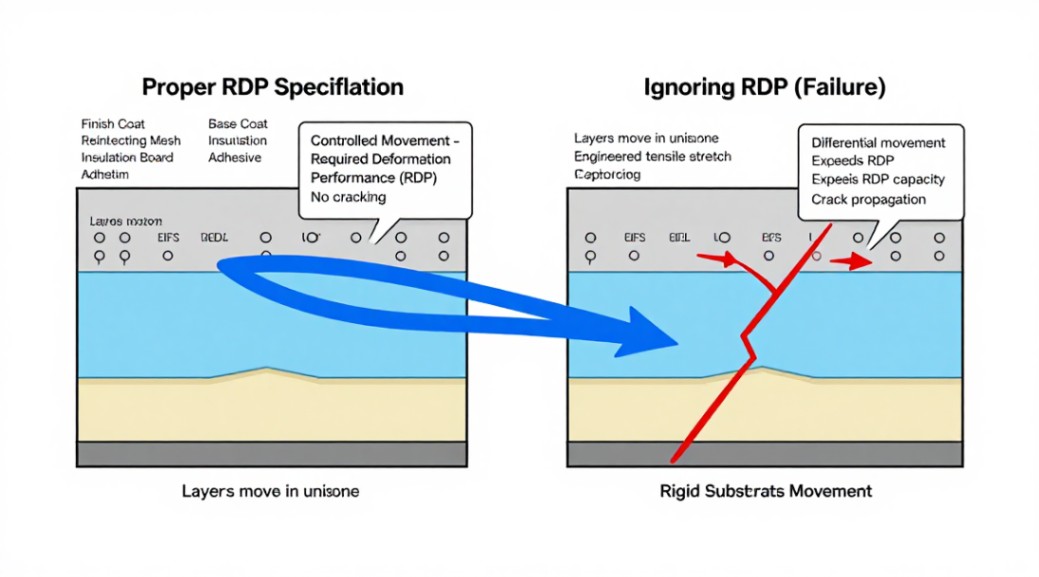
RDP for exterior insulation and finish systems is a measure of strain compatibility. The wall moves-thermal expansion, wind sway, structural creep. The insulation board, adhesive, mesh, and base coat must move together. If one component is too rigid, something gives. Usually, it’s a crack in the finish. RDP is the lab-tested number that proves the assembly can handle that movement. Think of it as a “ductility rating” for your entire cladding system.
The Costly Consequences of Getting RDP Wrong
This isn’t a theoretical concern. Wrong RDP means real, visible, and expensive problems. We’re talking cracks that track right through the finish coat. We’re talking moisture intrusion behind the insulation, leading to hidden rot and mold. We’re talking total debonding of the system from the substrate. The repair bill isn’t for a patch job. It’s for a full, tear-off remediation. That’s a budget killer and a reputation destroyer.
RDP vs. Ignoring RDP: The Stark Reality
Let’s make this crystal clear. The table below shows the direct outcomes of your specification choice.
| When You SPECIFY Correct RDP | When You IGNORE or GUESS RDP |
|---|---|
| The entire EIFS assembly moves as a unified, flexible skin. | Components fight each other. The weakest link (the finish) cracks. |
| Strain is distributed evenly across the facade. | Stress concentrates at panel joints and corners, causing predictable failures. |
| Long-term durability is engineered into the design from day one. | You rely on luck. The first major thermal cycle or wind event reveals the flaw. |
| Performance is validated by lab testing (ASTM C1380). | Performance is an unknown. You are the field test, and the building is the lab. |
| You have a clear, defensible specification for liability protection. | You have a vague spec that leaves you exposed when failures occur. |
The Three Factors That Dictate Your RDP Needs
You cannot pick an RDP value out of thin air. It’s a calculated decision based on the building’s reality. Forget one of these, and your spec is compromised.
- Building Movement Potential: Tall buildings sway more. Long walls expand and contract more. Your climate zone’s temperature swing is the primary driver of thermal movement. A 20-story condo in Chicago needs a different RDP for exterior insulation and finish systems than a one-story school in Florida.
- Insulation Board Type & Thickness: Not all boards behave the same. EPS, mineral wool, and polyisocyanurate have vastly different flexural properties. Thicker boards also change the dynamics. The RDP value must account for the specific board in your assembly.
- The Adhesive and Mesh System: This is the reinforcement. A lightweight mesh with a thin coat won’t handle the same strain as a heavy-duty mesh embedded in a thick, polymer-rich base coat. The system components are interdependent.
Your Action Plan: How to Specify RDP Correctly
Stop guessing. Follow this logical sequence to eliminate the risk.
1. Calculate the Movement. Work with your structural engineer to understand the anticipated drift and thermal movement for your specific building design and location.
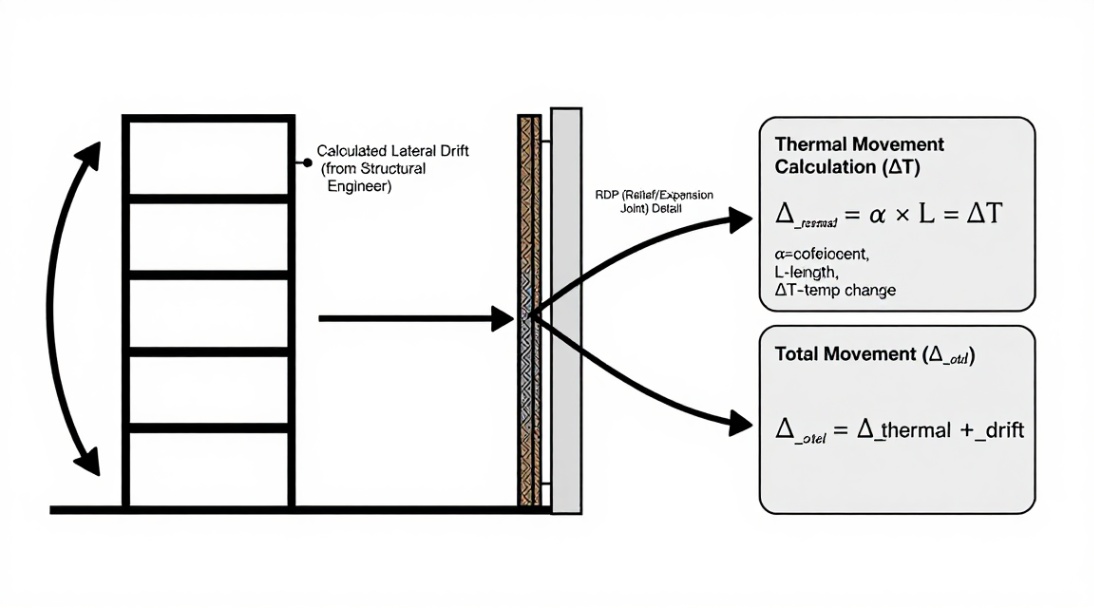
2. Consult the Manufacturer IMMEDIATELY. This is the critical step. Do not finalize a specification without this conversation. Provide the manufacturer with your movement calculations, board type, and design. They have the test data (ASTM C1380) for their specific systems. They will tell you the required RDP class and the exact assembly that achieves it.
3. Specify the Complete Assembly. In your specs, never write just “RDP Class 4.” You must specify the entire tested system: the specific manufacturer’s product names for the adhesive, mesh, insulation board, and base coat. RDP is a property of the assembly, not a standalone product.
This Is Not a DIY Specification
You wouldn’t guess the rebar size for a concrete beam. Don’t guess the RDP. The logic is identical. The forces are different, but the consequence of error is just as severe. The testing is complex, and the data resides with the system manufacturers. Your role is to define the performance requirement based on the building physics. Their role is to provide the tested solution that meets it.
The Only Safe Path Forward
If you’re responsible for the longevity of an EIFS facade, you have one job right now: verify your RDP specification. If your current project documents are silent on Required Deformation Performance, you have a major gap. That gap will turn into a crack.
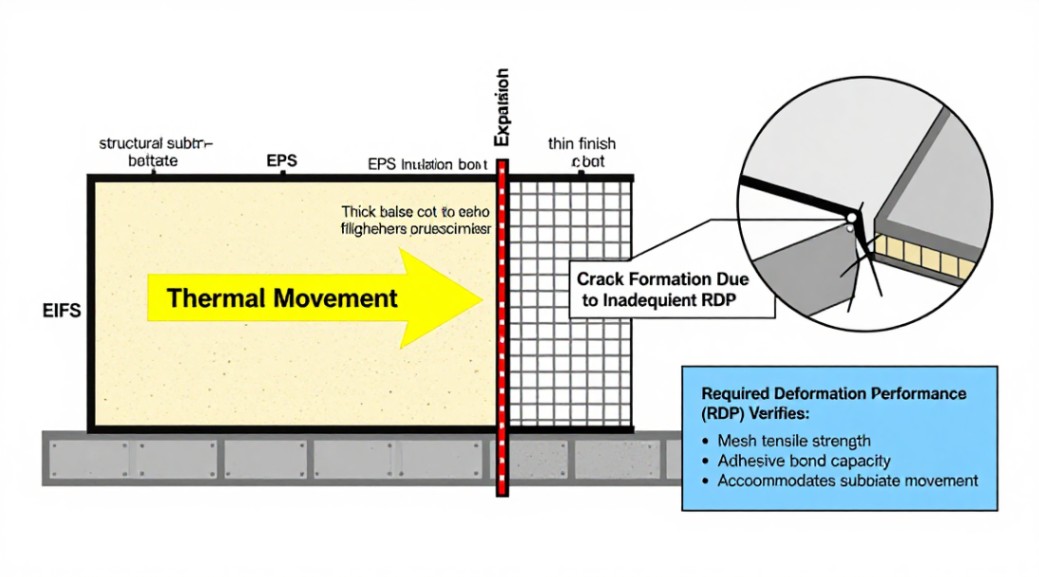
Do not proceed without expert input. We strongly recommend you contact the technical services department of a leading EIFS manufacturer. Schedule a consultation. Present your project parameters. Get their stamped system details and RDP performance data. This is not optional best practice; it’s the fundamental engineering required to prevent failure. Make that call before the first board is installed. Your client’s building-and your professional legacy-depend on it.
Supplier
We are the global leader in lightweight concrete and advanced engineered foam solutions. Known globally for its commitment to research, innovation, and applied expertise, we have been providing engineered foam solutions since the early 2012’s.
We can supply high-quality concrete admixture and foam concrete related products all over the world.
The company has a professional technical department and quality supervision department, a well-equipped laboratory, and equipped with advanced testing equipment and after-sales customer service center.
If you are interested, please feel free and contact us.