Concrete-mesa | Concrete Admixtures, Tools, and Production Machines

Stop Your Patches From Peeling: How Redispersible Polymer Powder for Repair Mortars Creates Bond That Lasts
70% of Thin-Layer Repairs Fail. Here’s Why.
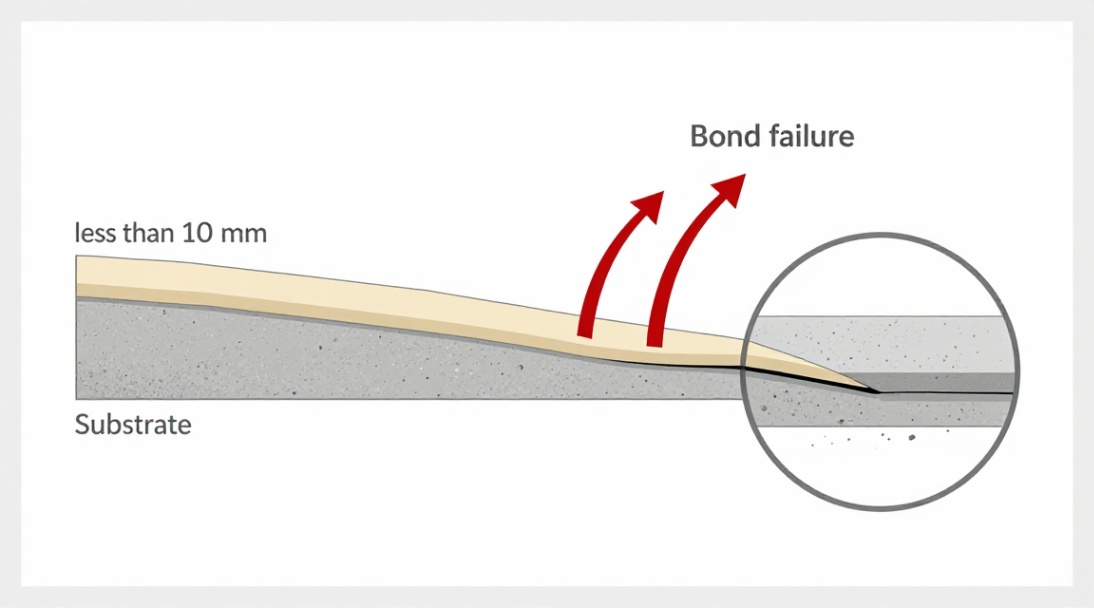
I was consulting for a municipal bridge repair team a few years back. The foreman showed me a patch they’d applied just four months earlier. It had popped off like a dried scab. He was furious. The data backs his frustration. Research from the International Concrete Repair Institute suggests that nearly 70% of thin-layer repair failures—those less than 10mm thick—can be traced directly to one root cause: insufficient bond strength at the interface between the old substrate and the new repair mortar. The fix isn’t a magical new kind of cement. It isn’t a fancy primer. The most reliable, field-tested solution sits inside a simple powder bag: redispersible polymer powder for repair mortars.
What You’re Actually Buying in That Powder Bag
When you open a bag of standard cement, you get hydration. That’s it. Cement crystals grow, they lock together, and they create a rigid, porous matrix. But when you open a bag containing redispersible polymer powder for repair mortars, you get a dual-action system. The powder itself is a dry plastic—typically vinyl acetate-ethylene (VAE) or an acrylic copolymer. It looks like flour. The moment you mix it with your water and cement, it doesn’t dissolve. It disperses. The plastic particles float in the mixing water. As the cement hydrates and hardens, water gets consumed. The polymer particles are forced together in the shrinking capillaries. They fuse. They coalesce into a continuous, flexible film that wraps around every cement crystal and every grain of sand.
This isn’t a theory. This is what happens in your mixing bucket. Many users on Reddit forums have shared their frustration: “I added the powder but my mortar still cracked.” The issue was almost always dosage or mixing procedure. Let me walk you through the exact process so you don’t make that same mistake.
Step One: Understand Your Dosage Sweet Spot
You cannot guess with this material. Pouring a handful into your mixer is a recipe for either a brittle patch (too little) or a weak, sticky mess that never sets (too much). The industry-standard dosage range for redispersible polymer powder for repair mortars is between 1% and 5% by weight of cement. Let me be specific.
- For a vertical or overhead repair where slump and sag are your enemy, start at the higher end: 4% to 5% polymer-to-cement ratio. This gives you maximum tack and adhesion.
- For a horizontal patch on a concrete floor where compressive strength is critical, stay low: 1% to 2%. You still get improved adhesion and water resistance without sacrificing hardness.
- For a general purpose skim coat, 2.5% to 3% is a safe, proven starting point.
Weigh your cement. Weigh your polymer. Do not use volume measurements. The bulk density varies between products. A scoop of one brand is not the same as a scoop of another. I keep a simple kitchen scale in my lab. You should too.
Step Two: The Mixing Sequence That Builds the Film
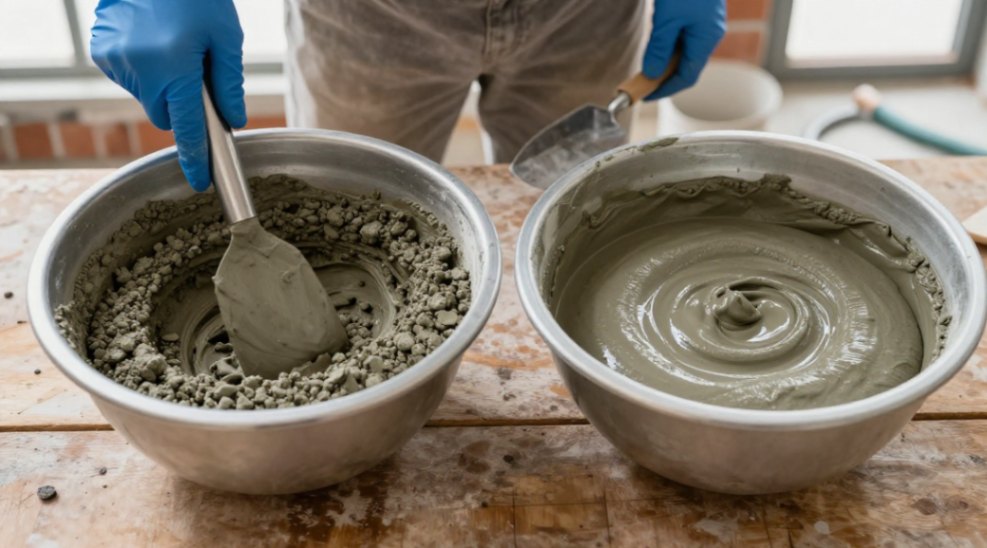
Here is where I see most professionals make a critical error. They toss the dry polymer into the mixer with the cement and aggregates, add water, and run the mixer. That produces a poor distribution. The polymer particles never get a chance to disperse uniformly. The film formation becomes spotty. You get a patch that is strong in one spot and weak two inches away.
Follow this order. First, dry blend your cement, sand, and any other dry additives (like silica fume or fly ash) for at least 30 seconds. Second, add the redispersible polymer powder for repair mortars to the dry blend and mix for another 30 seconds. Third, add 80% of your mix water. Mix for one minute. Fourth, slowly add the remaining water while the mixer runs. Total wet mixing time should be two to three minutes maximum. Overmixing shears the polymer particles and breaks the nascent film. You want dispersion, not destruction.
A user on a construction forum once told me his mortar was “soupy” after adding the powder. He had added too much water. Remember: the polymer powder does not increase water demand significantly. Your water-to-cement ratio should stay the same as your control mix. If your mix looks wetter, you added free water by mistake.
Step Three: Surface Preparation Is Non-Negotiable
You can have the perfect polymer-modified mix, but if your substrate is dirty, laitance-covered, or saturated, your bond will fail. Redispersible polymer powder for repair mortars creates a strong mechanical and chemical bond, but it cannot bond to dust. It cannot bond to oil. It cannot bond to a slick, troweled surface. You must prepare the substrate.
- Remove all loose material. Use a wire brush, grinder, or abrasive blasting. You need to expose the aggregate. The surface should feel like 80-grit sandpaper.
- Clean the surface. Vacuum or blow off all dust. Then dampen the substrate with clean water. The surface should be saturated surface dry (SSD). No standing water. No dry spots. The polymer film needs moisture to coalesce, but it cannot fight against a puddle.
- Apply the mortar immediately after the surface is prepared. Do not let it dry out.
Why This Powder Stops Cracking and Leaking
The polymer film does two things that cement alone cannot. First, it bridges micro-cracks. As the repair mortar shrinks during curing, tensile stresses build. In plain cement, these stresses create visible cracks. With a polymer film, the microscopic polymer threads stretch and absorb that energy. You get enhanced flexibility. The mortar moves with the substrate during thermal cycles or mechanical loading. Second, the film fills the capillary pores. Cement paste is naturally porous. Water, chlorides, and sulfates migrate through those pores. The polymer film blocks them. Your repair becomes a barrier. This is why adding redispersible polymer powder for repair mortars dramatically improves freeze-thaw resistance. Less water ingress means less ice formation means less spalling.
Real-World Performance: What the Forums Say
I spend time on forums and subreddits dedicated to concrete repair. The stories match my lab data. One contractor described a bridge abutment repair he did three years ago. He used a 3% VAE polymer dosage. The repair faces a harsh coastal environment. Salt spray, freeze-thaw cycles, traffic vibration. He posted photos last month. The patch was intact. No delamination. No map cracking. He said the only reason he inspected it was because a neighboring patch (done with a competitor’s non-modified mortar) had failed completely. That is the difference. The polymer-modified mortar acts as a binder modifier. It creates a composite that is greater than the sum of its parts.
Your First Test Batch: A Simple Checklist
Do not start on a critical structural repair. Mix a small batch. Apply it to a scrap piece of concrete. Cure it for seven days. Then try to break the bond with a chisel. A plain mortar patch will pop off with a clean interface. A polymer-modified patch will resist. The failure will likely be cohesive—the mortar itself will break before the bond line fails. That is what you want. That is the signature of a proper formulation.
Test the water absorption. Weigh the cured patch. Soak it for 24 hours. Weigh it again. A polymer-modified mortar should show less than half the water uptake of an unmodified control. Test the flexibility. Try to bend a thin sample. It will resist fracture longer.
This is not a complex process. It is a precise one. Measure your doses. Prepare your surface. Mix in the correct sequence. Cure the repair properly—keep it damp for at least three days. Do those steps, and your repairs will stop peeling. They will stop leaking. They will stop being a call-back headache.
You have everything you need to make a repair that lasts. The only question is whether you will take the extra ten minutes to do it right.
Supplier
We are the global leader in lightweight concrete and advanced engineered foam solutions. Known globally for its commitment to research, innovation, and applied expertise, we have been providing engineered foam solutions since the early 2012’s.
We can supply high-quality concrete admixture and foam concrete related products all over the world.
The company has a professional technical department and quality supervision department, a well-equipped laboratory, and equipped with advanced testing equipment and after-sales customer service center.
If you are interested, please feel free and contact us.